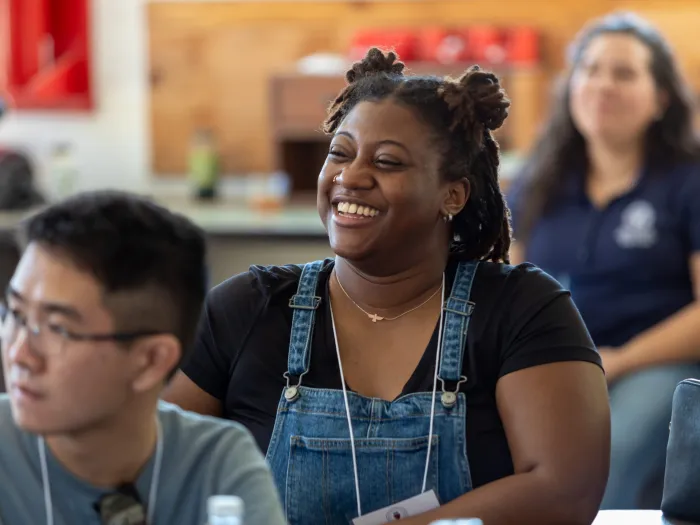
‘Moyo!’
Class on women’s ministry in Congo introduces Synod Schoolers to an energetic and faithful entrepreneur
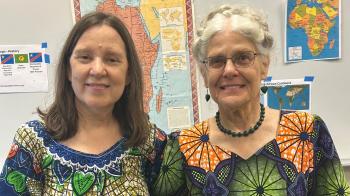
STORM LAKE, Iowa — “Congo Presbyterians and Women’s Ministry in Congo,” a class offered during last week’s Synod School, focused a good deal of attention on a woman called Maman Monique and the nonprofit ministry founded to support her considerable work in Congo, Woman Cradle of Abundance.
In fact, Dr. Elsie McKee, who led the class along with the Rev. Sarah Dickinson, even arranged for participants to meet her longtime friend, calling the Congolese woman via WhatsApp one afternoon and passing the phone around the classroom at Buena Vista University so everyone could tell her, “Moyo, Maman Monique,” in effect acknowledging the heart of her significant contributions thus far.
“Moyo,” she patiently told each participant.
McKee, who was born and raised in Congo, is a retired Princeton Theological Seminary faculty member. Dickinson, who has a young adult Congolese son who also met the class — but in person — is the pastor of Discovery Presbyterian Church in Omaha, Nebraska.
Maman Monique went to college and became a high school teacher and principal. She’s long had a deep faith. “She is heavily involved in the Presbyterian church in Congo,” McKee said.
“Elsie and I are twins,” Maman Monique told the class. “I bid you to pray for peace in our country. You can pray and support the training of women. Also, pray for me. I am very busy all the time.”
McKee said Maman Monique has a longstanding partnership with the Presbytery of Eastern Virginia “because they were interested in nutrition” and she once operated a farm and taught husbandry to Congolese women.
“She is someone you come back to when you’re feeling discouraged. She doesn’t give up,” McKee said.
“I hope we can grow in our feistiness,” Dickinson told the class.
On the first day of four, McKee gave students an overview of Belgian King Leopold II’s cruel reign in Congo. The United States was the first nation to recognize the Congo Free State, “Leopold’s fiefdom,” she said. “Congo Free State was named for free trade, not freedom.”
Born of a free Black mother in 1865, William Sheppard was determined to go to Africa as a missionary, “but the powers that be said it had to be [led] by a white man. Eventually they found Samuel Lapsley,” McKee said, and the two set out from the U.S. in 1890.
Lapsley died of malaria in 1892. “It was a big loss for Sheppard,” she said. He returned to the U.S. to gather additional workers, among them Maria Fearing, who sold her little house to Lapsley’s father to finance her trip. “She was in Congo more than 20 years,” McKee said. “My mother was teaching at the school she began when I was born.”
On the second day of class, Dickinson’s adopted son, John, shared some of his own history after having provided the class with homemade Congolese plantain beignets the day before.
John attended high school in Kinshasa, then worked in a grocery store for four years.
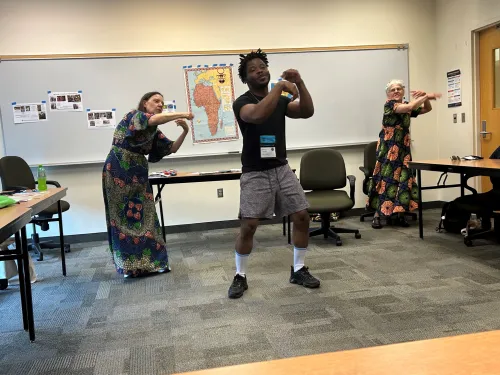
“I had a vision to go a little faster,” he said, and so he took night classes and moved to Tunisia. He was accepted at three U.S. universities and selected one. He taught students in his American mother’s class a line dance before saying goodbye.
Known by its acronym, FEBA, Woman Cradle of Abundance was founded on the familiar portion of John 10:10, Jesus’ assurance that “I came that they may have life and have it abundantly.”
“I came to FEBA in 2010. It’s education and economic empowerment to help women pick up the pieces,” McKee said. Friends and graduates of Princeton seminary helped FEBA, based in Cherry Hill, New Jersey, to obtain its tax-free status.
“People started getting interested in what we were doing,” she said. “We raised money to build a woman’s center” in Kinshasa, the capital city, noting that “a well-trained seamstress can make a decent living in Congo.”
Fashion, Dickinson explained, is “a source of pride” for Congolese women.
The course concluded with McKee and Dickinson distributing a moringa seed to each student.
“You can get up to 40% of your protein,” McKee said, “by eating the leaves.”
By transcribing their interviews, McKee helped Maman Monique Misenga Ngoie Mukuna write “Cradling Abundance: One African Christian’s Story of Empowering Women and Fighting Systemic Poverty.”
Synod School is a ministry of the Synod of Lakes and Prairies.
You may freely reuse and distribute this article in its entirety for non-commercial purposes in any medium. Please include author attribution, photography credits, and a link to the original article. This work is licensed under a Creative Commons Attribution-NonCommercial-NoDeratives 4.0 International License.