‘There are no words. But there are words’
The Presbytery of New York City celebrates the life of the Rev. Dr. Robert Foltz-Morrison, its former executive presbyter who died on July 6
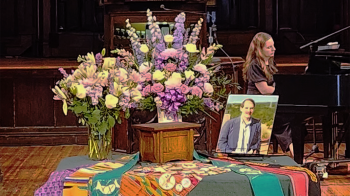
NEW YORK — With sunshine pouring in through the stained-glass windows of the Upper West Side’s Broadway Presbyterian Church and the unseasonably cool weather on a Saturday morning in July making the cautionary note about the English Gothic sanctuary’s lack of air conditioning a moot point, the Presbytery of New York City said farewell to the Rev. Dr. Robert Foltz-Morrison, its retired executive presbyter who died on July 6 at age 70.
“There are no words,” began the Rev. Thia Reggio, pastor of Manhattan’s Second Presbyterian Church and the presbytery’s moderator-elect.
“But,” taking a beat, “there are words,“ among them, “well done, good and faithful servant.”
She detailed how the man known to everyone as “Bob,” the son of Bob Morrison Sr., an Exxon executive, and his mom, “Teddy,” had spent his junior and senior high school years growing up with his four siblings in a religious household in the Panama Canal Zone.
Reggio celebrated Bob’s career as the “pastors’ pastor,” the self-effacing embodiment of Matthew 25:40, in particular, “just as you did it to one of the least of these brothers and sisters of mine, you did it to me,” a call back to verses 35-36.
Reggio’s eulogy recalled how Bob arrived back in New York as executive presbyter in the aftermath of the devastation left behind throughout the presbytery by the infamous 2012 hurricane best known as Super Storm Sandy. It was Bob who asked her — a newly ordained pastor with a pair of teenage sons — to coordinate New York’s local recovery efforts with the national efforts of Presbyterian Disaster Assistance.
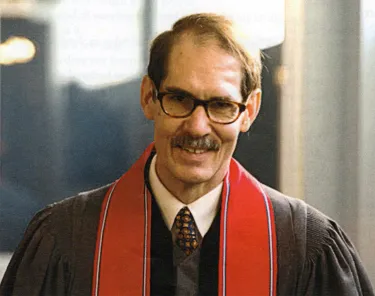
The road to Bob’s 2013 installation as executive presbyter began in 1982 as the now-rebranded Rev. Robert Foltz-Morrison, Princeton Theological Seminary graduate, Minister of the Word and Sacrament and husband embarking on life together with his Princeton Seminary classmate, the Rev. Leslie Foltz-Morrison.
Their marriage would extend for 43 years and be blessed with two sons: Andrew (accompanied to the service by his fiancée Landry), and Andrew’s brother, Daniel, who, together with his wife Alyssa, made proud grandparents of Leslie and Bob with the birth of Lydia, lovingly known as Liddy.
Bob’s first pastorate, a two-hour drive — depending upon traffic and the omnipresent construction — up the New Jersey Turnpike from Princeton and across the George Washington Bridge, the Cross Bronx Expressway to Exit 2B for Webster Avenue, then a turn into Newbold Avenue stopping at Fourth Presbyterian Church, a cultural universe 180 degrees removed from the seminary’s bucolic campus.
It was here that as “The Boogie Down Bronx” slogan was gaining traction, so were the immigrant communities re-populating and rejuvenating the borough, where their soundtrack was salsa and calypso and the Bronx-grown beats of Hip Hop. Bob’s ministry was out front in solidifying interfaith programs addressing hunger and food insecurities. As redevelopment accelerated on the numerous South Bronx city blocks infamously torched in the 1970s, his was a leading voice for ensuring there were many affordable housing opportunities available within these new units for those with housing insecurities.
Under the mentorship of the Rev. David Cockcroft, pastoring across the borough at Riverdale Presbyterian Church, Bob put the words of Matthew 25 in motion with his advocacy for LGBTQ rights, especially necessary during the early frightening and heart-breaking days of the scourge of HIV/AIDS.
In 1993, the Presbytery of the Twin Cities Area called, where Bob’s pastoral leadership served both the Golden Valley and House of Hope Presbyterian churches; four years later it was back to the East Coast as executive of the former Elizabeth Presbytery, now realigned as the Presbytery of Northeast New Jersey, pastoring the pastors in its mix of urban and suburban congregations.
By 2009, the interim call of the Church on the Green in Bloomfield, New Jersey, which segued to the pastorate of Delmar Presbyterian Church in New York between 2011-13, afforded him the opportunity to earn his doctor of ministry from Hartford Theological Seminary, the prologue to accepting the call from the Presbytery of New York City to be its executive presbyter.
Soon after his arrival, Bob encountered the Ghanaian fellowship in the midst of its 14-year journey to establish a permanent church home in the presbytery; Bob’s groundwork was a key element in making their dream come true in July 2024.
“Bob is Yaw!” eulogized the Rev. Dr. Moses O. Biney, a Ghanaian by birth and the longtime pastor of Brooklyn’s Bethel Presbyterian Reformed Church as well a former presbytery moderator. “Bob loved the immigrant communities, enthusiastically supporting them in their growth up from fellowships.”
Noting that Bob was born on a Thursday, Biney, replete in a black-and-white-striped vestment familiar to congregants in his native land, repeated his eulogy: “Bob is Yaw!” explaining the tradition of Ghana’s Akan peoples for naming a child with the day of the week they were born.
“Yaw is the word for Thursday,” he explained. “The Akan believe Yaw people represent strength, courage, bravery and leadership,” concluding, “Bob is Yaw!”
Other memories were shared by Bob’s brother Bill Morrison, citing Aaron Copland’s “Fanfare for the Common Man” as the anthem most befitting his older brother’s legacy.
There were other memories, especially around hamburgers, from Bob’s son, Andrew.
Musical tributes included Johann Wolfgang von Goethe’s “Wanderers Nachtlied II”set to Franz Schubert’s music and performed by Bob’s son Daniel, and the non-sectarian community choir Eventide from Manhattan’s West Side, featuring the Rev. Leslie Fotz-Morrison, which contributed Peggy Seeger’s “Love Call Me Home” and “Glory Bound” by Ruth Moody.
The Rev. Dr. Derrick McQueen, pastor of St. James Presbyterian Church in Harlem and a past moderator of the presbytery, elaborated on “the spiritual and theological bonds” Bob exemplified in his role as pastor to the pastors.
“He didn’t merely focus on those in the PNYC, but opened his arms to embrace caring for his interfaith colleagues” who also wear the collar of ministerial leadership, McQueen said, invoking the Hebrew blessing based on Proverbs 10:7, “May his memory be a blessing.”
As the service bulletin pointed out, Bob was not one to disappoint his parents: they had prayed before his birth that their son would become a Presbyterian minister. To this end, Bob enrolled in Davidson College, becoming a close friend with his roommate, the Rev. Dr. Robert Cathey, emeritus Professor of Theology at McCormick Theological Seminary.
In reading a letter from Cathey, the Rev. Chris Shelton, Broadway Presbyterian Church’s pastor — who would follow Bob’s last wishes to “preach a real sermon” in which he included the touchstone about working with “people you wouldn’t invite to heaven but will be surprised when you see them there later” — added voice to Cathey’s memories of the many times Bob and he learned about life, the Moody Blues, human relationships, Bob Dylan and how, a long time ago in a galaxy far, far away, a mystical Force was intertwined with the lives of all peoples on all sides of their societal struggles.
Cathey fondly remembered the time he found Bob, his curiosity piqued by a particular science article in a particular issue of Playboy magazine, sitting in the frat house library innocently paging through back issues on a quest for similar learning material, prompting warm, knowing smiles from those assembled that yes, Bob was that person who really did read Playboy for the articles.
All kidding aside, Cathey best remembered Bob as the exemplification of Micah 6:8: “Do justice, love kindness and walk humbly with your God.”
Ruling Elder Jim Nedelka, a member of avenue church nyc in the Presbytery of New York City, is a longtime contributor to Presbyterian News Service.
You may freely reuse and distribute this article in its entirety for non-commercial purposes in any medium. Please include author attribution, photography credits, and a link to the original article. This work is licensed under a Creative Commons Attribution-NonCommercial-NoDeratives 4.0 International License.