
Look for the helpers
At last week’s Synod School, Presbyterian Disaster Assistance offered a talk outlining its varied services
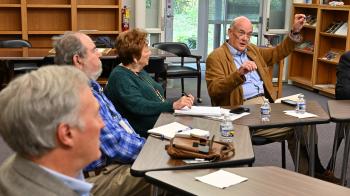
STORM LAKE, Iowa — With four members of the National Response Team accompanying her, the Rev. Dr. Kathy Riley offered up a talk during Synod School last week on Presbyterian Disaster Assistance and the many ministries it offers to people in crisis and others in need.
Riley is PDA’s Associate for Emotional and Spiritual Care. The four NRT members who assisted Riley with her evening talk were Wanda Beauman, Jim Ellor, Mark McCain and Marilyn Stone. PDA also offered courses on church safety and resilience to Synod Schoolers.
“We are always grateful for prayers, for your work at host sites and for donations to One Great Hour of Sharing and specific donations to meet the needs [caused by] disasters that are huge in scale,” Riley said.
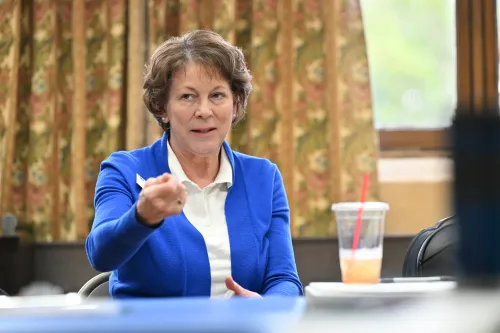
Then Riley asked a packed classroom: has anyone had direct experience with PDA?
One Synod Schooler was part of a work team sent by the Presbytery of North Central Iowa. Another worked in Puerto Rico alongside the organization Stronger Than Maria. One said she was the recipient of help following Hurricane Katrina.
To learn more about PDA’s ministry and impacts, Riley suggested reading Mosaic, a year-in-review for 2025. In 2025, the gifts of generous Presbyterians resulted in 211 grants to 36 countries and 28 states totaling more than $6.3 million in support for disaster survivors. Those gifts provided, among other benefits, disaster preparedness and mitigation, food security, livelihood support, Ebola prevention, shelter and rebuilding, clean water and sanitation, emotional and spiritual care, medical care, migration accompaniment and solar panels.
Forty-five grants were made following a hurricane or typhoon, with 39 awarded to provide migration accompaniment, 32 for conflict or trauma or human-caused disaster and 28 for flood relief.
Throughout 2025, 147 National Response Team members were deployed to 42 presbyteries.
PDA’s international work is different from its domestic work, Riley said. International work is done “almost entirely through grants to partners who are known and trusted.”
“We don’t send work teams internationally, because partners know what’s needed,” she said. “We work hard to establish and maintain those relationships.” PDA staff members regularly go on solidarity trips both domestically and internationally.
Migration Accompaniment Ministries “supports congregations and mid councils who support immigrants and migrants in their life journeys and travels,” she said. An important component is its “know your rights” training.
About 85 people make up PDA’s National Response Team. A team of four headed to Winnebago Presbytery last week as an initial deployment following a tornado. Riley called NRT members “the eyes and ears of PDA” as they talk to congregations and mid-council staff, worship at PC(USA) churches and “figure out what’s needed.”
“In a disaster, there can be 20-30 organizations responding, all with their own specialty,” she said. Some responders operate chainsaws while others set up pop-up kitchens. The Red Cross sets up shelters, and others put in muck and gut work following a flood. “PDA does not do any of those things in the initial response,” Riley said. Initial response grants “go out quickly. They go through the presbyteries, which is where we get our invitation to go in.”
Such grants include church damage grants and long-term recovery grants. “Grants and deployments are our two ways we respond to disasters,” Riley said. In most cases, “there is a big swoop of energy early on. Then, three or four months in, people realize the recovery will take a long time.” PDA offers resiliency and “burnout prevention” work.
During the initial response, “we don’t want to get in anybody’s way,” she said. Following last year’s flooding in the Texas Hill Country, “we didn’t go in for quite some time,” because people were still searching and clearing. In addition, PDA does not want to take up hotel space “that survivors need.” PDA representatives stay 30 or 40 miles away if hotel rooms are limited nearer to the affected community.
Across the country are 13 PDA host sites. “That’s where you see people earning the blue shirts,” Riley said. “We are incredibly grateful for those folks.”
PDA is both known and appreciated for its long-term recovery work. Riley said she was working in the Northeast eight years after Hurricane Sandy’s devastation in 2012. “We use grant funds as long as they’re needed,” she said.
Long-term recovery committees are formed after a disaster strikes. “We have people who can help train the committee how to do long-term recovery, and we stay as long as we are needed,” Riley said.
PDA partners with VOAD, Voluntary Organizations Active in Disaster, to help provide, for example, help for children who are still struggling emotionally following the Texas Hill Country flooding. “I call VOAD and ask if they can send some people in,” Riley said. “We work together to determine what the needs are and who has that particular capability.”
During a question-and-answer session following the talk, Riley said that although NRT members are trained before they’re deployed, “a lot of training happens on that first deployment.” A “generous gift” from the Lilly Endowment “will help us amp up training and cover education expenses.”
Asked how people who work full-time can help, Riley suggested “supporting your local host site. Be an active and aware supporter of PDA. Do a minute for mission in church and talk about [disaster response] in presbytery.”
“We also encourage local versions of the National Response Team,” McCain said. “Each presbytery can have a team to involve the people in the pews.”
“We love to help presbyteries be prepared,” Riley said.
Stone pointed out the Family Disaster Preparedness Plan Workbook designed to “help families become prepared and to help churches help families become prepared.”
“A church might hold a preparedness fair, inviting the fire department to come and do a demonstration to engage families,” Stone said. “It’s easy for kids to engage their parents in preparedness, and that carries over to churches.”
“You’d be amazed how useful those are to people who have lost everything,” Ellor said.
Riley concluded the talk by quoting a beloved Presbyterian.
“Mister Rogers said, ‘Look for the helpers,’” she said, “and they are legion.”
Synod School is a ministry of the Synod of Lakes and Prairies.
You may freely reuse and distribute this article in its entirety for non-commercial purposes in any medium. Please include author attribution, photography credits, and a link to the original article. This work is licensed under a Creative Commons Attribution-NonCommercial-NoDeratives 4.0 International License.


