Preaching justice through art
The Rev. Dr. Debra Mumford of Louisville Seminary leads a creative workshop for the Synod of the Covenant
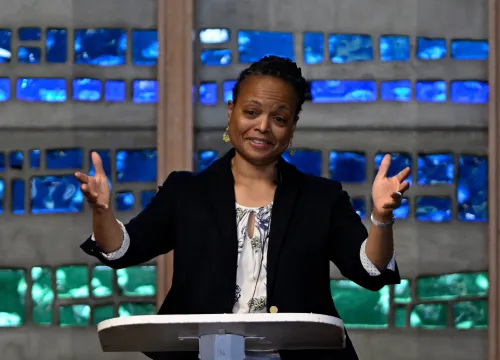
LOUISVILLE — A preacher can exegete a work of art in a way that’s similar to exegeting a biblical text. During a Synod of the Covenant workshop earlier this month led by the Rev. Dr. Debra Mumford, Vice President of Academics and Dean of Louisville Presbyterian Theological Seminary, preachers found out just how viable that approach can be. Watch Mumford’s 75-minute workshop, the most recent of the synod’s monthly preaching workshops, here.
Mumford said she first got interested in preaching on a piece of art when she saw a photo by South African photographer Mikhael Subotzky hanging in a Louisville museum. As part of an Art and Advocacy event offered by ACLU of Kentucky, Mumford and others were asked to select a piece of art in the museum and highlight issues of justice that might be found in the piece.
Subotzky’s “Sunday Church Service Beaufort West Prison” “kept calling me back,” Mumford said. “This image spoke to me.”
The image depicts a joyous worship service in a South African prison where bars cover the windows and paint is peeling from the prison walls.
“Art forces us to think and it forces us to feel. Art can invoke some kind of reaction,” Mumford said. The reaction might be, “I don’t like this,” but “sometimes it invokes something within us that captivates us.”
Art can also remind us of how far we’ve come. Mumford displayed a 1920 piece from the Smithsonian Museum designed to be placed in the window of a home. The print says, “A woman living here has registered to vote, thereby assuming responsibility of citizenship.”
“Everyone who passed by would know the woman inside had exercised her right under the 19th Amendment to register to vote,” Mumford said. “It was also designed to remind other women to do the same.”
Art can also “remind us we still have a long way to go,” Mumford said, displaying a projection of Breonna Taylor in Richmond, Virginia, in 2020, the year she was killed by police in Louisville, Kentucky.
“Art can inspire greatness or send us spiraling into hopelessness,” Mumford said. “Art can highlight the grace of God and critique the absence of the spirit of God.” Art can also “embody the Word of God,” she said. “I don’t know if you’ve ever looked at a piece and saw something profoundly spiritual about it.”
The simplest definition that Mumford has seen is this: art is “the use of imagination to express or reflect ideas or feelings.”
“My argument today,” she said, “is however we define art, however we feel about art, it’s a really good medium for preaching.” That’s because art “can reflect the goodness of God, can remind us of the will of God, and can convict us when we have strayed far from God.”
Most Sunday mornings, Presbyterians hear sermons that “generally focus on a biblical text. We are people of the Book, and the Bible is the central text,” Mumford said. “However, I want us to open our minds to think about allowing a piece of art to be the focus of the sermon.”
A work of art — whether it’s a photo or the piece itself — can attract and maintain the attention of worshipers, according to Mumford. “It can create visual interest and stoke curiosity. It might cause people to lean in for a little while,” she said.
When selecting a piece on which to preach, use some of the same selection criteria a preacher might use to select a biblical passage, Mumford advised. “We have to consider the preaching context. Who are the people in your congregation? What is happening in their lives? What do they need to hear, know, or do? As you think about your people and keep them in mind, you search for a piece that may speak into their lives.”
She reminded those in the workshop that art “is a work product” and is intellectual property. “Registered or unregistered, copyright still applies,” Mumford said. “If we’re going to use someone’s art, we need to get permission to do it.” Among the sites that grants free access to works of art is the National Galley of Art, MIT libraries, the Metropolitan Museum of Art, the Art Institute of Chicago, The Smithsonian and the Vanderbilt University Divinity Library.
Exegeting the art
“I know many of you are busy preachers. You don’t have a whole lot of time to spend on the process of exegesis,” Mumford said. She turned to Edmund Burke Feldman, Art professor emeritus at the University of Georgia, who’s “given us a way to exegete art that is simple, easy to follow and it doesn’t take forever to do.”
- Capture your first impressions, questions and emotions. What’s going on in your mind when you see the work?
- Name and describe the facts, such as colors, lines, shapes and texture. Also, who is the artist?
- Analyze the facts. Find relationships among and between all the visual evidence that’s gathered. Observe qualities including symmetry, balance and completeness.
- Interpret the evidence. Why is this happening? Was this place seen, remembered, or invented? Are these events real or potentially real? Is the work about the artist’s life? Is this a demonstration of skill, technique or process? Does the subject matter really matter?
- The final step is to identify biblical and theological implications. Even if there is no stated biblical text, art “often has biblical and theological implications,” Mumford said.
The Subotzky photo, for example, brought these ideas to mind for Mumford:
- All people are created in the image of God — even people in prison.
- God’s Spirit “is active in concrete historical situations of human existence.”
- Salvation requires us to love our neighbors — including the incarcerated.
- Repentance of sin requires confession of sin and commitment to changing sinful behavior.
- Sincere repentance is rewarded with “God’s forgiveness and forgetfulness,” she said. “Whatever they did, we serve a God willing and able to offer forgiveness.”
Mumford then divided workshop participants into small groups to practice exegeting a work of art. “Wouldn’t that be fun on a Sunday morning?” she said. “It could be cool, right?”
Dr. Heath Carter of Princeton Theological Seminary will speak during the next Synod of the Covenant preaching workshop beginning at 10 a.m. Eastern Time on Sept. 2. His topic is “Preaching in the Midst of Christian Nationalism.” Learn more and register here.
You may freely reuse and distribute this article in its entirety for non-commercial purposes in any medium. Please include author attribution, photography credits, and a link to the original article. This work is licensed under a Creative Commons Attribution-NonCommercial-NoDeratives 4.0 International License.