
‘I have to believe it is by intention that we have hearts and brains’
A NASA scientist turned Episcopal priest joins ‘A Matter of Faith: A Presby Podcast’ to share her thoughts on faith and science co-existing
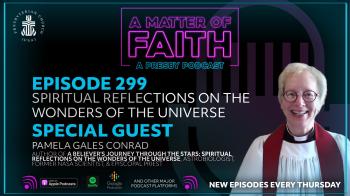
LOUISVILLE — Simon Doong and the Rev. Lee Catoe, who host the weekly podcast “A Matter of Faith,” no doubt figured inviting a NASA scientist turned Episcopal priest and author onto the program would make for a fascinating 54-minute conversation.
They were right.
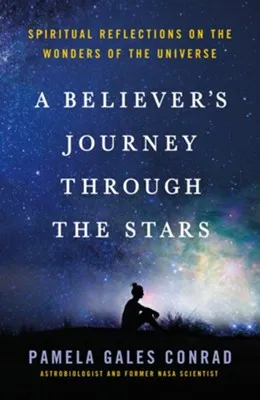
The Rev. Pamela (Pan) Gales Conrad, who wrote “A Believer’s Journey Through the Stars: Spiritual Reflections on the Wonders of the Universe” and worked as a NASA scientist before attending seminary and becoming an Episcopal priest, appeared on last week’s podcast, which can be heard here.
The hosts started with this question: We often hear that science and faith cannot coexist and are in opposition with each other. How does your experience with astronomy, space exploration and the Mars Rover mission and astrobiology challenge that perception?
“You’ve got to wonder why our heads would be stuffed with all this gray matter if we weren’t supposed to use it,” Conrad told Catoe and Doong. “One of the things I like about my specific faith tradition is that while we value the Scripture as the source of our information about God, we also say that it is important we use reason to interpret it, and we also rely on tradition.”
“I see that as permission from the faith space that I inhabit to go all out with all the things I’m curious about,” she said. “I believe we’re meant to use everything we’ve got. I have used [that in] every career I’ve ever had doing the things that I do, which are both of the scientific variety and also the faith variety. Because that works so well synergistically, I have to believe it is by intention that we have hearts and brains.”
Science and faith blur together in many ways, she said. One of those “is the fact that in science we really don’t have everything factually based.”
“Science is largely based on modeling, especially for things we can’t touch or use our senses to understand,” such as the origins of the universe and where it might be headed, Conrad said. Those are “some really big questions that are best understood both from the perspective of a model and also what empirical data we can get.”
“I do the same thing with my faith life,” she said. “The fact is that we have models that we’ve built about God, both from Scriptures and what we’ve learned from one another. We can feel there is something there, but we can’t come up with a formula to describe God.”
We rely on a model to describe the universe “until somebody comes up with a new model. I think that’s really consistent with how I look at faith,” she said. “As Christians, we believe that God became incarnate so we would understand embodiment and get a new model about how God might be asking us to live.”
“So the whole thing about models is, to me, a way in which those boundaries get blurred.”
Conrad’s doctoral dissertation required “some really difficult experiments,” she explained, some that had to be repeated eight or nine times to get a result. “The only reason I could do it eight or nine times is I had faith that if I kept doing it and improving it, eventually I’d get a result, and I did,” she told the hosts. “You do use faith, even when you’re doing an empirical pursuit like a scientific experiment.”
“To force those things into separate boxes — that is faith and science — is kind of silly.”
Doong shared that he was blessed to be raised by parents who are horticulturists. “I had the scientific method drilled into me from the time I was in kindergarten,” he said. “It gives you the perspective that if I try something and it doesn’t work, what should I try next?” He learned to apply that in his faith journey as well. “There have been times when I had preconceived ideas about how God was at work in the world,” he said, ideas that were challenged by something he’d learned, someone he’d met or somewhere he’d been, “and it didn’t stack up against what I had thought previously. Applying that scientific method, it forced me to think, OK, either the world is wrong and only my version of what I see is right, or I need to evolve my understanding of what it means to be a Christian, and this context is showing me there’s so much more to this world than I thought before.”
Even Jesus employed that method in his encounter with the Syrophoenician woman, Conrad noted.
“In science, we’re told to be curious and to keep trying things,” she said. “If we could use the enthusiasm we have for curiosity in science to explore God, think about how much more fun and how much easier it would be to teach a child about how to explore the spiritual landscape.”
She called exploration “our biological imperative,” a way to “understand about opportunities and threats,” including current challenges like climate change and rapid technological advances and “the inequity of our economic system and other things like structural racism. These things are very, very complex,” Conrad said. “They exist because we have taught our species not to ask questions when we have something that’s poking at us.” That poke is our moral compass “telling us to ask questions,” she said. “Exploration and encouraging curiosity and a thirst for wisdom is extremely important. We can’t solve anything without it.”
“If I have a question, I can’t hide it,” Catoe said. “It takes a lot of energy to suppress that because it’s so innate within us.”
If we’re in a state of waiting, such as the period of empire into which Jesus was born, “we often become passive,” Conrad said. “We’re waiting for somebody else to fix the stuff God has asked us to fix.”
Conrad spends “a lot of time thinking about the imagination and creativity of God and how does that affect my science, rather than the other way around,” she said. She’s also a musician who spends “a lot of time creating things. When I think about the stuff that God creates, I think my puny piece of music is nothing compared to that. But it expands my thinking.”
“The breadth of imagination that God has — there’s a little piece of that in all of us,” she said. “When we are having trouble in social settings or solving problems or balancing our checkbook or digesting some doctrine of faith, it is expected that we expand our way of thinking so we can think that broadly about the specific question that’s troubling us. What a gift that is! I think curiosity is important, but imagination is even more important.”
Asked about her book, which was published three months ago, Conrad said she hopes the main takeaway is “the permission to ask the questions and explore and to see just how much cool stuff there is out there.”
“I want everyone to know there is still beauty out there and new things to be discovered and ways in which we can learn to love each other even more,” she said. “That’s the message that underlies everything that’s baked into this book.”
New editions of “A Matter of Faith: A Presby Podcast” drop every Thursday. Listen to previous episodes here.
You may freely reuse and distribute this article in its entirety for non-commercial purposes in any medium. Please include author attribution, photography credits, and a link to the original article. This work is licensed under a Creative Commons Attribution-NonCommercial-NoDeratives 4.0 International License.


