
Responding to impacted Palestinian Christians
A panel speaks to the harms of Christian Zionism voiced by the Rev. Dr. Mitri Raheb and Muna Nassar during the Christianity without Christian Zionism conference
LOUISVILLE — As part of last week’s Christianity without Christian Zionism conference, attendees heard via Zoom from the Rev. Dr. Mitri Raheb and Muna Nassar, who offered up their voices of impacted Palestinian Christians.
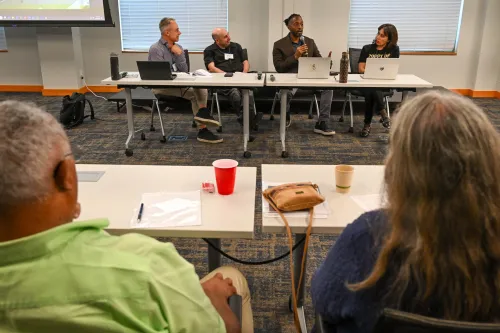
Afterward, a three-member panel moderated by Luciano Kovacs, a PC(USA) Global Ecumenical Liaison focused on the Middle East, responded to what they’d heard. The panel featured:
- Dr. Santiago Slabodsky, the Robert and Florence Kaufman Endowed Chair in Jewish Studies and Professor of Religion at Hofstra University in Hempstead, New York
- The Rev. Dr. Cristal Silva McCormick, who teaches Evangelism and Missions at Austin Seminary
- The Rev. Jermaine Ross-Allam, director of the PC(USA)’s Center for the Repair of Historic Harms.
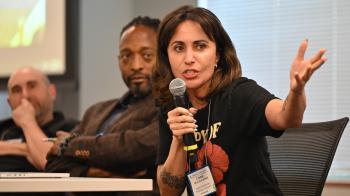
As Presbyterians and others do the work of solidarity, “the most important thing is to center Palestinian voices,” Silva McCormick said. When you’re speaking, she advised those attending the conference to “tell the truth. You can meet people where they are without lying to them.”
She tells her students that “nice kills.”
“We are not going to soften the language. That’s how we got here, liberal church. We have lots to repent from,” she said. “Putting Palestinians at risk because we’re being nice is a form of violence.”
“We cannot be afraid to offend people.”
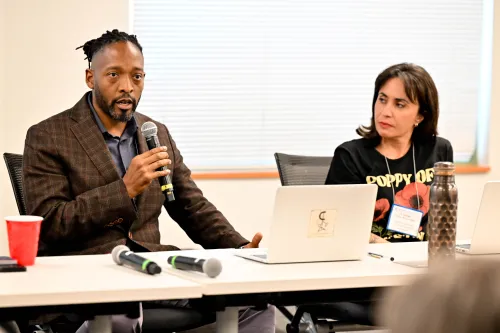
“Thank you for calling out this predatory fetish-ness of niceness,” Ross-Allam told Silva McCormick, also expressing thanks to Raheb and Nassar, who would return to the conference the following day to again speak via Zoom.
“Muna opened with identity fragmentation as a Palestinian Christian. It’s important for us to pay attention to it as well, the fragmentation responsible for Christian Zionism and its popularity,” Ross-Allam said. “There’s nothing wrong with being careful about language. But when it becomes a way of protecting yourself in a way that is killing others, we should all pay attention to the ways we use language — as if we are talking about people other than ourselves.”
When pointing out fragmentation, “we need to talk about our own fragmentation. We are also complicit, even as African Americans,” Ross-Allam said. “The problem with Christian Zionism isn’t something all of us started. But we all play a role, either to save ourselves or advance ourselves.”
When Ross-Allam was growing up in Southeast Texas, “both liberal Zionism and evangelical Christian Zionism was simply what was going on around us,” he said. “I am always interested in the materiality of historic harms,” which have “created the conditions that call us now to repair.”
What a prominent theologian like Raheb “allows us to understand is that Western Christianity allowed us to hijack the Christianity that came out of Palestine,” Ross-Allam said. “We have a great deal of teaching we must do — teaching ourselves and being taught.”
Among Ross-Allam’s suggestions are “acknowledging to ourselves that Christian Zionism is a bizarre and degrading superstition of historical Protestant communities. We have to acknowledge this is a very stupid idea and it’s not worthy of dignified or civilized people.”
That requires three subordinations, he said: “We must subordinate the Bible to the gospel, the Christian religion to the gospel and Protestantism to the gospel. These are necessary because we have become fragmented people, split at the root. We have been able to hide behind religion.”
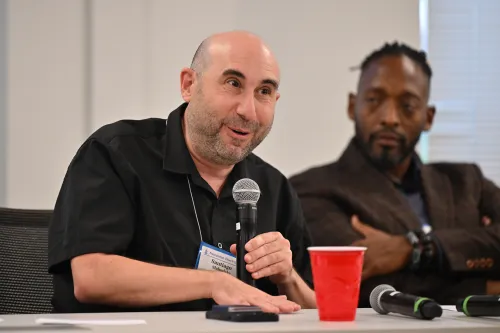
Slabodsky asked those in attendance this question: “Why do you want to save Christianity at all?”
“By the way, I think you should,” he said. “If we want Christianity without Christian Zionism, it presumes you want Christianity. I am an American Jew, and I believe it is important.”
Slabodsky pointed out the difference between identity politics and identity in politics. “The first is a strategy. Identity in politics is mobilizing fragmented selves for a struggle that goes beyond yourself,” he said. “Your community may have wounded many others. The identity in politics is relevant, and the risk is you will be too nice and ineffective.”
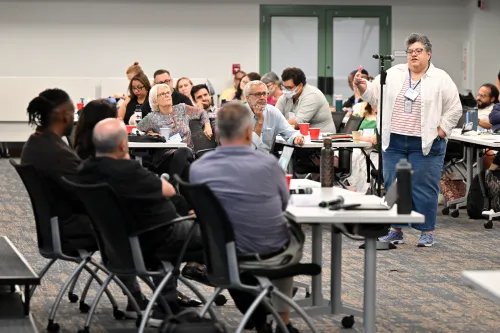
“Another risk is you might confront the problem of irrelevance,” Slabodsky said. “Christian Zionism has emerged as a challenge to be confronted.”
If the church is silent on this matter, “being invisible might be the end of political intervention,” he said. “Become relevant again. Organize in politics,” Slabodsky suggested.
During a question-and-answer session that followed the panel discussion, Slabodsky mentioned the “same side, different walls” art that’s been painted chiefly on the Mexican side of the border wall. “People are thinking about this in Latin America,” he said. “Communities understand what transnationality means.”
“Palestinians are transnational, not by choice. We need to go deeper” into the harmful ramifications of settler colonialism, he said.
“If you are going to do this work, you will be considered a heretic,” he said. “We need to learn it is OK to be the minority if you have integrity.”
You may freely reuse and distribute this article in its entirety for non-commercial purposes in any medium. Please include author attribution, photography credits, and a link to the original article. This work is licensed under a Creative Commons Attribution-NonCommercial-NoDeratives 4.0 International License.


