Hosts from Puerto Rico are eager to welcome fellow Presbyterians to the 228th General Assembly in 2028
The first GA outside the continental U.S. will offer commissioners an opportunity to experience hospitality, history and ministry firsthand
MILWAUKEE — When delegates and guests to the 228th General Assembly arrive at Luis Muñoz Marín International Airport in the summer of 2028, they already will know: This is no ordinary Presbyterian Church (U.S.A.) Assembly.
The predominantly white denomination will send its elected commissioners to San Juan, Puerto Rico, the first time the Assembly will be held outside the continental United States.
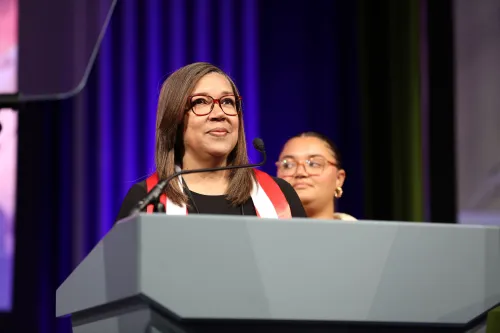
“There is great excitement about this,” said Ruling Elder Rosa Colón Rodríguez, who had just left the stage of the 227th Assembly with her daughter, Veronica Acosta Colón, a Young Adult Advisory Delegate.
Colón Rodríguez is moderator of el Presbiterio de San Juan, which will host the Assembly. “But I am more excited for when I return to Puerto Rico.”
Located just east of Hispaniola, the island boasts lively music, from bomba and plena, the traditional call-and-response and vigorous drumming, to reggaetón, born on the streets of the island nation in the 1990s. And of course, the sounds of salsa from greats like Héctor Lavoe and Willie Colón.
Visitors will enjoy tasty and seasoned mofongo and the traditional arroz con gandules, yellow rice with pigeon peas, usually with roast pork.
But the island’s most well-known attribute is her people.
“Puerto Ricans are very helpful,” said Dr. Emilio Pantojas-Garcia, a senior researcher and sociology professor at the Institute of Caribbean Studies at the University of Puerto Rico.
In fact, such spirited hospitality might be a problem, he added.
“One of the problems that you would have is that two or three people will want to give you explanations, directions,” he said with a chuckle. “Who will you listen to?”
Flor Vélez-Diaz is an assistant stated clerk and manager for judicial process and social witness at Presbyterian Life & Witness. A lifelong Presbyterian and native of Puerto Rico, Vélez-Diaz said the people of her homeland love to share their culture with visitors.
The road to the decision, however, was not smooth.
After hearing from Kate Trigger Duffert, director of General Assembly Planning, in December, the Unification Commission recommended Puerto Rico as the upcoming Assembly site. The Caribbean island is home to a synod and three presbyteries.
But in discussion during a meeting of the General Assembly Operations Committee, questions regarding safety for visitors revealed stereotypes that many people found hurtful.
“Those things would only have been said by someone who has not taken the time to learn the history and culture of Puerto Rico,” said Acosta Colón. In addition to serving as a YAAD, she is a Presbyterian deacon and co-moderator of Presbyterian Youth of el Sínodo Presbiteriano Boriquén.
Fellow YAADs asked her many questions about Puerto Rico.
“I came here to tell the other YAADs we are not all that different from anyone else,” she said. “We are all people, and we love to share our history and culture.”
Beyond the beauty of the island, though, poverty and corruption are both evident.
“The problem is that paradise has a backyard,” Pantojas Garcia said. “And there are many who are poor, who lack reliable essential services.” Forty-five percent of the population lives below the poverty line.
Commissioners overwhelmingly approved holding the next Assembly in Puerto Rico, but with an amendment — that before attending the 228th Assembly, “all commissioners, advisory delegates, volunteers and staff undergo cultural competency training on socio-political and historical relationship between Puerto Rico and the U.S.”
It is a complex and nuanced relationship.
Doubly colonized both by Spain in 1493 and the United States in 1898, Puerto Rico is an unincorporated territory of the United States, often referred to as a U.S. possession in legal documents.
Originally called Borikén (“the great land of the noble lord”) by the Taíno people, the island was named San Juan Bautista when under Spanish rule, then Puerto Rico after the U.S. colonized it.
Having been colonized as a place and discriminated against as a people, Puerto Ricans have become accustomed to being treated as second-class citizens. From mistreatment, they nurture the beauty they find inside, said the Rev. Fernando Rodríguez, associate presbyter for mission at the Presbytery of Denver. Although he was raised in Puerto Rico, he didn’t become Presbyterian until he moved to the United States for college.
“There is great life there,” he said of his homeland. “There will always be great life there.”
You may freely reuse and distribute this article in its entirety for non-commercial purposes in any medium. Please include author attribution, photography credits, and a link to the original article. This work is licensed under a Creative Commons Attribution-NonCommercial-NoDeratives 4.0 International License.