GA227 closing sermon gives audacious reckoning of church harms
The Rev. Laura Mariko Cheifetz offers a word on Isaiah 58 and healing after a GA shaped by concerns over institutional power and mistrust
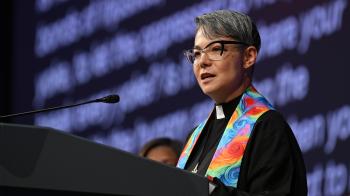
MILWAUKEE — The 227th General Assembly of the PC(USA) concluded Thursday afternoon with worship. The service included the installation of the newly elected Moderators of the Assembly, the Rev. Marta Pumroy-Cordero and the Rev. Dr. Kristopher D. Schondelmeyer, and an emotional charge and blessing from the outgoing Moderators, the Rev. CeCe Armstrong and the Rev. Tony Larson.
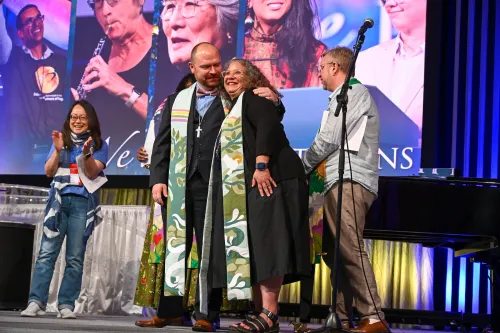
While these cornerstone traditions brought a meaningful tone of gratitude and excitement to the Assembly’s conclusion, it was the sermon that seemed to stir the exhausted hearts and minds of those gathered.
It was a sermon that included this question: “What does it even mean to bring healing to a world in such desperate need of it, when we, inheritors of a religion of empire and a patriotism built of death and domination, are the ones who are so broken?”
This question, posed by the preacher, the Rev. Laura Mariko Cheifetz, gave voice to an undercurrent of concern that seemed to permeate this year’s gathering. Cheifetz, who serves as transitional executive presbyter of the Presbytery of San Francisco, offered a powerfully prescient and unflinchingly honest reflection on Isaiah 58’s call to the church.
Cheifetz had the unenviable task of giving the final word to an Assembly filled to the brim with weighty overtures about both the church’s stance on matters of justice and its own internal conflicts.
Nearly two weeks of online committee meetings and in-person plenaries saw the Assembly approve actions on multiple social issues, including divesting from fossil fuels, repudiating Christian nationalism, calling Israel's actions in Gaza genocide and advocating for access to gender-affirming healthcare. But these moves toward justice were perhaps overshadowed by long and tense debates around misuse of institutional power and calls for accountability for various denominational entities.
There were also multiple controversies around ethical engagement among Assembly participants themselves, with concerns about racist statements regarding Puerto Rico, host of the next Assembly in 2028.
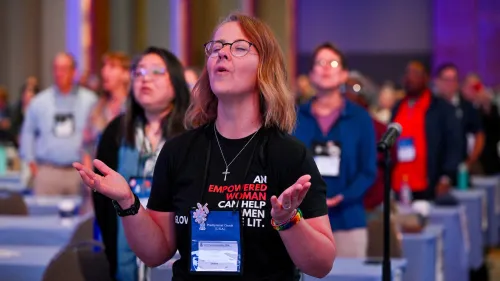
Amid all of this conflict, Cheifetz stepped up to bring a message of hope and healing. With her trademark snark, she acknowledged the challenge of the work, earning knowing laughter when she said her presence in such a significant pulpit as a queer biracial woman would make “generations of the white heteropatriarchy spin in their graves and squirm in their seats.”
The sermon boldly proclaimed the transformative power of a faith that we do not simply have, but which “has us.” However, with a frankness for which she is well known, Cheifetz pulled no punches in calling out the PC(USA)’s past and present harms, naming the “audacity” of believing we could be agents of healing when we’ve participated in so much harm.
Her message clearly struck a chord with those in the room.
“Quoting Scripture while mistreating your employees will not make you righteous,” she said, to cheering from those gathered. “Declaring oneself agents of a true faith while committing spiritual violence against your siblings will not make you holy. Spirituality … is not about what goes on inside one’s heart. It is also what one actually does out there in the world.”
Cheifetz told the Assembly that the healing we need requires a faith that calls us to know our sins “in our bones.”
“Faith that calls us to struggle with what ails us, what is really wrong with what we have done, instead of skip to a quick symbolic action, as though our sins were written on an Etch A Sketch instead of upon the Earth,” Cheifetz said.
Despite the unabashed naming of where the church has fallen short, Cheifetz’s message did ultimately express a hard but holy hope and a way forward for a denomination striving to be a better reflection of Jesus, whom it claims to follow. She described a long litany of ways she hears God in her own context, including care for immigrants, anti-racism work and the celebration of human diversity.
She said those in the church must allow our hearts to break, acknowledge all that we have broken and trust that we are met by a “God [who] holds us even when we have let go.”
Cheifetz described the role a “break” plays in a song, and quoted youth spoken word poet and nonprofit leader Michelle “Mush” Lee as saying, “The break is the moment the song almost collapses and that is exactly where the freedom is.”
Cheifetz explained that in various genres of music, the break offers an opportunity to join the dance. For Christians, and for Presbyterians more specifically, she said the freedom we encounter in the break comes from Christ.
“Don’t you see that we are free? We worship a living God, a savior, who was executed, died, was buried, and descended into hell, and who, on the third day, rose again. We have already lived through death. We have been to hell and back. We have already lived through countless heartbreaks, survived and fought to stay in a church that had broken its promises long before it baptized us.”
Reckoning with damning truths and the “painful, gorgeous mix” of sin and beauty is a crucial part of healing, she said, acknowledging that “we are the church we are because we were the church we were.”
Still, Cheifetz challenged the Assembly not to get lost in the church’s failures.
“We forget that in this failure, in recognizing it, in breaking the heart open, our hearts have the chance to become bigger,” Cheifetz said. “A broken heart is the moment of possibility.”
Though she didn’t hesitate to call out her own denomination’s sin, Cheifetz said she was “heartened by our conviction to bring healing” and “flabbergasted by our audacity to believe we can do so.” But she cautioned those in worship to understand that we are not creators of healing but collaborators, invited to join in the healing and liberating work of God.
Calling liberation both possible and inevitable, Cheifetz asked the Assembly, “How many of us are less our ancestors’ wildest dreams, and more the culmination of the liberation created by the space in the heartbreak they caused or endured?”
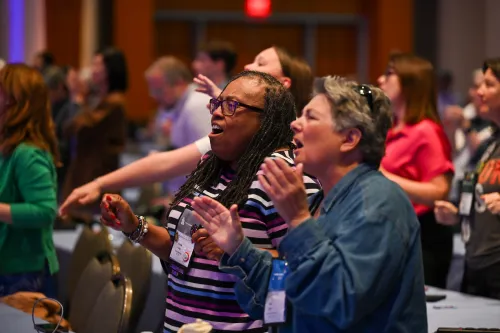
She was met with passionate cheers and shouts of “Amen.” Some in worship rose to their feet to applaud.
“God’s healing will happen with or without us,” she said, adding that the church’s job is to stay ready for the break, the moment to jump in and dance.
“The music has changed. The moment is now,” she said, echoing the words of Isaiah in calling her fellow Presbyterians to remove the yoke, offer food to the hungry, comfort the afflicted and loose the bonds of injustice.
As her sermon drew to a close, Cheifetz looked out at the Assembly with a vibrant smile and told them to dance. Stevie Wonder’s “Signed, Sealed, Delivered I’m Yours” immediately played through the loudspeakers, and hundreds of Presbyterians long nicknamed “God's Frozen Chosen” jumped to their feet, clapping in gratitude and dancing in hope.
You may freely reuse and distribute this article in its entirety for non-commercial purposes in any medium. Please include author attribution, photography credits, and a link to the original article. This work is licensed under a Creative Commons Attribution-NonCommercial-NoDeratives 4.0 International License.