General Assembly votes for fully in-person GA in 2030
Presbyterian Life & Witness is being directed to do research to help inform decisions about additional assemblies

MILWAUKEE — Commissioners to the 227th General Assembly voted Wednesday to return to a full, in-person assembly format in 2030, but the frequency of such gatherings and other details won’t be determined until after research by Presbyterian Life & Witness.
By a vote of 389-83, the General Assembly approved GAO-02, which commits the Presbyterian Church (U.S.A.) to an in-person Assembly, with an abbreviated, three-day exhibit hall in four years.
GAO-02, which passed in an amended form, also states that robust financial support will be provided for in-person childcare for commissioners, and it directs leadership of Presbyterian Life & Witness to study other details, such as “frequency, financial implications, Book of Order changes, use of technology and in-person/hybrid formats,” so that it can report back to the next General Assembly in 2028.
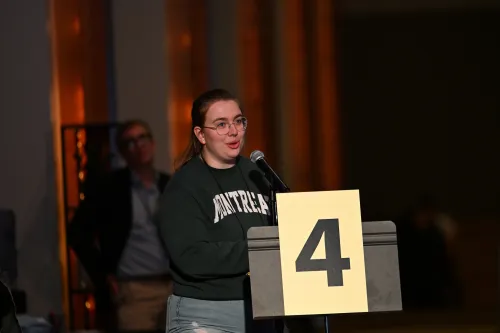
Those speaking in favor of an in-person assembly included Addy Tracy, a Young Adult Advisory Delegate from the Presbytery of Scioto Valley, who felt hindered by this year’s online committee format.
“A struggle I experienced while we were in committee was connection,” Tracy said. “I found that the barrier of Zoom made it extremely hard to meet and know the other commissioners and advisory delegates in my committee. Without the connection of shared meals, hallway chats and after-committee discussions, our group discernment was severely limited. As a connectional church, the connections built between commissioners and delegates is invaluable to the General Assembly process and is significantly hindered by Zoom.”
Another speaker during plenary 11 was Commissioner the Rev. Heather Prince Doss of the Presbytery of Northern New England, who stressed the importance of zeroing in on 2030.
“It was very clear in our committee that PL&W needs at least four years lead time,” Prince Doss said. “We need to tell them today if we want to meet in person in 2030,” leaving PL&W “room to decide for 2032 and beyond on a timeline that is workable for the excellent staff.”
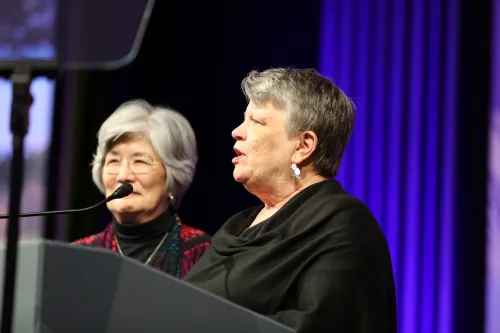
The site of the 2030 Assembly has not been decided, and Wednesday’s vote does not apply to the next General Assembly, a hybrid gathering in Puerto Rico.
The final vote on GAO-02 occurred after hearty discussion and various maneuvering, including an amendment to form a study group to examine holding a three-year General Assembly rotation to save money. “Finding ways to save money and lower per capita is important for our many small churches that are struggling,” said Commissioner the Rev. Sarah James, a teaching elder from the Presbytery of Missouri River Valley. “A lot have already closed, including the church that my grandpa was the pastor of for 25 years.”
The Rev. Jihyun Oh, Stated Clerk of the General Assembly and Executive Director of PL&W, noted during the discussion that the Constitution requires GAs to be at least biennial, so a change to three years would require a constitutional amendment.
Plenary 11 also included various items of business from the General Assembly Relationships (GAR) Committee in addition to business from the General Assembly Operations (GAO) Committee.
Approved items included GAR-06, which provides a new introduction to the Manual of the General Assembly, and GAR-12, which provides standards for the size of certain committees, such as the Presbyterian Committee on the Self-Development of People. It will not apply to the Presbyterian Historical Society Advisory Committee, thanks to a successful amendment.
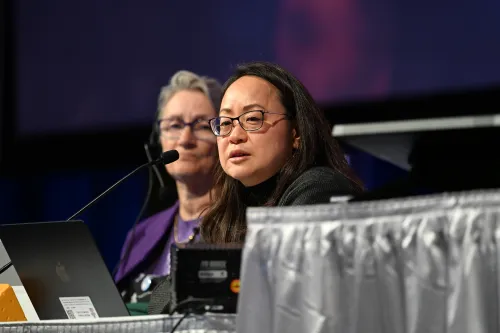
During the GAR report, that committee’s moderator, the Rev. Ruth Faith Santana-Grace, and vice moderator, the Rev. Brent Sheffer O'Neill, took time to highlight the hard work that led to a new Organization for Mission (GAR-05).
Among other things, it requires the Stated Clerk and Executive Director of Presbyterian Life & Witness to, before “substantially restructuring, reducing or eliminating programs that maintain long-term relationships with named global partner churches,” provide written notice to affected partner churches at least 90 days in advance, when circumstances permit. It also requires reporting “the substance of the consultation to the PL&W Board before authorizing the restructuring and include a summary of the consultation and partner responses in the agency’s next report to the General Assembly.” When “urgent circumstances do not permit advance consultation,” the Stated Clerk and Executive Director “shall provide written notice and explanation to partners as promptly as possible and report to the PL&W Board within 30 days.” (Read more here.)
“We want to take this moment to commend our committee for their grace, their patience, collegiality and sense of humor, and we want to express a word of gratitude for the Unification Commission for their perseverance over these last four years,” O'Neill said. “Well done, good and faithful servants.”
You may freely reuse and distribute this article in its entirety for non-commercial purposes in any medium. Please include author attribution, photography credits, and a link to the original article. This work is licensed under a Creative Commons Attribution-NonCommercial-NoDeratives 4.0 International License.