What lies beneath
First Presbyterian Church’s part in the history of the Underground Railroad in Racine, Wisconsin

RACINE, Wisconsin – The tidy entryway of First Presbyterian Church of Racine, Wisconsin, belies the dusty passageways underneath that run the length of its historic sanctuary.
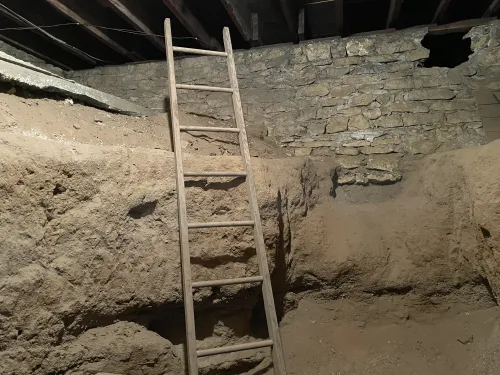
Passageways where certain artifacts — a pair of shoes from the 1800s, a hat, pieces of broken plates — were discovered, and stand as compelling evidence that the congregation was a former stop on the escape route for enslaved people seeking freedom, namely the Underground Railroad.
Today those items that were found in the crawlspace under the sanctuary are verified and on exhibit at the Racine Heritage Museum, as First Presbyterian Church continues to partner with area historians to tell its story and live out its vision as “a church centered on God’s salvation, which embodies liberation from all that dehumanizes and wholeness which is being the people God calls us to be.”
Assembly-goers who boarded buses to attend First Church on Sunday not only experienced uplifting, dynamic worship with a fitting message, “Hospitality,” from the Rev. Darren Utley on Matthew 10:40-42, followed by a lively coffee hour and a generous lunch, but also an hourlong presentation by Utley about the church’s history with the Underground Railroad.
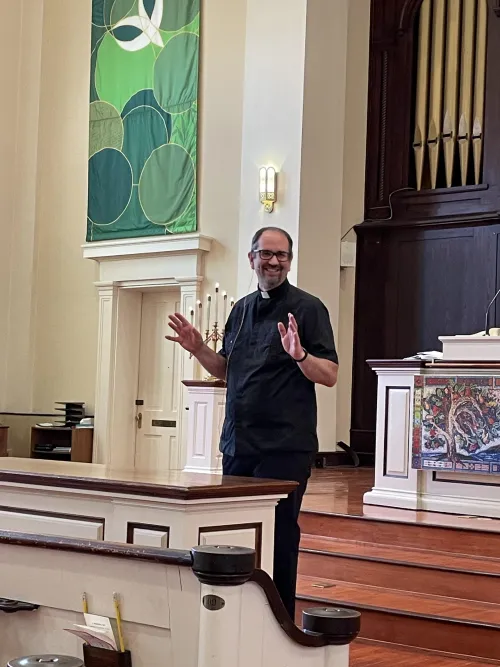
Utley’s talk quoted liberally, with her permission, from material prepared by Pauline G. Mitchell, Project Director for the Racine Underground Railroad Heritage Trail.
Mitchell’s words resonated with those standing in the space.
“Before we begin, I invite you to imagine Racine in the year 1855,” wrote Mitchell. “Imagine the sound of footsteps in the night. Imagine the quiet courage of individuals who refused to remain enslaved. This church stood not only as a house of worship, but as a moral declaration. Within these walls, freedom was preached — and beneath this floor, evidence of that courage was hidden. Today, we do not simply recount history; we stand inside it.”
Founded in 1839, First Presbyterian Church was among the first religious institutions to be created in Racine. It was built in 1852 and added to the National Register of Historic Places in 1973. In 2019, the congregation earned recognition by the National Park Service’s National Underground Railroad Network to Freedom.
According to the church’s published history, the congregation adopted the Articles of Faith and Covenant that had been adopted by the Presbytery of Wisconsin [later the Presbytery of Milwaukee] in 1839, which took a stand against slavery. Later, three governing body resolutions (1841, 1843, and 1849) opposing the institution of slavery and refusing membership and communion to slaveholders were also adopted by First Presbyterian Church.
“Resolved, that in the eyes of this convention American slavery is a sin,” reads an October 1841 resolution by the Presbytery of Milwaukee, “that is a sin of such magnitude that all who practice it or knowingly promote [it] should be excluded from our pulpits and the fellowship of our churches.”
The church itself was organized and pastored by a number of dedicated abolitionists, including Rev. Cyrus Nichols, the first pastor; Zebulon Humphrey and T.M. Hopkins.
When Utley was called to serve as First Church’s pastor five years ago in the midst of Covid, committed to continue in his predecessors’ footsteps, he found a series of quilts in storage representing an Underground Railroad Quilt Code. The code was used as a map to instruct enslaved people fleeing north toward freedom on the Underground Railroad, with each quilt giving a distinctive message for escape to complete their journey toward liberation.
Utley was determined to create a story to get people to come back after the pandemic.
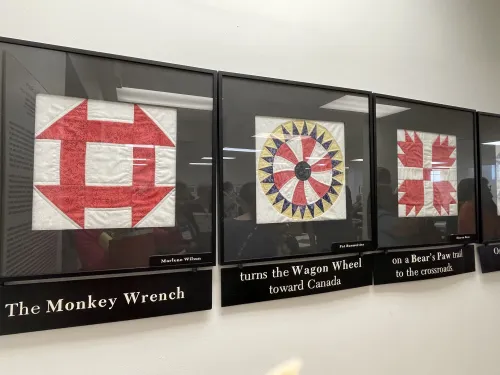
“How do we remain true to the abolitionist history and this symbol of resilience,” he asked, “to tell each other about pathways to freedom?”
The quilts now hang on a wall on the building’s lower floor, adjacent to a tunnel where escaped enslaved people may have once hidden.
Today the church offers free tours to schools, community groups, churches and the general public to experience this important history and to learn of the congregation’s ongoing witness.
“We consider this a sacred space,” said Utley at the close of the tour. “It holds the aspirations of people seeking freedom, seeking liberation. That spirit still remains in this space.”
You may freely reuse and distribute this article in its entirety for non-commercial purposes in any medium. Please include author attribution, photography credits, and a link to the original article. This work is licensed under a Creative Commons Attribution-NonCommercial-NoDeratives 4.0 International License.