From puff puffs to Presbyterian polity
General Assembly visitors discover a global family at West Granville Presbyterian Church
MILWAUKEE — “What a special day!”
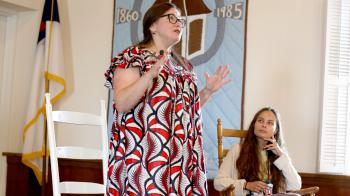
With those words, the Rev. Elizabeth McCord welcomed worshippers to West Granville Presbyterian Church on Sunday as the congregation opened its doors to commissioners and visitors attending the 227th General Assembly of the Presbyterian Church (U.S.A.).
“Not only do I get to welcome our wonderful congregants here in person and joining us virtually, but we have Presbyterians from across the country visiting today,” said McCord, the congregation’s interim pastor. She quickly broadened that welcome. “Here at West Granville, we have Presbyterians from around the world every Sunday.”
That simple observation captured what General Assembly visitors encountered throughout the morning: a congregation where global Christianity is not merely a profession of faith but an everyday reality.
Located on Milwaukee’s northwest side, West Granville has changed significantly over the past decade as educators and families from Western Africa have made their homes in the area. Many came through international teacher recruitment programs developed to address staffing shortages in Milwaukee Public Schools. Some of those teachers and their families found a church home at West Granville, reshaping the congregation’s fellowship and community life.
McCord highlighted that reality from the beginning of worship, thanking the African families preparing “a big feast for our lunch” and encouraging visitors to stay after the service for fellowship. Her welcome echoed the morning’s Gospel reading from Matthew 10:40-42, in which Jesus teaches “whoever welcomes you welcomes me and welcomes the One who sent me.”
Laura Meyer, a longtime member who volunteers with the congregation’s livestream ministry, has witnessed that transformation firsthand. A member for more than 20 years, Meyer has watched West Granville evolve as families and educators arriving from West Africa became central to the congregation’s life, especially their children and youth programs. “We had a lot of families from Togo that came, pre-Covid,” Meyer said. The shift accelerated as local schools increased international recruiting especially from Nigeria and Ghana. “[Milwaukee Public Schools] brought a bunch of international teachers here, because they had such a teacher shortage, so they bought visas and brought people here to teach,” Meyer said.
Presbyterian families arriving from countries including Cameroon, Ghana, Nigeria and Togo joined a congregation already committed to community, education and service, creating a church that reflects global migration patterns in a very local setting.
That connectional vision extended into the children’s message. As children made their way to the front of the sanctuary, McCord held up a map of the United States and used it to explain the PC(USA)'s system of presbyteries. “If our church is like our family, a presbytery is like our neighborhood,” she told them. It is “where we all get together and we serve and we worship God together and we eat together.”
Pointing to Milwaukee and then to places represented by visiting commissioners, she described the map as “like a big family picture” showing “where all of our extended cousins and all of our big family Presbyterian family live.” Inviting the children to color the maps as “kind of a way of praying,” she closed with a simple petition: “God, thank you so much for making us one big family.”
The theme of connectedness continued during the sermon time. Instead of a traditional sermon, McCord hosted what she called a “rocking chair conversation” on a front-porch set built inside the sanctuary by church members. For the summer, she explained, West Granville is exploring how faith takes shape through conversations and testimony.
Her guest on Sunday was the Rev. Jackie Rodriguez, a former intern at West Granville who now serves as director of Presbyterian Campus Ministry at Duke University and was visiting while serving as a commissioner at General Assembly. Reflecting on her time with the congregation, Rodriguez said she learned about hospitality through the church’s actions. “The way that this congregation intentionally honors people” left a lasting impression, she said. “Every church describes themselves as welcoming,” she added, “but it’s cool that each church also has a distinct way that that manifests itself.”
After worship, a receiving line stretched from the sanctuary through the narthex, down hallways and stairwells and toward the fellowship hall below. Along the way, Presbyterians from California to Cameroon, Georgia to Ghana and New York to Nigeria exchanged stories about the familiar sounds, smells and traditions that make a congregation feel like home.
“One thing I like about the Presbyterian Church is that no matter where you go in the world, a Presbyterian church is a Presbyterian church,” said the Rev. Wylie Hughes, a teaching elder commissioner from the Presbytery of Western New York. Hughes soon found himself comparing notes with longtime West Granville member and ruling elder Farrukh Daniel about an unexpectedly emotional challenge many congregations eventually face: changing communion bread.
Serving a congregation in the Netherlands, Hughes recalled the panic when the member who had baked communion bread for 25 years died. The congregation eventually adopted a new practice of using day-old loaves from a local bakery, but not before discovering that people were mourning more than a recipe.
Daniel immediately understood. “We had a doctor here that made his own wine,” he said. For decades, according to Daniel, communion at West Granville carried the tastes and fingerprints of particular people. Sometimes the bread came from “somebody’s grandma.” When those bakers and volunteers died or could no longer serve, replacing the elements proved unexpectedly difficult. Store-bought loaves were “dry,” Daniel recalled. “Not everyone liked sourdough.”
Beneath those preferences, however, was something deeper. What felt like a debate over bread was often grief for the people who had mixed the dough, baked the loaves and carried traditions across generations.
Standing in a receiving line filled with Presbyterians from across the United States and around the world, Hughes and Daniel shared a quiet recognition: Churches do not simply inherit recipes. They pass on living stories. And every congregation eventually learns that faithfulness sometimes means carrying those stories forward in new forms.
Downstairs, visitors found one of those newer forms waiting for them. Tables overflowed with yams, beef kabobs, coconut rice, jollof rice, rice and beans, fresh fruit, savory chutneys and trays of “puff puffs,” a popular fried dough found across much of West Africa.
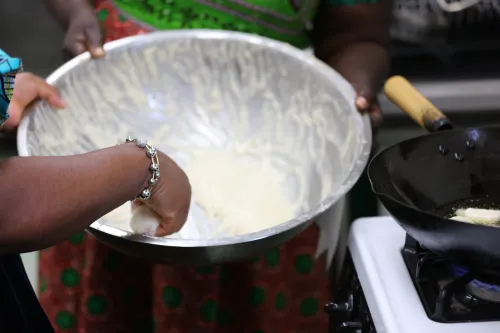
Elder Hildegarde Essoka introduced the cooks and the dishes they had prepared. Essoka came to West Granville more than a decade ago after another Presbyterian congregation closed. Since then, she has helped welcome newer families arriving in Milwaukee and connect them to both the church and the broader community.
Among those preparing the meal was Linda Annor, a member who moved from Ghana two years ago to teach culinary arts in Milwaukee Public Schools. Like many newer members of the congregation, Annor and her family arrived through an international teacher recruitment program that has brought educators from West Africa to Milwaukee. She and her husband were already ordained as ruling elders with a strong commitment to community volunteering when they moved from Ghana.
The congregation’s ministries reflect those commitments. Members support a nearby public school, maintain a mission partnership with a hospital in Malawi, and nurture a growing Sunday school and youth ministry.
Among West Granville’s most beloved regular traditions are African feast lunches much like the one prepared for General Assembly visitors. On World Communion Sunday in October, Essoka said, puff puffs serve not only as a favorite treat but also as communion bread.
Popular throughout Western Africa, puff puffs are made from a simple dough fried until golden and sweet. Essoka noted that similar pastries appear throughout many cultures under different names, carrying traditions across regions and generations.
Like the congregation itself, the pastry carries a story of migration. Recipes travel. Names change. Traditions adapt. Yet something essential remains.
At West Granville Presbyterian Church, that story becomes sacramental. During communion, an ordinary piece of fried dough prepared by members of the congregation receives the Words of Institution and is shared as the Body of Christ among worshipers from Wisconsin, Western Africa and beyond.
You may freely reuse and distribute this article in its entirety for non-commercial purposes in any medium. Please include author attribution, photography credits, and a link to the original article. This work is licensed under a Creative Commons Attribution-NonCommercial-NoDeratives 4.0 International License.