Women of Milwaukee: Sarah, Margaret and Lois
Looking back at a handful of trailblazing Presbyterian women, including the first female moderator of a Presbyterian General Assembly
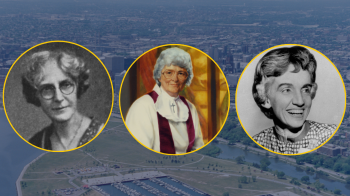
In 1971, Ruling Elder Lois Stair (1923-1981) took to the stage as the newest moderator of the UPCUSA General Assembly.
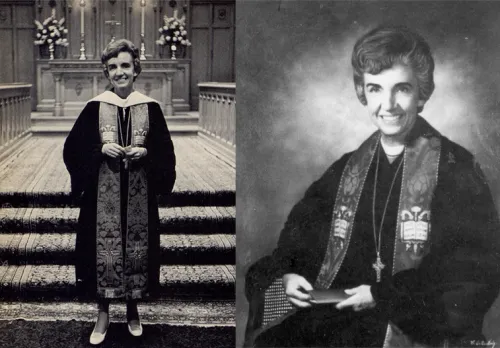
This was a historic moment, as Stair was the first woman elected to the position — one of the highest leadership positions within the church. Stair had been serving as ruling elder at First Presbyterian Church of Waukesha, in Wisconsin, since 1957. Between then and her election as Moderator, she was a commissioner for General Assembly as well as moderator of Milwaukee Presbytery and the Synod of Wisconsin.
In her first address, after she stood at the podium and announced, “Here I am, filled with amazement and gratitude and standing in the need of prayer,” Stair posed a question to the assembly: “What sort of confidence should I have?” she asked. “Should I be like the young Black secretary made bold by the sign over her desk: ‘Think uppity’? ‘Think uppity’… I must have been thinking uppity to have accepted this nomination, and Milwaukee Presbytery must have been thinking uppity to nominate me.”
Milwaukee: the city that is hosting this year’s General Assembly and a place described by Stair as forward-thinking. Her nomination to the position was not the first time the Presbytery of Milwaukee had been “thinking uppity,” Stair assures the assembly — rather, they’d done this before, at the 1930 gathering. She tells the story of a young pastor and his “ready-to-go meeting of his congregation, and the moment that the assembly acted to have women elders, there was a woman elder — Sarah Dickson — elected, ordained and installed in that place. So, they’ve been thinking uppity a long time in Milwaukee,” she concluded.
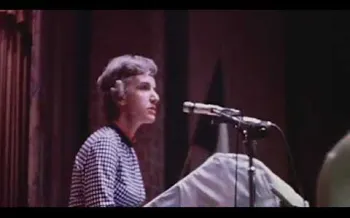
Stair, the first woman moderator of a Presbyterian general assembly, made sure to mention another trailblazing woman who’d come before her and helped to pave the way: Sarah E. Dickson (1880-1965), a Presbyterian deaconess and religious educator who became the first woman ordained as a ruling elder in the PC(USA) on June 2, 1930, at Wauwatosa Avenue Presbyterian Church, Wauwatosa, Wisconsin.
Eight years prior, in 1922, the Presbyterian General Assembly allowed women to be deaconesses — a larger role than before, but still a limited one, as a deaconess could not preach as an elder could. Dickson participated in the training program, and by 1925 she’d been ordained as a deaconess.
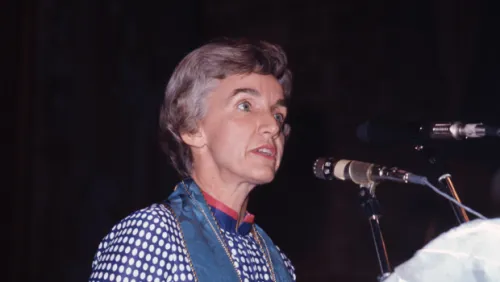
Dickson was a member of Dr. Cleland McAfee’s congregation at Forty-First Street Presbyterian Church in Chicago, but would serve in a handful of sanctuaries around the city, including Second Presbyterian Church and First Presbyterian Church. At First Presbyterian, she served as director of religious education, where, in the early 1920s, a group of young adults organized a play, a “dramatization.” This theater club at the church is what brought Richard E. Evans and Sarah Dickson together — Dickson would become an influential and irreplaceable figure in Evans’s life, encouraging him to pursue a calling to the ministry, enabling him to do so by caring for his relatives to free him for his studies, and joining him in Wauwatosa, Wisconsin, where he had been installed as pastor of Wauwatosa Presbyterian Church in November 1927. There, she served as the congregation’s first Director of Religious Education.
The “ready-to-go” young pastor that Lois Stair mentioned in her acceptance speech at the 1971 GA was none other than the Rev. Richard Evans. Under his and Dickson’s joint leadership, the church in Milwaukee grew rapidly. In the winter 1990 edition of American Presbyterians, a past publication of the Presbyterian Historical Society, readers learn that “by 1930, Dick Evans was in firm control of the church and was uniquely positioned to move quickly should Overture B pass the General Assembly,” which would make women eligible for ordination as elders. The vote to approve the overture occurred on May 31, 1930. “From Cincinnati [Evans] telephoned instructions to call a congregational meeting on Monday 2 June,” Krugler and Weinberg-Kinsey wrote, during which the church members “voted unanimously to elect Dickson as a ruling elder. Ten days later … the church ordained her. With her ordination, less than two weeks after the General Assembly announced approval for the overture, the PC(USA) had its first woman ruling elder.”
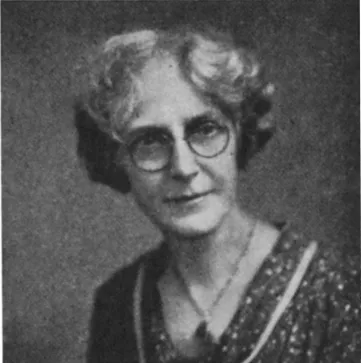
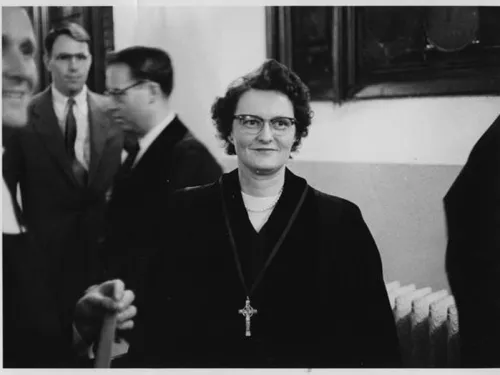
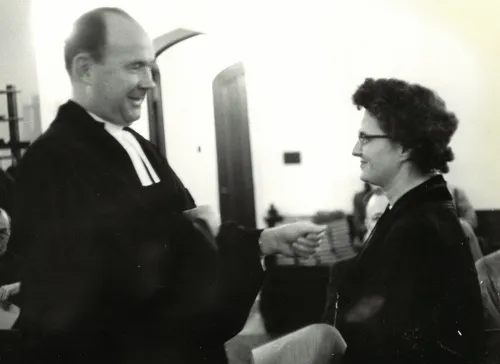
In October 1956, almost three decades after Dickson’s milestone ordination, another historic ceremony took place — Margaret Towner’s ordination as the first woman minister of the Presbyterian Church.
Margaret Towner had moved back to Syracuse, New York, and opened her own photography studio when she began volunteering her spare time to work in the music and education program at her home church. She took a position as part-time director of Christian education at a nearby church, then decided to continue her education in order to become a commissioned church worker (CCW), one of the positions in the church open to women at the time. She attended Union Theological Seminary from 1951 to 1954, at which time she returned to her home church as a CCW for a brief period before the First Presbyterian Church of Allentown, Pennsylvania, installed her as a CCW in charge of the education program in October 1955.
The overture permitting the ordination of women — which had been brought in front of the 1953 General Assembly and appointed a committee, which proposed its amendment to the 1955 General Assembly, which voted to approve the report and send the overture to the church’s 256 presbyteries for ratification — was finally, officially authorized at the 1956 General Assembly.
It was around this time that the pastor of her home church in Syracuse, William H. McConaghy, wrote Towner a letter asking if she wished to be ordained in the sanctuary there. Towner, busy with her work in Allentown, sent off her response and arranged for the Lehigh Presbytery to dismiss her to the Cayuga-Syracuse Presbytery. The date was set for Oct. 24. Only as the fall drew closer “did the significance of the event become clearer. Inquiries to church officials confirmed that Margaret Towner was to be the first woman ordained in the Presbyterian Church of the U.S.A.," write Krugler and Weinberg-Kinsey.
There were no empty pews. A crowd of nearly 300 gathered for the historic service in Syracuse; local and national media outlets covered the event. The day following her ordination, Towner returned to Pennsylvania where she was installed as an assistant pastor.
It was not easy sailing from there, however. Her colleagues often vocalized their expectation that she’d only be around until she got married; she faced issues of pay equity in various positions; a year passed in which she was an ordained minister but had yet to preach at a regular service. Eager to serve the church in whatever capacity, Towner fought battles against stereotypes and prejudices, and continued moving forward in her faith and ministry, regardless of the noise.
Twenty years after the ceremony, in a 1978 interview conducted by Ed Wicklein, Towner reminisced on the reception of the first woman minister by the church. “So, do you turn down opportunities to speak, because you feel like a curiosity,” she wondered aloud, “or do you go, because — even though you’re a curiosity, maybe by your presence and what you say you can help other women along the way.” At the time of the interview, Towner was serving as co-pastor of Kettle Moraine Parish in the Presbytery of Milwaukee, where she remained until her retirement in 1989. Towner celebrated her 101st birthday this past March.
Resources
Highlights of the 183rd General Assembly, Rochester, New York, May 17-26, 1971. Pearl Digital Collections.
1971 General Assembly: Contains footage of speakers, including moderator Lois Stair, and general scenes of plenary. Pearl Digital Collections.
Krugler, John and David Weinberg-Kinsey, “Equality of Leadership: The Ordinations of Sarah E. Dickson and Margaret E. Towner in the Presbyterian Church in the USA,” American Presbyterians, Volume 68, Number 4, Winter 1990, published by the Presbyterian Historical Society. www.jstor.org/stable/23333078
You may freely reuse and distribute this article in its entirety for non-commercial purposes in any medium. Please include author attribution, photography credits, and a link to the original article. This work is licensed under a Creative Commons Attribution-NonCommercial-NoDeratives 4.0 International License.