Reformed Identity in US Committee tackles Christian nationalism
Young Adult Advisory Delegates chisel away at artificial intelligence
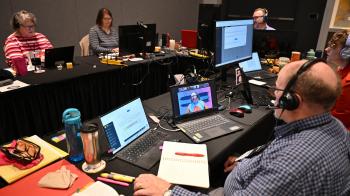
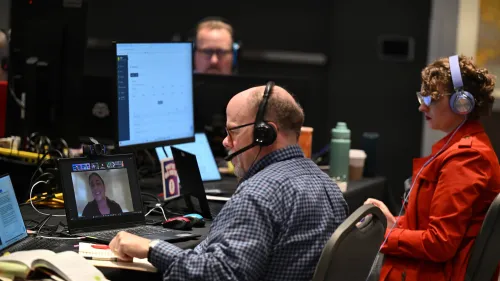
Commissioners on the Reformed Identity in the U.S. Committee approved with amendments several overtures calling out explicit and hidden dangers on Tuesday, including Christian nationalism and the use of generative artificial intelligence.
Also, the committee disapproved an overture calling for the commemoration and study of the Reformed tradition’s many contributions to the nation’s independence on its 250th anniversary.
Commissioners heard reports on overtures highlighting the ideology of Christian nationalism, one a social witness policy lifted by the Advisory Committee on Social Witness Policy (ACSWP) and another from San Jose Presbytery calling for direct action from the church.
Regarding a social witness policy and call for investment in the future study and education of using artificial intelligence, Young Adult Advisory Delegates deftly chiseled away at the overture, calling for stronger language on AI’s dangers and questioning the overture’s steep price tag.
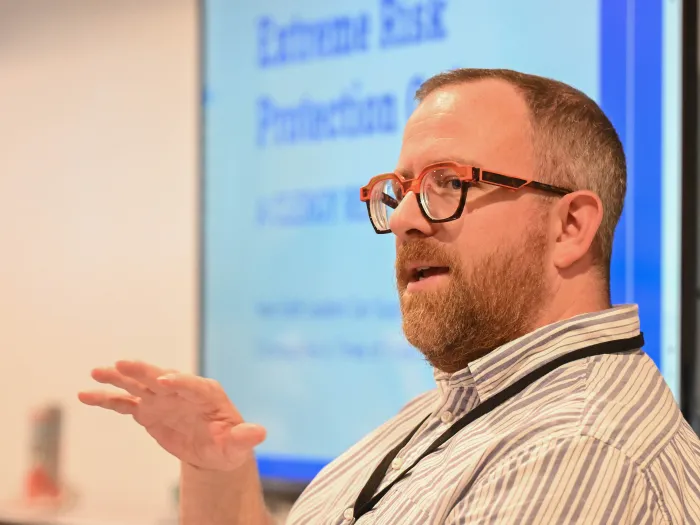
Dr. Rick Nutt, overture advocate for ACSWP, introduced RUS-07, Standing Against White Christian Nationalism, by noting its power to harm by co-opting the Christian faith.
“White Christian nationalist ideology is about power,” he said. “It's about the power to decide who is a citizen and the power to decide what kind of nation we will be, whether or not we will have a specifically Christian identity, or whether we will be a nation that welcomes and is open to a diversity of religious ideas within our context.”
Further, Nutt said, RUS-07 calls for all Presbyterians to study the ideology and its dangers. It asks preachers to offer sermons focused on the dangers of Christian nationalism at least once a year.
“We also want this to be something that that the denomination can take and use to think seriously about these issues,” he said.
Both RUS-07 and RUS-01 call on the church to recognize the ideology and guard against its adherents’ desires to merge Christianity with U.S. civic life and national identity. But RUS-01, On Taking Action to Repudiate Christian Nationalism and Affirm our Faith Commitments, goes further, said overture advocate Elizabeth Wylie, a ruling elder from San Jose Presbytery, which brought the overture.
“RUS-01 one moves us from policy into action. Let's name the problem. Christian nationalism is distorting, harming our neighbors and growing in our pews,” Wylie said.
She said RUS-01 asks that the Stated Clerk to send to presbyteries for ratification a proposed amendment to the Book of Order:
Shall F-1.03 be amended to add new section F-1-0305 as follows:
“My kingdom is not of this World
“The church shall not align with any ideology that seeks to privilege Christianity in public life or conflate religious identity with national or ethnic supremacy. Such ideology, in all its forms, which seeks to privilege a singular religious-cultural framework in civic life, is incompatible with the example and teachings of Jesus Christ, a theological error, a threat to faithful witness, and contrary to the church.”
The overture also asks the Stated Clerk and Moderators of the General Assembly to issue a joint public statement repudiating the ideology and mandate an interfaith coalition to oppose it altogether.
Partner advisory delegate Victor Kim said his church, Presbyterian Church of Canada, just adopted recommendations speaking against Christian nationalism. He said several ecumenical coalitions would be encouraged to share in this work with PC(USA).
The committee approved social witness policy regarding the use of artificial intelligence.
Robust conversations and a flurry of amendments greeted the introduction of RUS-08, the social witness policy titled “The Algorithm and the Almighty: Navigating Artificial Intelligence through a Reformed Lens.”
The overture brought by ACSWP recommended careful study of the uses and pitfalls of artificial intelligence, an ever-changing technology touching just about every part of our lives.
The recommendation also included creating an advisory committee to study and share on matters of emerging technologies along with the formation of a Center for the Future to be housed within the Office of Innovation.
Expected costs for the overture are $599,663.
Kylie Vogel, a YAAD from Mountain Laurel Presbytery, questioned the hefty price tag.
“I'm just looking at the financial implications, and I'm kind of blown away by how much resources will be put into AI education,” she said.
RUS-08 as recommended to General Assembly proposed referring to Presbyterian Life & Witness leaders to examine how existing resources could provide educational materials, continue study of AI’s impact and collaborate with ecumenical partners before creating a new entity.
Priscilla Samuel, a YAAD from Presbytery of the Coastlands, offered amendments of specific safeguards. She and other YAADs offered amendments regarding ethical and moral guidance when using AI, particularly when using AI in sermons and pastoral care.
After wrestling with several amendments to RUS-02, On Commemorating the 250th Anniversary of the American Revolution, commissioners voted to disapprove the overture.
Proposed by the Presbytery of Northeast New Jersey, RUS-02 sought to encourage the study of American history, particularly with the large representation of Presbyterian and other Reformed tradition leaders who shaped this young nation.
Several commissioners noted the celebratory tone of the overture. Rebeka Fergusson Lutz, teaching elder from Detroit Presbytery, said it “asserts a kind of American exceptionalism that I think is dangerous.”
She said studying the denomination’s history is valid.
“Some well-placed donations to the Presbyterian Historical Society by people who feel strongly about this would be absolutely fine,” she said. “There's no need to spend denominational resources to do this historical research work.”
You may freely reuse and distribute this article in its entirety for non-commercial purposes in any medium. Please include author attribution, photography credits, and a link to the original article. This work is licensed under a Creative Commons Attribution-NonCommercial-NoDeratives 4.0 International License.