On final day, Ordination Committee approves six items, including study on collaborative ministry
The committee also voted against two items concerning ruling elder ordinations and roles

On its final day of work Wednesday, the Committee on Theological Education and Ordination wrapped up ORD-07 and then made efficient work of addressing the remaining eight items of business on its docket. Roughly half of these eight items concerned standard approvals that take place at every Assembly. Of the remaining items, one concerned collaborative ministry efforts while three addressed the roles, rights, and authority of ruling elders and deacons.
After spending nearly all of Tuesday on intensive work and deliberation around each of ORD-07’s 10 recommendations, the committee took its final vote on the report as its first official action on Wednesday morning. Despite some concerns raised about changes to the report by representatives from the Racial Equity Advocacy Committee (REAC), the committee ultimately approved the item of business as amended by a vote of 50-9, trusting the full Assembly to do any necessary additional work during plenary.
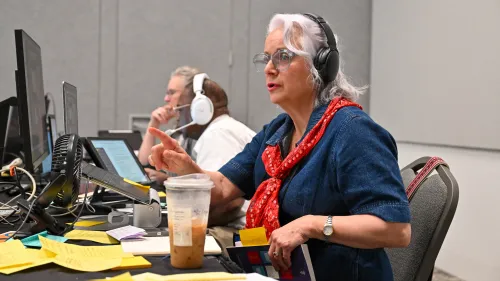
With their work on ORD-07 finally concluded, the committee turned its attention to the approval of minutes and related documents from the Committee on Theological Education in ORD-12, ORD-13, and ORD-15, all of which the committee passed quickly and unanimously.
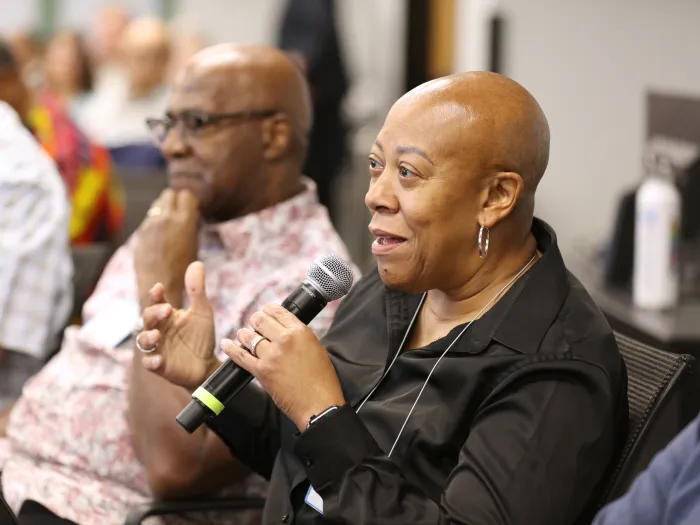
The committee then heard from the Rev. Dr. Lyndsey McCall-Gilliam, speaking as an overture advocate for ORD-03, “On Studying A Collaborative Approach to Ordained Ministry for the Faithful Support of Congregations and Ministers.” McCall-Gilliam drew on her doctoral work as she passionately addressed the pervasive negative impacts of burnout, isolation, and resource scarcity on ministers and churches alike.
ORD-03 asked the General Assembly to form a special committee for the purpose of “study and develop recommendations for an approach to ordained ministry in which ministers serve together as part of ministry teams, supporting faithful ministry in congregations by drawing on their particular gifts to meet the evolving needs of the church, and to report its progress to the 228th General Assembly (2028) and its final recommendations to the 229th General Assembly (2030).”
McCall-Gilliam acknowledged that such innovative approaches have been explored by churches and presbyteries on a smaller scale but argued that a full denominational effort would provide essential insights and support. While some committee members argued that a dedicated committee was an unnecessary use of denominational funding, ORD-03 was ultimately approved by the committee and will go before plenary.
McCall-Gilliam told Presbyterian News Service after the vote that she was "on Cloud 9 for the church" and was setting her sights on the next hurdle: the full Assembly's vote on the overture next week.
The committee then took up ORD-01, “On Preventing Conflicting Ordinations,” which was submitted by Highlands Presbytery and offered a process of engagement between a church session and any ruling elder or deacon who holds another ordination outside the authority of the PC(USA) in order to address conflicts of interest. The example highlighted by the overture advocate centered on church officers who sought online ordination from the Universal Life Church for the purposes of officiating a marriage ceremony.
While proponents for the item argued that it provided essential guardrails to protect the sacredness of the church’s ordained offices, others — including the Advocacy Committee on LGBTQIA+ Equity — suggested that it would unnecessarily legislate and impede efforts to care for others “in places where the church falls short.” An amendment was proposed and approved that added language to clarify this overture would not apply to civil authorities to conduct weddings or other duties. However, ORD-01 as amended was ultimately disapproved by the committee by a ratio of nearly two to one.
The committee next considered and quickly approved ORD-05, which granted a list of theological institutions permission to celebrate the Lord’s Supper until the next General Assembly in 2028. This is a necessary item of business that comes up at each Assembly.
The committee returned to the previously approved item ORD-06 — the Presbyteries' Cooperative Committee on Examinations for Candidates Self Study — to vote on the addition of an official comment drafted by a trio of committee members. The comment commended the efforts and commitment of members of the PCC and advised a shortened list of those to be included in the overture’s proposed annual gathering for various church leaders involved in the ordination exam process. Committee member Brad Bryant clarified that the recommendation on a shortened list intended to lower the threshold of organizing said gathering so that it might be more likely to happen. Moderator Charlotte Lohrenz announced that the motion to add the comment passed nearly unanimously.
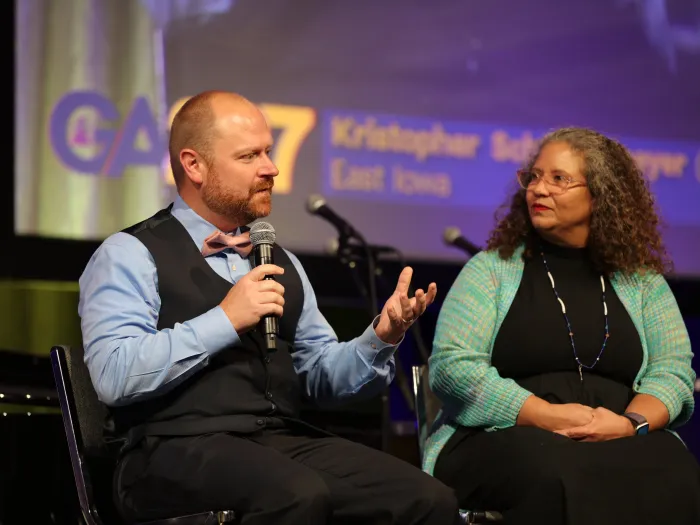
Scott Kindig of Susquehanna Valley Presbytery spoke before the committee to advocate for both of the committee’s final items of business, ORD-04 and ORD-02. ORD-04 would allow newly elected ruling elders to serve at the mid council level without a mandatory term of service in their own congregations first. Kindig, who is a ruling elder as well as a pastor’s spouse and church employee, pointed out that some church members may be precluded from serving as ruling elders in their own congregation due to their own church employment status or their relationship to church employees. This overture, which Kindig wrote, would still allow such people to serve at the presbytery or synod level.
The Advisory Committee on the Constitution recommended against this overture, noting that there is no official rule against church employees or staff spouses from serving their congregations as ruling elders. Kindig acknowledged his own ignorance of some of the constitutional and polity matters that ACC addressed, which led to several committee members suggesting that a study of some sort might be more appropriate than an overture that moves forward with such a significant change. One committee member proposed a substitute motion recommending such a study, but both the substitute motion and the original overture failed to pass committee.
ORD-02, meanwhile, proposed changes to several section headings in the Book of Order that would clarify they refer specifically to Ministers of Word and Sacrament and not other ordained offices of the church. In this case, the ACC praised the desire for precision in clarity and recommended the overture be approved. After some questions and back-and-forth about the impact of "shall" vs. "may" and section shifts in the Book of Order, the committee ultimately voted overwhelmingly to approve the overture.
Lohrenz closed the committee's final day of business the same way she opened it, offering words of gratitude and praise to the committee members for their dedication and efforts over the course of the week. She also took a minute to directly address the committee's Young Adult Advisory Delegates, assuring them that their service was essential and "not symbolic" and then took time to recognize each member of the committee's support staff.
After three long days spent together on Zoom, members of the Committee on Theological Education and Ordination will have the opportunity to greet each other in person, as they join hundreds of other commissioners at the in-person plenary portion of the General Assembly, which begins this weekend in Milwaukee.
You may freely reuse and distribute this article in its entirety for non-commercial purposes in any medium. Please include author attribution, photography credits, and a link to the original article. This work is licensed under a Creative Commons Attribution-NonCommercial-NoDeratives 4.0 International License.