Racial Justice Committee votes on three orders of business on first day of General Assembly
The committee voted Monday to approve two overtures and refer one to the Office of Presbyterian Life & Witness
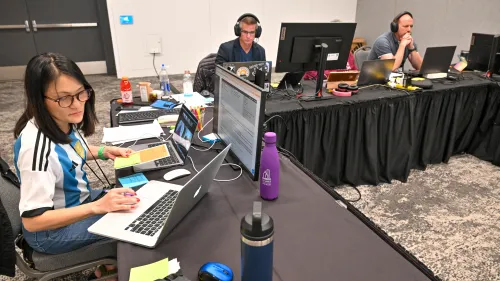
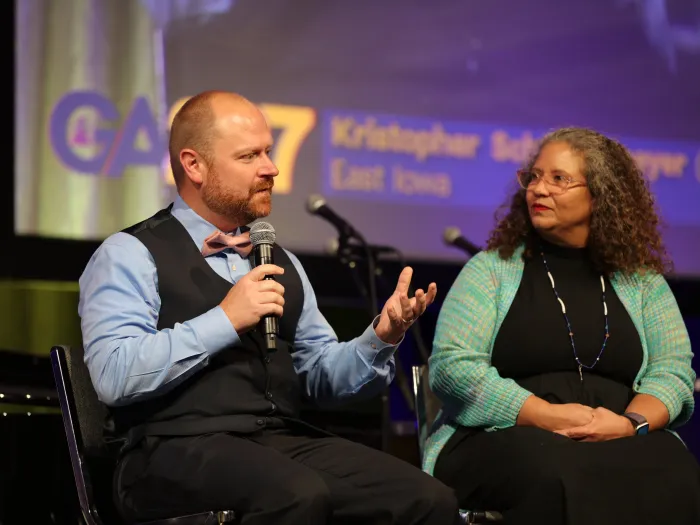
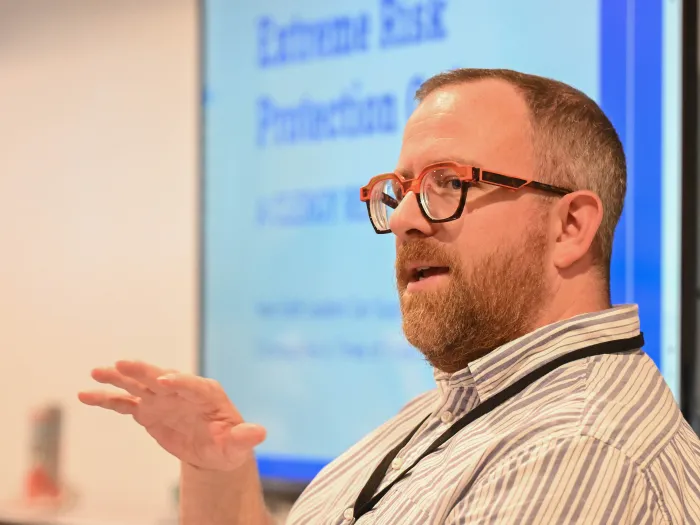
Over the course of their first day together on Monday, the Racial Justice Committee voted on three of the four overtures brought forward for consideration. With Patricia Bligen Jones of Charleston Atlantic Presbytery at its helm as Moderator, the committee heard presentations from three representatives of REAC, the Racial Equity Advocacy Committee. Each resource person spoke on one of the presented overtures.
Shani McIlwain spoke on RAC01, an overture that recommends the formation of a special committee on African American ecclesiastical repair. She brought up the theme of this year's General Assembly gathering — persevering toward wholeness — clarifying that, "If that is truly our theme, then we must ask ourselves an honest question: wholeness for whom?" McIlwain told her audience that their shared goal was ensuring that African American congregations, 43 years after the reunion in 1983, were not merely surviving, but thriving.
Following McIlwain, the vice chair of REAC spoke on RAC02, the resolution to review implementation of the 2022 Black Women and Girls Task Force Report. "The work of the task force was thoughtful, rigorous and deeply faithful," Kymberlaine Banks declared. "Ultimately, this is about more than one report — it is about aligning our actions with our values. REAC is asking the church to slow down just enough to name where we are … and to recommit to the work with clarity.”
Before opening the floor to motions on orders of business, the committee heard the Rev. Jermaine Ross-Allam, director of the Center for the Repair of Historic Harms, speak on RAC03, a resolution on Liberia Project 180. Ross-Allam offered context to the overture and outlined its three main goals: firstly, to clarify the origins of the nation of Liberia itself through researching why and in what manner Presbyterians cofounded the American Colonization Society; to research and understand how the colonial manner in which the nation was founded continues to contribute to conflict in Liberia and in the U.S. on a social level; and to better grasp how the teachings of missionaries may have aided in the demonization of African religion in Liberia to such a degree that there are social, political, and spiritual dissensions today.
Much of the discussion between committee members revolved around the necessity of referral. Does the committee recommend referring this project to the Office of Presbyterian Life & Witness, or approve the overture as it is? Will referring the project to PL&W mean that the process is stretched out; would the work be done quicker if passed with the current language? These were the kinds of conversations occurring during committee discussion; these were the most poignant question in regards to RAC01 and RAC03.
As discussion on RAC01 wound down, committee members were in agreement that this work must be undertaken — but by whom? Was a special committee really necessary? Committee members asked questions of each other, of their moderator, and of REAC, whose representatives were able to clarify that they and the National Black Presbyterian Caucus were in favor of referring the overture to PL&W. Another commissioner, from San Jose Presbytery, voiced her resolution to vote against the referral, and instead re-work it with REAC and the National Black Presbyterian Caucus to ensure that authority was appropriately shared in amending the overture. In the end, the committee was split: a motion to refer the overture to Presbyterian Life & Witness, lifted up by a commissioner from Illinois Presbytery, passed with 36 votes in agreement and 21 against. The committee voted to refer RAC-01 to PL&W.
Once the vote concluded, before moving on to the next order of business, Vice Moderator Steve Watts of Inland Northwest Presbytery grounded the group with prayer. This was done after each order of business.
In contrast to RAC-01, the approval of RAC-02 was swift. A motion to approve RAC-02 was made by a commissioner from New York City Presbytery. The item was put to a vote, and, with 56 votes in favor and two against, the motion to approve RAC-02 was passed.
The final order of business for the day was RAC-03, the overture dealing with Liberia Project 180. A motion to refer the overture to Presbyterian Life & Witness was made.
Once again, all conversation turned toward the necessity and efficiency of referring this work to Presbyterian Life & Witness. Questions regarding causation, current scholarship, and whether the Racial Equity Advocacy Committee agrees with the Unification Commission's recommendation to work with PL&W were discussed.
Ross-Allam was called on once more, as commissioners asked for clarification. He spoke of the foundational work already done, and shared with the committee that the Center for the Repair of Historic Harms has been working with a team of indigenous Liberian researchers to conduct both qualitative and quantitative study. The goal of this project is not to cast blame, but rather to "name [Presbyterians'] role in the conflict, and in doing so, encourage others to do likewise," Ross-Allam explained.
The vote was taken, and, with 15 votes in favor and 43 against, the motion to refer RAC-03 to PL&W failed.
A motion was then made to approve RAC-03 as it was written. With 57 in favor and two in opposition, the motion to approve RAC-03 was passed.
And, with that, the Racial Justice Committee's first day of meeting came to a close. Before commencing closing worship, Vice Moderator Watts tied up the day's business with a conclusory prayer of gratitude and encouragement.
The three commissioners chosen to review the minutes of the Racial Equity Advocacy Committee stayed after worship to meet with Committee Parliamentarian Seth Normington of Nevada Presbytery to discuss their review of the 15-page-report. RAC-MIN-01 would be the opening matter of business on Tuesday.
You may freely reuse and distribute this article in its entirety for non-commercial purposes in any medium. Please include author attribution, photography credits, and a link to the original article. This work is licensed under a Creative Commons Attribution-NonCommercial-NoDeratives 4.0 International License.