This month in Presbyterian history
A conference in Edinburgh, a two-week-long celebration, and a visit to the World's Fair
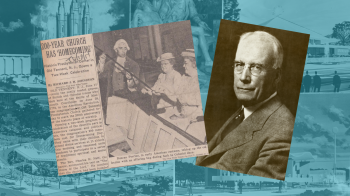
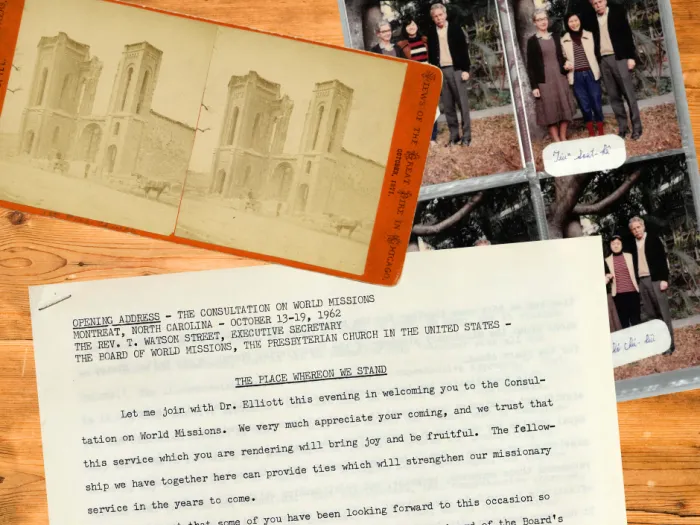
On June 14, 1910, three delegates spoke at the opening session of the World Missionary Conference in Edinburgh: Lord Balfour of Burleigh, President of the Conference, bringing greetings from His Majesty the King; Randall Thomas Davidson, the Archbishop of Canterbury, on “The Central Place of Missions in the Life of the Church”; and Robert E. Speer, secretary of the Board of Foreign Missions of the Presbyterian Church in the United States of America.
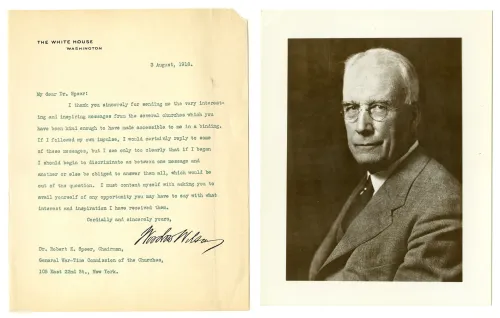
In 1891, while in the middle of his studies at Princeton Theological Seminary, Speer was recruited by the Presbyterian Board of Foreign Missions to act as their secretary. He left his academic career and served with the Board until his retirement in 1937. A decade prior to his retirement, Speer had been elected moderator of the General Assembly of the Presbyterian Church. A native of Huntingdon, Pennsylvania, Speer became a key administrator and strategist for one of the largest denominational mission agencies in the nation — positions and duties that had him writing to President Woodrow Wilson in 1918. In his reply, Wilson thanks Speer "for sending me the very interesting and inspiring messages from the several churches which you have been kind enough to have made accessible to me in a binding."
Speer was also known to be a compelling orator, and his address at the World Missionary Conference is evidence of this. “Our corporate experience testifies to the headship of our Lord as the most real fact in our common life, and we know ourselves to be gathered here this evening … because He has been governing our ways and is assembling us here in His name,” Robert E. Speer said in his speech. “I am to speak this evening of this conviction, that Jesus Christ Himself is the Leader of the Missionary Enterprise. There is nothing that one can say that is not already familiar and dear to our hearts. I can only simply bring back our minds to that with which we are already familiar regarding — first the fact, and second the way, and third, the meaning of this great leadership, which is our dearest and deepest conviction.”
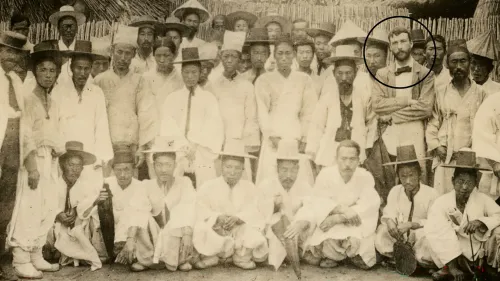
This conference, the meetings of which were held in the Assembly Hall of the United Free Church of Scotland, was unique. Only official delegates from denominational mission societies were granted permission to attend, and the conference was one of the earliest that had representatives authorized to speak for their denominations. In terms of speaking, speeches were limited to seven minutes; consultation, planning, and discussion were the order of the day. The conference’s purpose was not to educate the public on mission work, as past events had been. Rather, the delegates were focused on framing the joint actions they needed to perform in the world to further the proclamation of the Gospel. They were working toward a shared goal: the plan for the future of missions near and far.
With 1,355 delegates attending from missionary societies in the British Isles, Europe, Canada, the United States and Australia, the World Missionary Conference in Edinburgh helped give rise to the modern global ecumenical movement.
In June 1951, the Old Tennent Church in Freehold, New Jersey, hosted a two-week-long celebration in honor of its 200th anniversary. “Amid the neatly tended graves of British and Colonial troops who died here at the Battle of Monmouth Courthouse on June 28, 1778, in the American Revolution, the congregation of Old Tennent Presbyterian Church gathered today to mark the 200th anniversary of the historic place of worship,” the New York Times reported by way of writer Richard J. H Johnston.
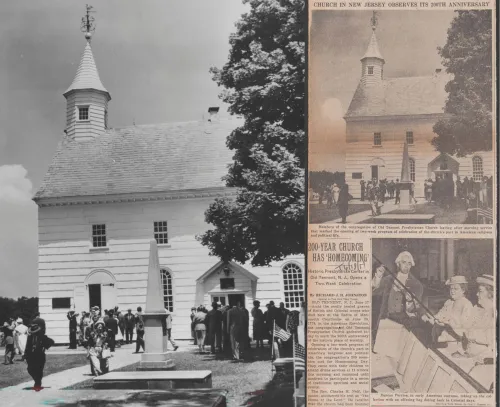
On June 17, the church’s 200 members gathered in the sanctuary for Homecoming Day — “They came with their children to attend divine services at 11 o’clock this morning and remained until sundown,” Johnston shared. The pastor of the congregation, the Rev. Charles H. Neff, offered a sermon titled “The House of the Lord,” in which he recalled the founding of the church by the Rev. William Tennent, its first pastor, “and that it was built of wood and stone by pre-Revolutionary artisans.” At the back of the church stood young men dressed in Colonial costumes, wielding poles upon which collection bags were mounted. The parishioners all brought box lunches to get them through the day of services, which marked the opening of their two-weeks of commemorative programming.
This year, another church begat by William Tennent is celebrating their 300th anniversary — the Neshaminy-Warwick Presbyterian Church in Warminster, Pennsylvania is hosting various celebrations during the course of the year. This past weekend, on May 30, the William Tennent House Association hosted a banquet in celebration of the legacy of William Tennent, pastor and founder of both Old Tennent Presbyterian Church and Neshaminy-Warwick Presbyterian Church as well as the founder of what many consider the first college in Pennsylvania, the Log College at Neshaminy. This celebration of the legacy of William Tennent and the mark he left took on additional layers as a celebration of America250, a commemoration of the 300th anniversary of the church he founded, and an opportunity to draw awareness to the mission of the organization that shares his name.
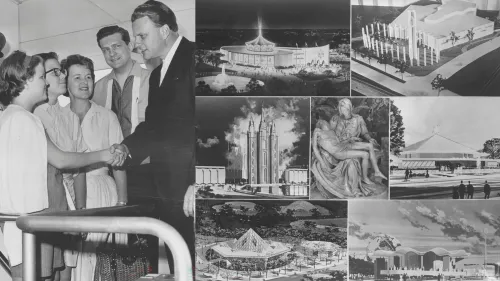
In June 1964, millions flocked to the Big Apple to experience the New York World’s Fair. In fact, the 12 millionth visitor was greeted by famed evangelist Billy Graham — "the mark was reached when Lynn and Robert Simmons of Clifton, Iowa, shown here with their parents, passed through the gates.”
Along with millions of visitors, representatives of 18 denominations and agencies were present at the Fair, where they gathered in the Court of Protestant Pioneers to participate in the cornerstone-laying ceremony for the new Protestant and Orthodox Church Center. “Sponsored by the Protestant Council of the City of New York, the center will include exhibits by a number of Protestant bodies,” the press release published by the Religious News Service noted. “It also will have a reception-information area under auspices of the Protestant Council and the National Council of Churches.” Present during the ceremony were representatives of religious groups that had leased space in the new center, which included members from the American Baptist Convention, Protestant Episcopal Church, Methodist Church, UPCUSA, Reformed Church in America, and more.
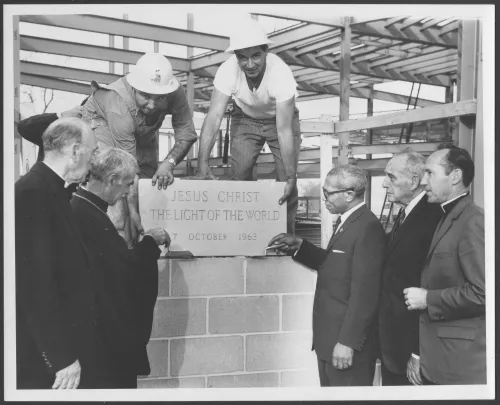
The cornerstone itself was inscribed with the center’s theme: “Jesus Christ — the Light of the World.” Watching workmen adjust the 15-by-31-inch limestone block, from left to right, are: Dr. John Sutherland Bonnell, pastor emeritus of Fifth Avenue Presbyterian church in New York who is honorary president of the Protestant Council and co-chairman of the Steering Committee for the Center; Greek Orthodox Metropolitan Germanos of Hieropolis; Dr. M.L. Wilson, pastor of Manhattan Convent Avenue Baptist church; Robert Moses, president of the World's Fair Corp., and Dr. Dan M. Potter, Protestant Council Executive director.
The cornerstone laying of the $3 million center was just the tip of the iceberg in regards to the Christian presence at the 1964 New York World’s Fair — there were a number of Christian exhibits scattered across the event. “Spires, towers, crosses, famous religious art objects, and light beams reaching skyward will project the Christian message to the 70 million people expected to visit the 1964-65 New York World's Fair,” the Religious News Service reported. The religious pavilions at the fair spanned more than seven acres and included the Vatican Pavilion, the Roman Catholic pavilion — which featured Michelangelo’s “Pieta,” which the late Pope John XXIII had agreed to send to the fair for display — the Protestant Center, the pavilion of the Church of Jesus Christ of Latter-day Saints, the Billy Graham Pavilion, and the Christian Science Pavilion.
Enjoy these glimpses into Presbyterian history in years past? Donate to the PHS Annual Fund, which supports the efforts of the Presbyterian Historical Society to collect, preserve, and share the past in order to transform your current perspective on church history.
You may freely reuse and distribute this article in its entirety for non-commercial purposes in any medium. Please include author attribution, photography credits, and a link to the original article. This work is licensed under a Creative Commons Attribution-NonCommercial-NoDeratives 4.0 International License.