A timely talk on Christian nationalism
Dr. Miranda Zapor Cruz of Indiana Wesleyan University unpacks a concerning topic for the Synod of the Covenant
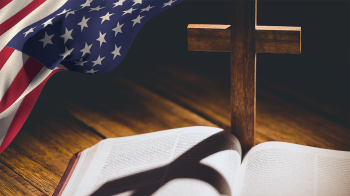
LOUISVILLE — The upcoming 227th General Assembly will consider overtures to repudiate Christian nationalism and to approve social witness policy entitled “Standing Against White Christian Nationalism.”
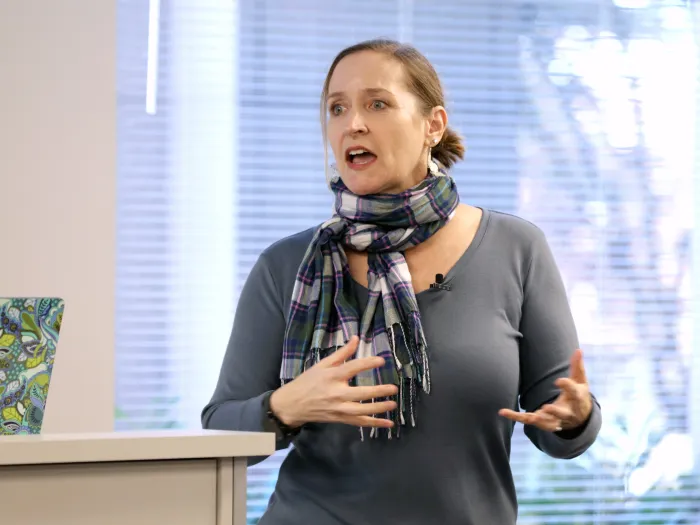
Thus, last week’s webinar that Dr. Miranda Zapor Cruz offered to the Synod of the Covenant couldn’t have been timed any better. Cruz, Professor of Historical Theology at Indiana Wesleyan University, titled her talk “Christian Nationalism: Beyond the Buzzwords.” The 97 minute presentation can be seen here.

The synod’s executive, the Rev. Dr. Chip Hardwick, hosted the event, part of a series on Christian nationalism being offered by the Synod of the Covenant. The next in the series will feature Dr. David Congdon, a lecturer at the University of Kansas. It’s set for 10 a.m. through 11:30 a.m. Eastern Time on June 10.
Cruz noted the term “Christian nationalism” has been around for a century or more. One definition is it’s the belief that the United States is or ought to be a Christian nation, that “select Christian moral convictions ought to be the foundation of American law,” Cruz said.
Christian nationalism also asserts that Christian institutions “should have privileges or favor, officially or unofficially,” she said, including parachurch organizations and Christian universities.
Here’s what it’s not, according to Cruz: It’s not patriotism, which “can be a wide and welcoming ideology.” It’s not evangelism because “It’s not interested in people becoming Christian,” Cruz said. “The goal is for people to conform their behaviors to Christian ideals.” Christian nationalism is not “any Christian influence in politics at all,” she said, citing U.S. Senate candidate James Talarico, who was a student at Austin Presbyterian Theological Seminary and whose “Christian faith is clearly influencing his politics,” Cruz said, “but his approach is not Christian nationalism.” Finally, Christian nationalism is not “Christians who are politically conservative.”
Christian nationalism comes in three types, she said: Ethno-Religious, Christian Reconstructionism and Dominionism.
Ethno-Religious Christian nationalism, Andrew L. Whitehead and Samuel L. Perry say in their “Taking America Back for God,” is “a cultural framework — a collection of myths, traditions, symbols, narratives and value systems — that idealizes and advocates a fusion of Christianity with American civic life.”
In her own book, “Faithful Politics: Ten Approaches to Christian Citizenship and Why It Matters,” Cruz says that “significantly, the ‘Christianity’ in Christian nationalism refers to culture, history and morality, not necessarily the theological tenets of Christian orthodoxy.”
The strand of Christian nationalism can be remembered by this formula: Christian = Heritage + Morality.
Contemporary influences include immigration, where “a lot of enforcement has direct reference to preserving heritage or a way of life” and “protecting the homeland,” she said. “There is something about America so tied with Western European Christian heritage that immigration from other places is a threat to that.”
While living in Texas, Cruz said she was “taken aback” around the Fourth of July “by all the churches advertising their God and Country services. They had patriotic bands and their campuses were lined with American flags. It was literally displacing Christian worship.”
Christian Reconstructionism “teaches that America needs to be reconstructed as a theonomy in which biblical law is the template for civil law,” Cruz wrote. It “requires revolution, a radical reordering of society that is not merely an application of Christian beliefs or values to the Constitution, but a rewriting of the Constitution itself to codify biblical law.”
The equation for this strand of Christian nationalism is Christian = Biblical Law.
Christian Reconstructionism “was fringe until very recently,” Cruz said. It’s incompatible with Christian faithfulness because “it makes humans responsible for bringing God’s kingdom on Earth.”
It also misinterprets the New Testament, she said. “If our mission is to make disciples, this approach cannot accomplish that,” Cruz said. “If anything, it accomplishes the opposite by making people resentful of Christianity and making it about law and politics.”
She answered a participant’s question about patriarchy by saying proponents of Christian Reconstructionism “would say patriarchy is God’s design.”
“There’s a re-emergence of Christian patriarchy right now” in places including the Pentagon, she said. “Some piece of that is coming from this Christian Reconstructionism kind of influence.”
The third strand, Dominionism, is also known as the Seven Mountains Mandate. Similar to Christian Reconstructionism, it’s the idea that, as Cruz writes, “Christian believers are called to not only preach the gospel and win converts to Christ but also to establish the kingdom of God on Earth.”
The key difference between the two is that for Dominionists, “the conflict between society’s laws and values and those of the kingdom is the result of demonic influence that only Christians can recognize and cast out,” Cruz wrote.
She displayed this equation to describe Dominionism: Christian = Spiritual Dominion à Temporal Dominion.
According to the Seven Mountains Mandate, which dates back to the 1970s, “the way to gain spiritual dominion is by gaining temporal dominion” by getting like-minded people elected to office, Cruz said. The idea of the New Apostolic Reformation movement “is that new apostles ordained by God have the authority to lead followers in claiming this spiritual dominion.”
It’s a global network, Cruz said, and because it’s global, it’s diverse both racially and culturally. “That can be confusing,” she said.
Addressing what’s wrong with Christian nationalism, Cruz offered at least three ideas:
- Pride — Christian nationalism “claims humans have the ability to bring God’s kingdom to Earth and that God can’t do it without us,” she said.
- Power — Christian nationalism “seeks power and control, not meekness and service, and accepts the enemy’s offer that Jesus refused.”
- Fear — Christian nationalism is “rooted in the fear that society will collapse without us and promotes fear of any ‘other’” — especially non-white people, Cruz said.
“It’s disgusting, and it’s also deeply un-Christian,” she said. Christianity in fact “has no nation and no people group. The only requisite for being a Christian is professing Christ as Lord and living like it.”
Faithful alternatives to Christian nationalism include:
- Maintain prophetic distance, as Nathan did when confronting David. “Don’t be wrapped up in partisanship or with a political leader or movement,” Cruz said.
- Safeguard religious liberty. “The liberties Christians in the United States enjoy are only as safe as the liberty everyone who’s not a Christian also enjoy,” Cruz said.
- Consider the social implications of faith. “Loving our neighbor is not just a feeling we have,” she said. “It can have policy implications.”
- Appreciate sphere pluralism. American society has many spheres, including the church, the government, schools, family and the media. “Each has a role to play in a flourishing America,” Cruz said.
You may freely reuse and distribute this article in its entirety for non-commercial purposes in any medium. Please include author attribution, photography credits, and a link to the original article. This work is licensed under a Creative Commons Attribution-NonCommercial-NoDeratives 4.0 International License.