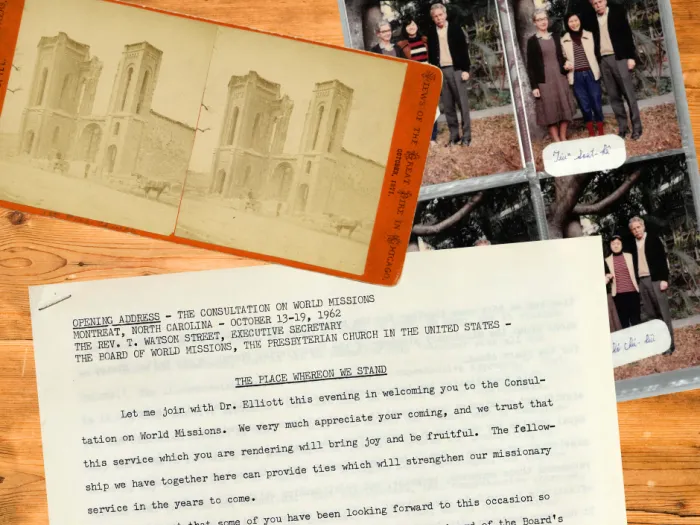
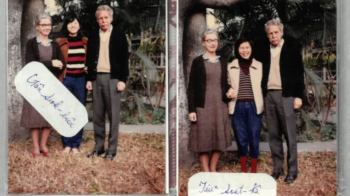
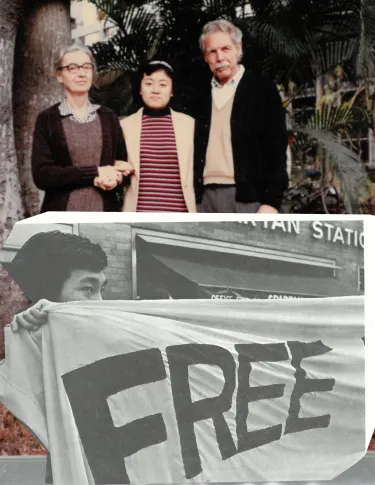
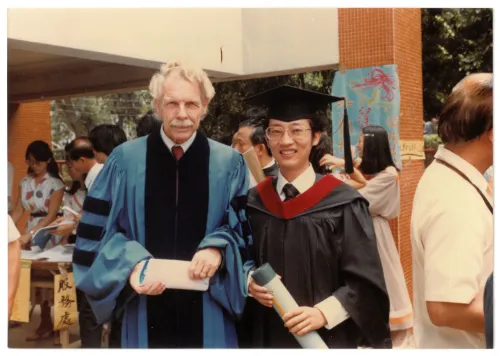
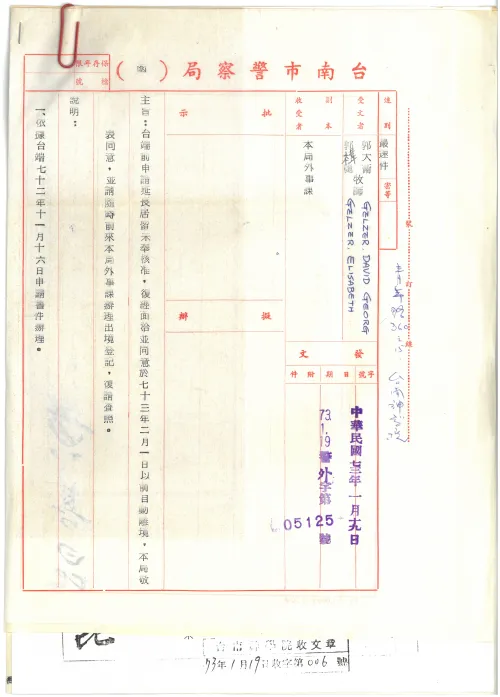
David and Elisabeth Gelzer leave Taiwan, 1984
The final installation in a series contextualizing mission-focused GA227 overtures
The Presbyterian Historical Society continues its series contextualizing items of business before the 227th General Assembly. Here we turn to the overtures addressing the restructuring of the PC(USA)’s World Mission and calling for a new missiological statement.
In the global political transformations following the Second World War, Presbyterian mission workers found themselves in between declining imperial powers —chiefly Great Britain and France — and the national churches of newly independent nations. As the people who they worked alongside, harvested crops with, taught, and were taught by demanded independence — in Cameroon, in Lebanon and Syria, in Iraq and Iran — mission workers and administrators found the centralization of authority over missions in New York City and Atlanta to be incompatible with the new age. And so missions changed.
Many stories of Presbyterians finding their way through an utterly changed political reality can be told. Our third installment examines the decade two Presbyterian missionaries spent working for the church of Taiwan.
David and Elisabeth Gelzer leave Taiwan, 1984
David and Elisabeth Gelzer were already mid-career mission workers by the time they got the call to serve at Tainan Theological College, at the behest of the Presbyterian Church in Taiwan (PCT).
In a series of recordings in 1996, David Gelzer narrated the beginnings and ends of their time in Taiwan, a period of tumult in the Church and in a society under martial law. The couple spent their time of service without learning Taiwanese, so as David says, “We were ignorant of many things that became evident only as we went along.”
Their work inside the PCT would be bound up with Taiwanese struggles over religious freedom, free association, free speech, and independence, caught as the island was between two superpowers, the United States of America and the People’s Republic of China.
Taiwan had been fleetingly independent in 1895, in between periods of Chinese and Japanese occupation. Imperial Japan would remain in power on the island until 1945. Victorious Allies in 1945 promised the Chinese Nationalist leader Chiang Kai Shek that he and his party, the Kuomintang (KMT), would win Taiwan.
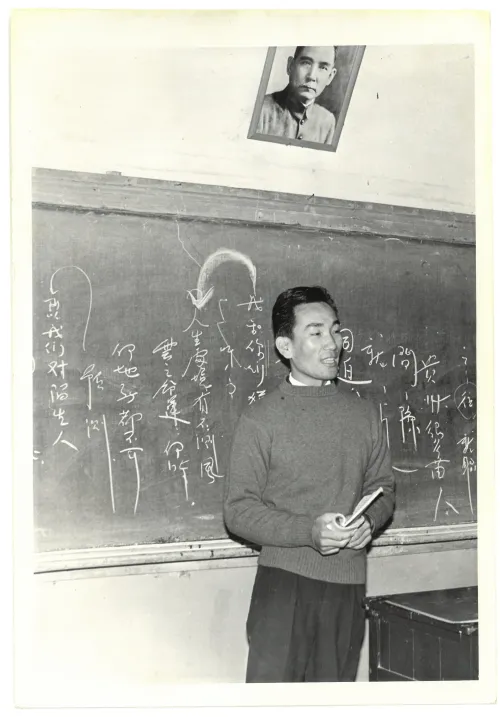
The KMT began martial law in 1947 with a campaign of “white terror.” Among the massacres is one now known as 228. On February 28, 1947, Nationalist troops murdered some 20,000 people, focusing on “the educated elite” — pastors, lawyers, and teachers. In Gelzer’s telling, this was a war of occupation and subjugation: “The intention of Chiang Kai Shek and his group was to subdue the Taiwanese.” The Nationalists changed the official language of the island to Mandarin. Churches were required to worship in the state language, and no other.
After Communist victory in the Chinese Revolution, more than a million mainland Chinese Mandarin speakers fled for Taiwan. As Chiang and his army fled, they pillaged Beijing’s museums, shipping some 10,000 crates of artifacts to Taipei.
Chiang’s plan was that the setback was temporary — the Republic of China run from Taipei was a government in exile; it only followed that the party would regroup and reclaim the mainland. The dominant power in Taiwan, then, was an imperial one — a group wanting to dominate a place, and then return home.
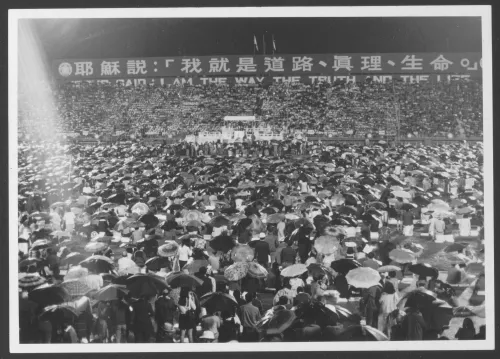
The ruling party was conservative and, though not officially Christian, was strongly influenced by Protestant and Catholic churches. Chiang himself was Methodist — his state funeral was a Christian burial, broadcast on all TV stations. Six months after that, the evangelist Billy Graham held a revival in Taipei. For five days, from October 29 to November 2, 1975, he baptized people by the stadium-full. Some 40,000 Taiwanese rededicated themselves to Christ that week and went looking for churches to join. The only institution that could accommodate them, in Gelzer’s telling, was the 175,000-member strong Presbyterian Church in Taiwan (PCT).
The PCT was the fruit of foreign mission work. English and Canadian Presbyterians had set up two separate missions beginning in 1865 — the English in the north, the Canadians in the south, separated owing to the island’s topography. Self-government came in the form of two presbyteries: the southern established in 1896, the northern in 1904.
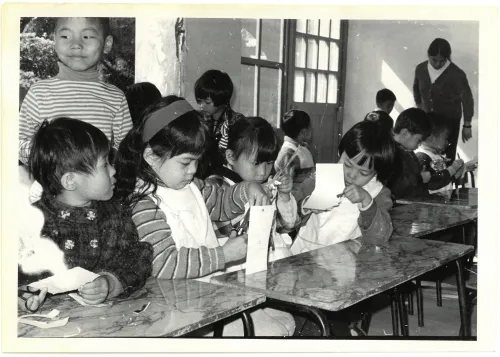
These were united into a Synod in 1912. Self-sufficiency continued to grow, until by the 1950s no foreign missionary held authority in the PCT — not even at the local level as pastor of a church, though mission workers were still welcomed at schools and seminaries.
As the international community recognized the legitimacy of the People’s Republic of China, and Taiwan was relieved of the “China” seat on the UN Security Council, political change came to the Church. In 1971, the PCT issued a theological statement affirming the human right of self-determination, and affirming the plurality of the island’s people. In Gelzer’s telling, the PCT’s attitude was “we are composed of various ethnic groups and late arrivals, but we are one people on this island and we have our own destiny to fulfill.”
Though carefully anti-communist in tone, the statement called on KMT leaders to immediately hold fully-democratic elections. In this way, the PCT offended every power — rebuking China, the ruling party, and the United States in equal measure. Through Gelzer’s eyes, this opened the period of the KMT’s “persecution of the Presbyterian Church. Because it saw it as a threat.”
The Gelzers, among the late arrivals, came in the middle of the action. Taiwan in the 1960s and 1970s saw a massive influx of United States aid and investment. The “Taiwanese miracle” of economic development in Gelzer’s telling “came at the expense of the people.” Concessions to U.S. and Japanese firms permitted subhuman working conditions, child labor, and environmental exploitation.
Movement against the regime, however, came to a head with assaults on the freedom to worship. In January 1975, government troops marched on indigenous Christian churches in the north of the island, interrupting Sunday worship. They found Bibles and hymnals in native tongues, confiscated them, and repeated the official order for Mandarin-language worship.
In response, the PCT issued a second public statement. “Our Appeal” addressed the economic and social conditions of the island, again asserted that human rights are ordained by God, and appealed against the gradual encirclement of the Church by the state.
State response was overwhelmingly negative. The PCT was a target, both for asserting universal values outside the state, and for its longstanding international connections. Regime newspapers — there was no other kind — issued articles condemning the PCT, telling it, “The business of the church is to take care of the spiritual things, political responsibility lies in the hands of the government and the authorities,” says Gelzer. He and other PCT figures had their mail confiscated and shredded and their phones tapped.
In Gelzer’s telling, in 1979 and 1980 the PCT was “totally isolated.” Other Christians were hostile. Many had come over with Chiang Kai Shek and had adhered to his way of thought. Southern Presbyterian missionaries held to the wishes of these Mandarin-speaking expat communities, and by and large did not speak out against KMT suppression.
At Tainan Theological College, students and faculty organized pro-independence groups, which were swiftly infiltrated by government spies. A 2019 report of Taiwan’s Transitional Justice Commission revealed that 18-year-olds were recruited by the government to enroll in colleges strictly to serve as informers.
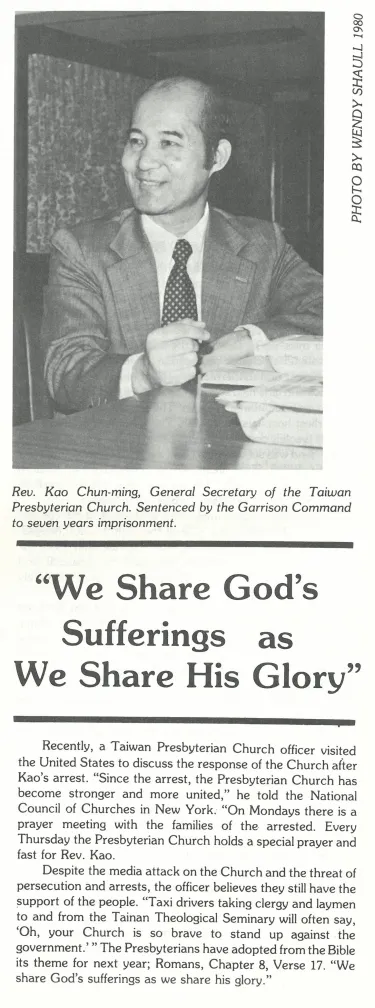
And immediately following the General Assembly of 1980, Dr. Kao Chun-ming, general secretary of the PCT, was imprisoned, along with 14 other activists. Presbyterians started prayer vigils throughout the island; visitors were sent to negotiate for Kao’s release, among them UPCUSA Stated Clerk William Phelps Thompson.
International pressure did not, however, bring about Kao’s release, and as 1980 turned into 1981, the church questioned whether their general secretary would run for re-election from prison. The government was at work on the proceedings, paying 49 delegates from tribal areas in the north 50,000 Taiwan dollars each to vote against Kao. In the end, the vote came in 233 for Kao, 49 against; only the bought voters opposed him.
Another tampered election led to the Gelzers’ expulsion from Taiwan. The KMT promised partially open elections, scheduled for December 1983. Voters would have a choice between the KMT and two or three smaller parties. As Gelzer describes them, “These were like wholly owned subsidiaries of the government — they had their headquarters in the same building — their platform was identical with the platform of the Kuomintang.”
Activists suggested to Kao's spouse, Kao Lee Li-chen, that she run for a seat in the Legislative Yuan. She turned to a small group of confidants, Gelzer among them, to ask what to do. While many counseled her to stay away from the regime, Gelzer told her, “Yes, I would say if you have the courage, I would go ahead.” Mrs. Kao developed a campaign, barnstorming the south, usually speaking for only 10 minutes but to thousands of people. Returning to Tainan just before the election, her campaign held a rally in a public square one night, and David and Elisabeth went down into the large crowd, amid banners and loudspeakers. “It was dark," Gelzer remembers. "But there are cameras that can take pictures without flash.”
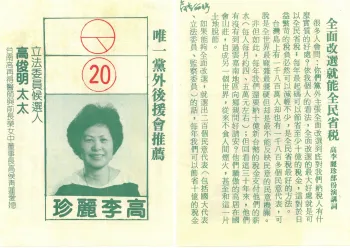
The Gelzers were photographed by KMT spies and their images were published in the regime newspapers, identified as Europeans supporting a political rally — a forbidden act. That month, November 1983, their residence permits were up for renewal. This time, the process took longer than normal.
On December 3, the Gelzers watched election returns come in on TV. Results from the south were delayed. Finally Mrs. Kao’s precinct came in — the independent had lost by 17 votes in a constituency of 175,000 voters. Gelzer holds that “the KMT tinkered with the vote,” and that, in reality, Mrs. Kao won by about 20,000 votes. Her loss elevated her public profile, and led eventually to her husband's release " on good behavior" in 1985.
The system of state repression was untenable. Martial law ended in 1987.
David Gelzer’s works of witness for the causes of religious freedom and Taiwanese independence were ordinary. He helped set up meetings, drafted statements, wrote and translated articles and letters. His forced departure was extraordinary.
In December 1983, the Gelzers’ permits expired. One night, their neighbor and boss, Dr. Xiao, was visited by the police, who suggested that the Gelzers resign their positions at TTC and return to the United States to avoid trouble. Dr. Xiao stepped across their shared alleyway and relayed the news to David.
David replied that this would only be possible under one of three conditions. The first option would be that his employer, the seminary, must find him “morally and intellectually unfit to teach” and fire him. The second option was the PCT terminating their relationship with him as a mission coworker.
Then there was the third condition. “The regime has to tell me," Gelzer told his neighbor. "The police have to say to me, you are out. I didn’t come here as a tourist. I’m not going as a tourist. I didn’t come of my own volition. I came at the request of the Church and the Seminary. Therefore, I'm here until one of the three of you tells me, 'out you go.' And I'll be gone tomorrow."
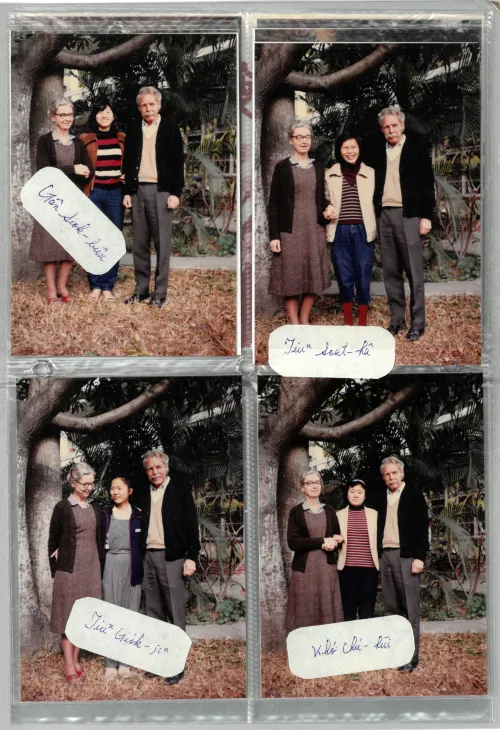
The Gelzers were initially given 72 hours to leave Taiwan — this was extended to 10 days to allow them to finish grading final exams. Their expulsion was announced at a TTC end-of-semester celebration to their students’ shock. In their personal papers, which live in the archives of the Presbyterian Historical Society, the expulsion order sits alongside an album of photos of their students.
After their expulsion, the Gelzers itinerated, traveling to churches, writing, and making radio appearances to relate to outsiders the conditions of repression that the Presbyterian Church faced in Taiwan. The 1984 General Assembly, for its part, would pass an overture expressing concern over the continued imprisonment of Dr. Kao.
On David’s death in 2016, the Presbyterian Church of Taiwan remembered him as a “staunch advocate and activist of self-determination, political freedom and peace.”
The idea of “decolonizing” the mission relationship in Taiwan was, in 1984, not a germane idea. In the course of a little more than eight years, the Gelzers adapted to a political and social situation they weren’t briefed for, in languages they didn’t fully learn, and were governed by the laws regarding aliens. Despite their status as strangers, their work was to accompany their adoptive church, to walk alongside their peers in struggle and in joy, as friends. The regime that imprisoned their colleagues, and beat and gassed their students, was itself strange — imported from abroad. And the imperial relations that remained to be undone weren’t those between an Asian populace and its European helpmeets, but those between the government and the people it rules.
Learn more
Hollington K. Tong. (1961). Christianity in Taiwan: a History
David and Elisabeth Gelzer papers. Accession 07-0912
Michael Stainton. (2000). "Through Love and Suffering: The Role of the Presbyterian Church in Taiwan’s Democratization"
Taiwan Church News, January 2025, “As a Church under White-Terror Surveillance, PCT reports KMT’s Human Rights Abuses”
You may freely reuse and distribute this article in its entirety for non-commercial purposes in any medium. Please include author attribution, photography credits, and a link to the original article. This work is licensed under a Creative Commons Attribution-NonCommercial-NoDeratives 4.0 International License.