Presbyterian profile: The Rev. Harold Voelkel (1898-1984)
The story of a United Nations chaplain assigned to the POW camps during the Korean War
In the archives of the Presbyterian Historical Society there is a plaque fashioned from beer cans.
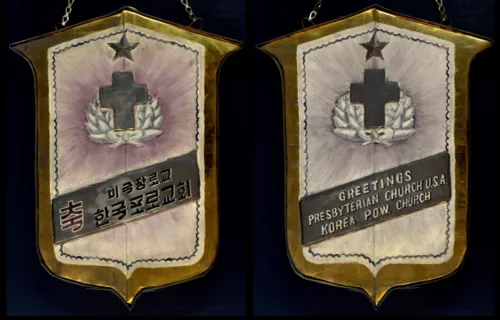
Both sides of the tin plaque are painted, portraying a message and icons. The message is the same — one side is in English, the other in Korean. “Greetings Presbyterian Church U.S.A. Korea P.O.W. Church,” the English translation reads. The banner text sits below a thick black cross, which is topped by a five-pointed star and cushioned by a pillow of white feathers. The artifact, which lives in the Museum Collection at PHS, includes a tag that reads: "Plaque made from tin cans by North Korean prisoners of war presented to the Board of Foreign Missions in appreciation of services of Chaplain Harold Voelkel."
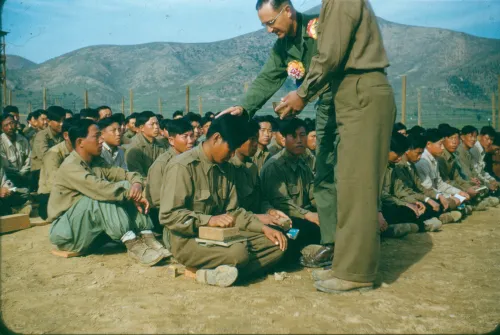
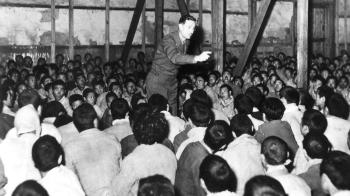
The Korean War — which sliced the peninsula into two — began in June 1950 and continued through July 1953. General MacArthur’s amphibious assault on Inchon just a few months into the conflict led to the capturing of over 150,000 POWs of the People’s Army of North Korea. Operation Chromite, this UN assault fronted by MacArthur, would lead to their retaking of Seoul two weeks later. During this time, Chaplain Harold Voelkel held services for those being held in POW camps. This plaque, made by the men he communed with, was sent to the church as an expression of appreciation for the service and devotion shown by Voelkel during the war.
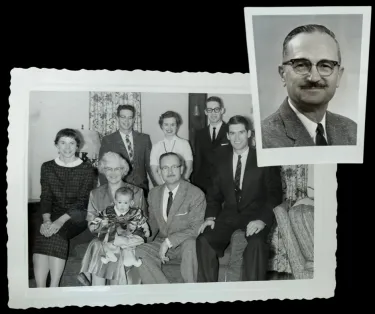
The Rev. Harold Voelkel was a native of Philadelphia. Born on Feb. 14, 1898, he joined the church at the age of 14, in 1912. Voelkel graduated from Moody Bible Institute in Chicago in the summer of 1922. In an essay written by his son, Jack Voelkel, we learn that Harold’s passion was evangelism. “Over the years he had trained generations of young Presbyterian missionaries how to do open-air evangelism,” Jack reminisces. “As a teenager, I had helped attract crowds in country villages by making a ‘joyful noise’ playing hymns on my trumpet.”
In 1929, after graduating from Princeton Theological Seminary and getting married, Voelkel left for Andong, Korea, where he and his new wife served together. He and Gertrude Elizabeth Swallen were wed the year before, on August 28, 1928.
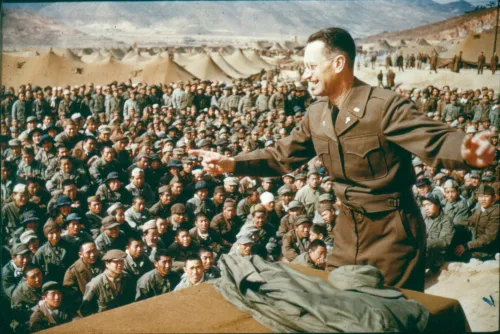
During World War II, Voelkel served as a chaplain, pausing his missionary service to work with the military. With the outbreak of the Korean war in 1950, he was once again pulled away from Andong for a chaplaincy amongst the Korean POWs. Voelkel and his team captured moments in the camps on film and sent them overseas to the Board of Foreign Missions for publication. In a March 1951 batch, his accompanying note reads: “We have 40,000 prisoners in my camp, divided into 7 compounds of about 5,000 plus, each. These pictures are all of different compounds.”
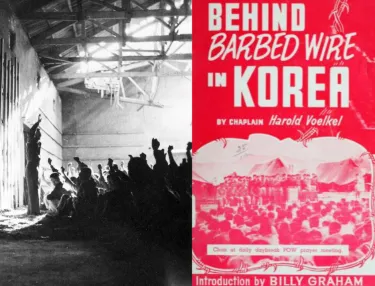
In his memoir, “Behind Barbed Wire in Korea,” the introduction of which was penned by popular evangelist Billy Graham, Voelkel wrote that, “The ministry to the POWs has been the happiest and I believe the most fruitful ministry of my life … a work among 150,000 men that eventuated by His grace in churches, Bible conferences, and Bible Institutes … God has guided, protected, and prospered all along the way. [God] has kept His hand so manifestly and wonderfully on this work that at times I break out into laughter at the marvel of it all — God saving, training, and inspiring men to radiant Christian lives behind barbed wire. It is another of His holy surprises.”
In 1961, the Religious News Service snapped an “unusual photograph taken in the office of Posun Yun, President of the Republic of Korea.” Voelkel and a handful of other churchmen from South Korea are pictured presenting “pictorial evidence of the growth of a native clergy from former Communist soldiers” to the President.
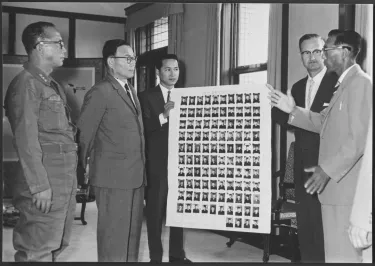
“The display shows the pictures of 104 North Koreans, former prisoners of war who have embraced Christianity, graduated from religious training schools and entered fulltime Christian service,” the caption reads. From left to right, the men in the image are identified as Chaplain Sukk-bong Yang, Chief of Chaplains of the Republic of Korea Army; President Posun Yun; an un-named man referred to as only “a secretary” holding one side of the display; Voelkel holding the other side of the display; and Jee-suh Pahk, an ordained minister of the Presbyterian Church in the Republic of Korea, at the far right.
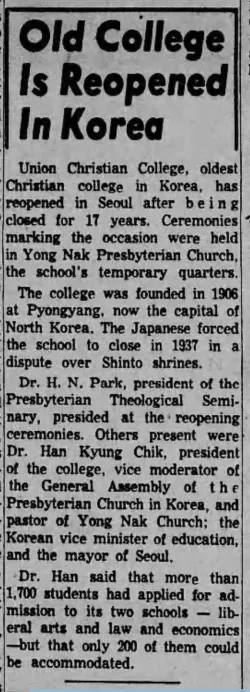
The final years of Voelkel’s service in Korea were dedicated to the re-establishment of what is now Soongsil University in Seoul. The previous iteration of the school had been founded in Pyongyang in 1905 as Union Christian College. A Presbyterian-led institution, and the first four-year university to be established in Korea, at its helm stood the Rev. Samuel Moffett, who founded the mission in Pyongyang a decade earlier, and the Rev. William M. Baird, who had been in Korea since 1891 and had started the Pyongyang mission’s schools in 1897. Union Christian College thrived, its school-body reaching toward 100 during its peak in the mid-1930s. The college also included schools for boys and girls, called Soongsil Academy, where Kim Hyong Jik — the father of Kim Il Sung — studied as a teen in the 1910s.
But in 1938, with the oncoming war threatening to spill over the horizon, the school closed its doors. The school’s president had left Korea two years earlier, after he’d been stripped of his position and confined to his home after an intense dispute regarding religious freedom and shrine worship. While Union Christian College never returned to its original home in North Korea, the Presbyterian church and its missionaries worked tirelessly to reestablish it in South Korea. Their labor culminated in the “re-opening” of the “oldest Christian College in Korea” in Seoul in 1954, according to a clipping from the Harrisburg (Pennsylvania) Evening News. Today, Union Christian College is Soongsil University, which continues the lineage of the original college in Pyongyang.
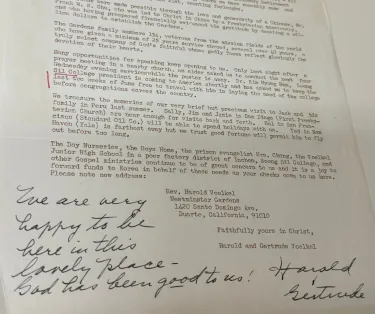
The Voelkels retired from missionary service in late June 1968. In one of their final “Dear Friends” letters, Harold Voelkel shares that the president of Soongsil College is headed his way, and “has asked me to keep the last two weeks of June free to travel with him in laying the need of the college before congregations across the country.” He concludes by saying that, writes that “The Day Nurseries, the Boys Home … the Voelkel Junior High School … Soon Sil College, and other Gospel ministries continue to be of great concern to us.”
There is a hand-penned message at the bottom left, perhaps written by Gertrude. “We are very happy to be here in this lovely place,” she writes. “God has been good to us!” Signed, faithfully yours in Christ, Harold and Gertrude Voelkel.
You may freely reuse and distribute this article in its entirety for non-commercial purposes in any medium. Please include author attribution, photography credits, and a link to the original article. This work is licensed under a Creative Commons Attribution-NonCommercial-NoDeratives 4.0 International License.