Maggie Kuhn, the wrinkled radical
Older Americans Month is celebrated every May
At the age of 65, Margaret Eliza Kuhn retired from the workforce.
This wasn’t of her own accord—she was forced to do so by her employer, the UPCUSA. It was part of company policy. That same year, she and five other women who had been pressured into mandatory retirement gathered in Philadelphia and titled themselves the “Consultation of Older and Younger Adults.”
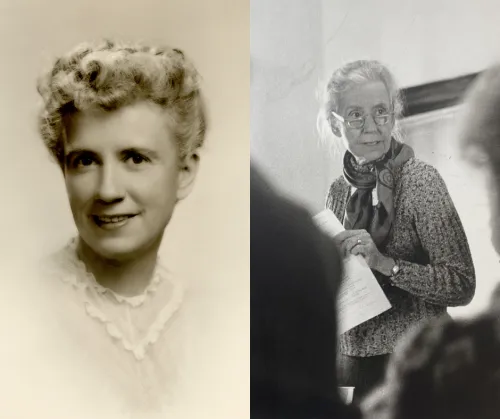
This name did not stick—the Consultation transformed into Kuhn’s Gray Panthers, a name given to them by a New York Times reporter in 1972. An advocacy organization founded in the interest of eliminating mandatory retirement and protesting the war in Vietnam, the Gray Panthers dealt with issues that affected folks at all ages—though they are best remembered for the fiery, outspoken, energetic old woman at the helm, Maggie Kuhn.
Maggie didn’t take up the mantle of activism in her golden years, as is often assumed. She was a lifelong activist who had spent decades fighting for human rights, social and economic justice, global peace, integration, urban renewal, and an improved understanding of mental health issues by the time the Gray Panthers came into being in 1970. She’d been affiliated with many service and advocacy groups, including the Memorial Society of Greater Philadelphia; Hospice, Inc.; the National Institute for the Seriously Ill and Dying; the National Senior Citizens Law Center in Washington, D.C.; the National Committee for Responsive Philanthropy; the Bread and Roses Community Fund; and the National Policy Center on Employment and Retirement in Los Angeles.
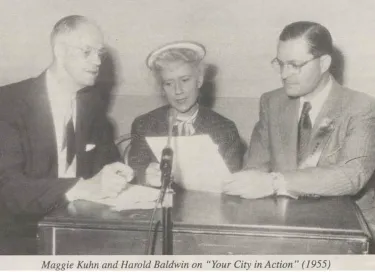
Reflecting on that time in 1977 for Parade magazine, Kuhn said even though she knew mandatory retirement was coming, it shocked her. “I suddenly felt wounded and angry at having been sent out to pasture to get lost. Then I figured there must be thousands of old people just like me, and so I decided the time was ripe for us to fight back.”
Born in 1905, at the beginning of the 20th century, Maggie Kuhn lived through a time of tremendous change—in which she played a large part. After graduating from the College for Women of Western Reserve University in Cleveland, Ohio, in 1926, Maggie took a position with the Young Women’s Christian Association (YWCA) in her college-town. In 1930, she transferred from the Cleveland YWCA to the office in Philadelphia’s Germantown, where she served for over a decade. 1941 saw Maggie rising among the ranks, as she took a position with the National Board of the YWCA in New York. From then until 1947, she worked in the United Service Organizations Division (USO), before spending a quick year in Boston as program coordinator for the General Alliance of Unitarian and Other Liberal Christian Women. Her career with the Presbyterian Church began the next year, in 1948.
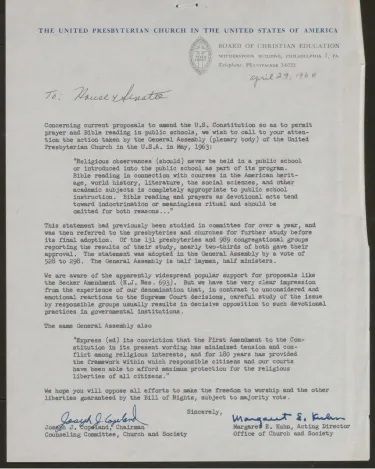
From 1948 until 1965, Maggie Kuhn served on the Board of Christian Education’s Office of Church and Society, where she edited publications, oversaw social welfare programs, and consulted with women’s groups. In January 1961, Kuhn participated in the first White House Conference on Aging as a consultant and member, gaining valuable insights that would serve her well in the Gray Panthers.
In 1965, she transferred to the Board of National Missions, where she served in the Division of Church and Race and worked closely with Gayraud Wilmore and J. Oscar McCloud, two highly influential Black theologians.
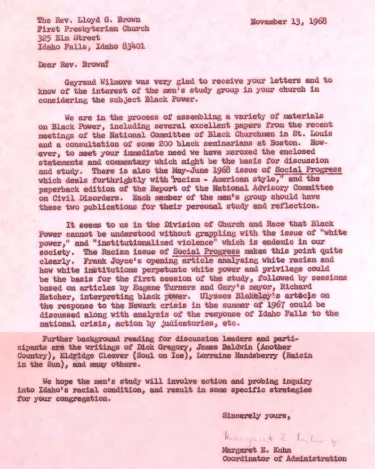
“It seems to us in the Division of Church and Race that Black Power cannot be understood without grappling with the issue of ‘white power,’ and ‘institutionalized violence’ which is endemic in our society,” Kuhn wrote in a 1968 correspondence with an Idaho minister requesting resources for a men’s study group on the subject. She then offered a short list of reading materials, beginning with the “Racism issue of Social Progress,” the journal she edited on behalf of the church, before including suggestions for “further background reading”—namely Lorraine Handsberry’s classic “Raisin in the Sun” and James Baldwin’s “Another Country.”
Then came her forced retirement and the founding of the Panthers—the rest was history. She founded her organization in Philadelphia, where she resided, and where folks would gather in the basement of a local church to strategize. In 1977, the group published “Nursing Homes: A Senior Citizen’s Action Guide.” The Gray Panthers’ influence grew and grew, until it stretched across 32 states and six countries.
After sustained pressure from the Gray Panthers in 1986, President Ronald Reagan abolished the law mandating forced retirement. Old age, Kuhn argued, ought to be seen as an accomplishment, not something to be pitied. She argued that, “The first myth is that old age is a disease, a terrible disease that you never admit you’ve got, so you lie about your age. Well, it’s not a disease, it’s a triumph. Because you’ve survived. Failure, disappointment, sickness, loss—you’re still here.”
Furthermore, when President Gerald Ford referred to her as a “young lady,” Kuhn offered the following retort: “Mr. President, I am an old woman.” She later explained her frustration by saying, “My wrinkles are a badge of distinction. I earned them. Don’t flush away my life by denying them.”
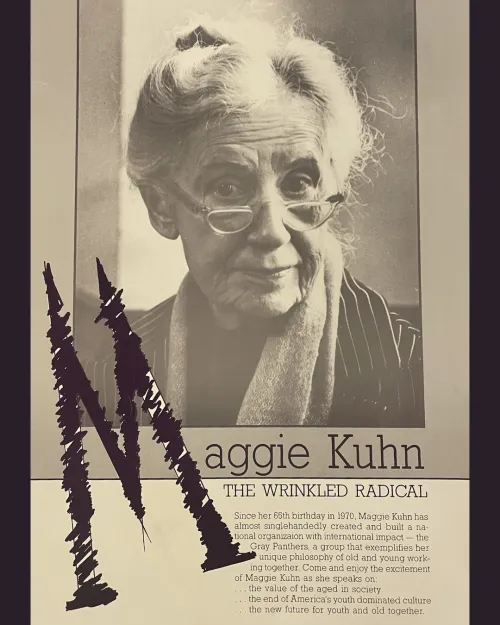
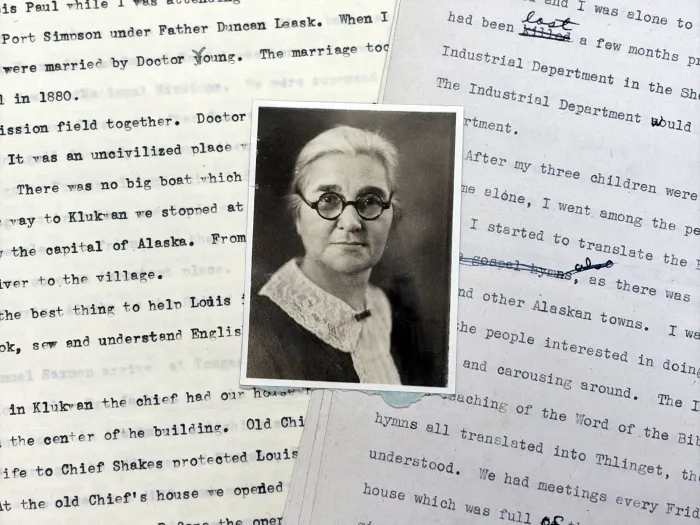
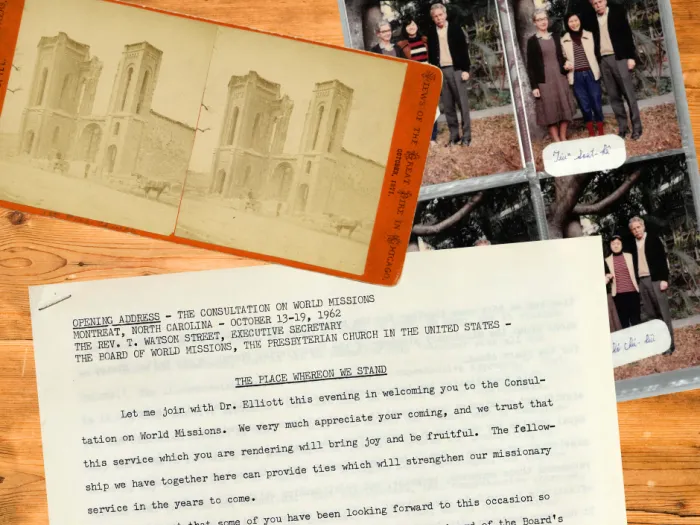
At the Presbyterian Historical Society, there are a plethora of materials related to Maggie Kuhn. The Maggie Kuhn Papers consists of over 27 cubic feet of correspondence, administrative documents, reports, books, photographs, and other materials documenting Kuhn's personal life and professional work. The Gray Panthers records are held by Temple University's Urban Archives in Philadelphia.
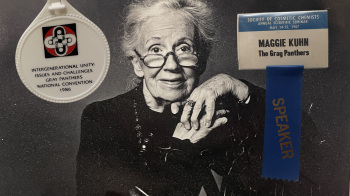
The Maggie Kuhn Papers are particularly rich in their documentation of Kuhn's work with the UPCUSA. The history of Maggie Kuhn lives at PHS—letters she wrote, notes she took, recognitions and plaques awarded her from cities and universities and the national government, posters and programs and participation ribbons—the list goes on.
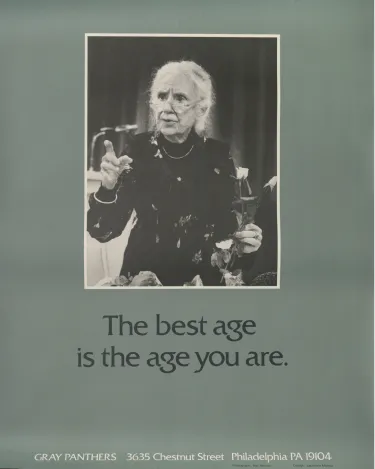
A lifelong American activist, Kuhn spent her time on this earth fighting for human rights, social and economic justice, global peace, integration, elders’ rights, and more. She fought for herself, and she fought for her fellow humans. Maggie asked that her gravestone be inscribed with the words, “Here lies Maggie Kuhn under the only stone she left unturned.” This is also the title of her 1991 autobiography, “No Stone Unturned: The Life and Times of Maggie Kuhn.” She forever altered the perception of senior citizens; she and her Gray Panther Growl will be remembered for decades to come.
When asked to comment on what had inspired a life such as hers, she quoted a favorite Bible passage, from chapter 6 of the Book of Micah: “But what does the Lord require of you but to do justice, to love kindness and to walk humbly with your God.” Kuhn died in her sleep in 1995 at the age of 89, but her vision of what society could be—and should be—continues to serve as inspiration for old and young alike.
To collect, preserve, share, and transform: this is the mission of the Presbyterian Historical Society. The oldest denominational archives in the nation, PHS leverages its collections and archival work to galvanize the transformative power of history in the Presbyterian Church (U.S.A.) and wider community. Support our efforts to preserve the past to empower the future by donating to the PHS Annual Fund today.
You may freely reuse and distribute this article in its entirety for non-commercial purposes in any medium. Please include author attribution, photography credits, and a link to the original article. This work is licensed under a Creative Commons Attribution-NonCommercial-NoDeratives 4.0 International License.