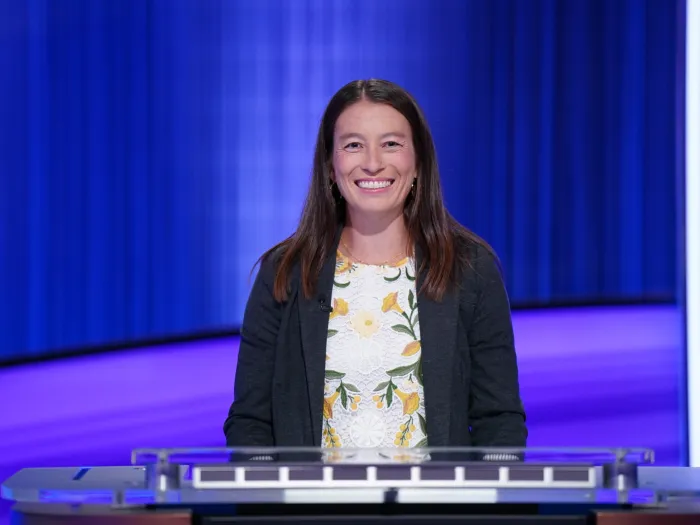
Presbytery podcast shares the wisdom of a NASA doctor
Dr. Heidi DeBlock joins the Rev. Dr. Shannan Vance-Ocampo of the Presbytery of Southern New England on ‘Connecting Our Conversations’
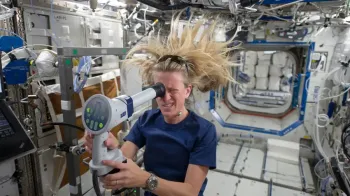
LOUISVILLE — “Connecting Our Conversations,” a podcast of the Presbytery of Southern New England, featured a timely guest during a month that included the launch and successful return of Artemis II: Dr. Heidi DeBlock, a critical care physician living in Maine who’s worked for more than 30 years as a visiting research scientist at NASA’s Johnson Space Center’s Cardiovascular Laboratory.
DeBlock is married to the Rev. Dr. Scott DeBlock, the resource presbyter for the Presbytery of Northern New England. The host of this edition of the podcast, named “Space, Science and Wonder,” is the Rev. Dr. Shannan Vance-Ocampo, general presbyter of the Presbytery of Southern New England. Listen to her 55-minute conversation with DeBlock here.
DeBlock said she began going to the Johnson Space Center in 1990 as a student. “They kept asking me back, and I kept going back, willingly,” she told Vance-Ocampo. Beginning in 1995, she got involved in a large research study that required her to attend a number of NASA landings. “It’s fun to see them come down, because so much has happened to our bodies while we’ve been in space.”
The last time she was working in the lab at NASA’s Human Research Program, “they asked me to put all the data into the archives, and I realized it was my own data,” she said. “I’ve been here a while.”
In addition to data, “we glean so much technology from NASA,” DeBlock said. Monitoring systems in intensive care units in hospitals across the nation “were invented because we went to the moon and we monitored the astronauts,” she said. “There’s all sorts of fun stuff I work with every day that’s a result of NASA having to create it.”
Drug delivery systems such as patches were invented to enable long space flights. Insulin pumps came from space technology, and “a lot of the work we did in physiology refined how we monitor and control patients’ blood pressure on Earth,” DeBlock said. “We had to learn about our own body and our own physiology. We’re not built for space at all.”
When astronauts blast off, blood and other fluids get pulled down to their feet. “The brain says, ‘Get rid of the extra fluid,’ and so you start making urine. Astronauts get up there and they start peeing away,” DeBlock said. Astronauts also get congested in space, their faces fill out, and their hearts and other organs are affected.
“It’s like standing up quickly from bed in the morning. Sometimes you get light-headed and almost pass out,” she said. That happens to about 25% of astronauts and women more then men, owing to what DeBlock called “the estrogen effect.”
DeBlock studied cardiac arrythmia in astronauts, “and even the electrical integrals within the heart. All the other systems are changed too — the way our blood flows through our lungs is different and the way we absorb nutrients is different, which changes the way we absorb and distribute our medications,” she said.
“Now we’re figuring out this Spaceflight Neuro-ocular Syndrome,” she said. “Some of the astronauts are coming back from long-duration orbit with vision problems. They go up with 20/20 vision and they come back with 20/200. Some of them are horribly affected, and it has taken some years to correct.”
It could be what’s going on within the brain with inter-cranial pressure or what’s going on in the eye itself, DeBlock said. “There’s a lot of theories and some really interesting physiology being figured out about the eye,” she said. “In the end, I think that’s going to help patients here on Earth with any ocular problems.”
“By putting our bodies up there — and essentially them breaking — we can see them restructure themselves when they come back to Earth,” DeBlock said. “It’s like de-engineering a machine. That’s how you figure it out.”
“I’m hearing a lot of sacrifice for the astronauts themselves,” Vance-Ocampo said. “We think of catastrophic failures when astronauts were killed, but there are much more subtle things that are going on for them — some known, some unknown. They themselves are part of a science experiment.”
“They know that. You sign up for a potentially fatal mission,” DeBlock said. “The other part is that you sign up to do science.” In the days of the Space Shuttle, astronauts and scientists would hold a “pitch day,” when scientists discussed their proposals and the crew picked the ones they wanted to work on. For DeBlock, that could mean collecting data before the launch; during the mission, especially if there’s extra vehicular activity such as a spacewalk; “and then after the mission as they recover. You have to do that when they’re whole, when they go up into space and break, and when they come back down and fix it again. It’s the whole spectrum.”
When DeBlock and her colleagues attended landings, the astronauts would forego an immediate reunion with their families to allow the scientist to collect the research data they needed. “We want them before they’re getting used to gravity again,” she said.
Vance-Ocampo said she marveled at hearing the faith stories offered by the Artemis II astronauts. “You are married to a clergyperson,” Vance-Ocampo told DeBlock. “You’re watching them have this absolutely ethereal experience, a supernatural, godly experience. What’s that like for you?”
DeBlock recalled a conversation she had with her husband-to-be back when he was a pre-med student and she was majoring in astrophysics. The two were engaged in “a deep conversation. He asked, ‘What are we children of?’ I said, ‘We are children of the universe. We’re made of the stuff of the universe and of the Earth.’ He said, ‘I am a child of God,’ and I said, ‘How much different is that?’ To me it’s how we are here.”
“As far as the astronauts go, they’ll tell you there’s nothing like the deep black void of space and then looking at the Earth,” DeBlock said. International Space Station and Space Shuttle astronauts are in low-Earth orbit, “but if you’re going to the moon, you see the Earth as a blue ball.”
“That’s something the Apollo and Artemis astronauts had the privilege of seeing,” DeBlock said. “I’m sure there’s no describing the awe they were seeing, but they all have their descriptors.”
One thing Vance-Ocampo noticed during the Artemis II press conference was Christina Koch, a mission specialist, choking up briefly as she described the wonders of what she and her colleagues had seen.
“I can only imagine,” Vance-Ocampo said. “The feeling I got [while following the mission] is a sense of oneness of humanity” as people on Earth took in some of what the astronauts were seeing.
“The theologian in me wonders about what we’re thinking about,” Vance-Ocampo said. “I was thinking: Is there a chaplain for the astronauts? How does one get that job?”
You may freely reuse and distribute this article in its entirety for non-commercial purposes in any medium. Please include author attribution, photography credits, and a link to the original article. This work is licensed under a Creative Commons Attribution-NonCommercial-NoDeratives 4.0 International License.