Worship and music leader talks up the importance of participatory music
Dr. Maren Haynes Marchesini is the most recent guest on the Presbyterian Association of Musicians’ ‘Sounding Board’
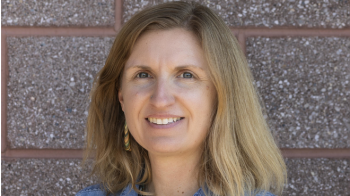
LOUISVILLE — Choral director, cellist, composer, vocalist and scholar Dr. Maren Haynes Marchesini is director of worship and music at Hope Lutheran Church in Bozeman, Montana. Amidst all her varied duties, which include the Roots in the Sky chamber choir, Haynes Marchesini managed to fit in 77 minutes to speak to Sarah Abushakra and Jeremy Roberts, the hosts of “Sounding Board,” a production of the Presbyterian Association of Musicians. Their conversation is available here, here or here.
Roberts asked Haynes Marchesini, what brought you to where you are today?
Raised in the Presbyterian Church (U.S.A.), Haynes Marchesini said her grandmother and great-grandmother “were church music people” at Hysham Community Presbyterian Church in Hysham, Montana. Haynes Marchesini earned her undergraduate degree at Whitworth University in Spokane, Washington, then served a year as a Young Adult Volunteer. All of that “set a trajectory for being interested in ministry but wanting to do other kinds of things,” she told the hosts.
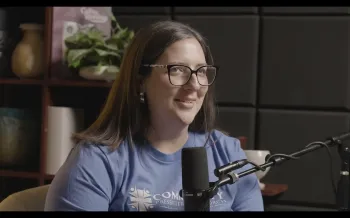
She went to graduate school “and ended up with a job at a Lutheran church while pursuing my doctorate,” Haynes Marchesini said. She studied a Seattle megachurch for her dissertation project, but has worked since then “leading a church choir and doing a lot of other interesting things,” some of them related to ethnomusicology, the study of music in its social and cultural contexts.
She traveled to orphanages in Kazakhstan to adopt two children and worked on the U.S.-Mexico border and in Guatemala, “getting to know the migration situation there,” as well as spending “a bit of time” in Israel-Palestine.
“It seemed obvious that ethnomusicology was a good fit for exploring issues of music and meaning, and music and justice,” she told the hosts, “and getting to know the brilliance and capacity and value systems of people from other places.”
Witnessing artists’ activism from musicians including Bobby McFerrin and others “gave me some extra entrée into not only brilliant people, but elders and scholars interested in how you bring together community formation and a deep sense of spirituality and identity with music,” she said. “How do we live together? How do we practice our values in the ways we do ordinary things like sing together? What is the community we are creating out of those gatherings?”
Roberts asked her about what working with improvisation, including a jazz trumpeter, has taught Haynes Marchesini about herself.
“I came to improv late,” she said. “I played the cello growing up.” When she took an improv class from the jazz trumpeter, it was the only “B” she would receive in her music courses as an undergraduate.
“I started playing with worship bands, a great place to start” because of the simple chord progressions and straightforward key signatures, she said. “It was a great place to try stuff.”

“Then I started with indie rock bands. I started composing, and it became a chamber-rock thing I was part of,” she said. She enjoyed playing three-hour gigs with her friend, Kate, where “you get out of your ego. You aren’t in your thinking brain anymore. You’re in dialogue and total freedom with another person and you don’t care where things go. It takes us and carries us somewhere that’s unexpected.”
“That’s my spirituality at its best place: where does the Spirit carry me where I couldn’t have come up with if I sat down and tried to reason my way through a problem?” she said. “Improv and other experiences have become part of my composition practice, too. The best things that come out of it is where I’m not really thinking about what I’m doing,” when “the first ideas is the best idea. Let’s get it on the page and see what happens. It’s a delightful process.”
The hosts asked Haynes Marchesini about Holden Village, a Lutheran camp and conference center in Chelan, Washington, reachable by a two-hour boat ride and an hour-long bus ride.
“It’s an old mining village that was gifted to the [Evangelical Lutheran Church in America] for a retreat center,” she said. Holden Village does “things around music, religion and art,” including “deep theological practices. Every time I go there, I am cracked open in some unexpected way.”
It was there she connected with the liturgy of John Hermanson, now the artist-in-residence and director of sound and technology at Hope Lutheran Church. “We did a residency program to put his music into a songbook,” she said. “Holden Village reached out about bringing his Isaiah liturgy back for a summer. It was a beautiful piece focused on justice, peace and renewal.” Haynes Marchesini did the transcriptions and the arranging for the piece.
Asked about what she’s learned at Holden Village, Haynes Marchesini noted that “we still have a responsibility to explore what God is doing in the world. You don’t have to throw tradition on the junk heap, but we have a need to keep expanding the aperture.”
Abushakra noted that Haynes Marchesini wrote an article in the most recent edition of Call to Worship on the differences between presentational and participatory music.
Haynes Marchesini recalled participating in the Son Jarocho tradition of music from the Veracruz region of the Mexican Gulf Coast. It’s the style that produced Ritchie Valens’ “La Bamba.”
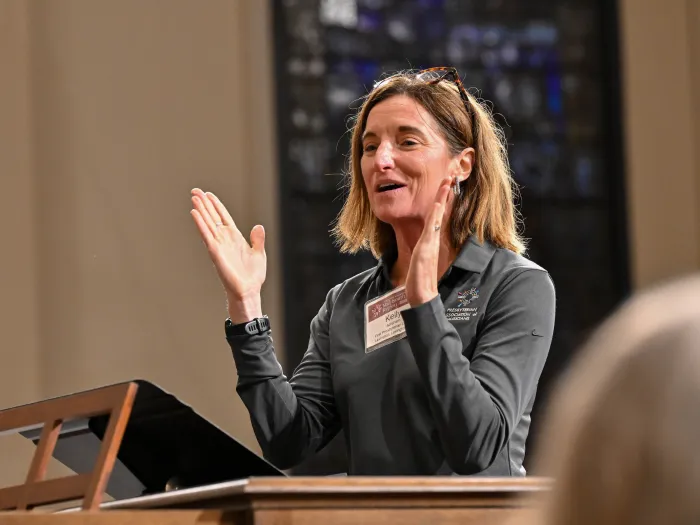
“Everybody’s part of it. You gather around the platform [where dancers perform a tap dance]. You can sing and play from the very beginning,” she said. “Singers call out songs in a call-and-echo style. The objective is to get the maximum number of people involved as possible.”
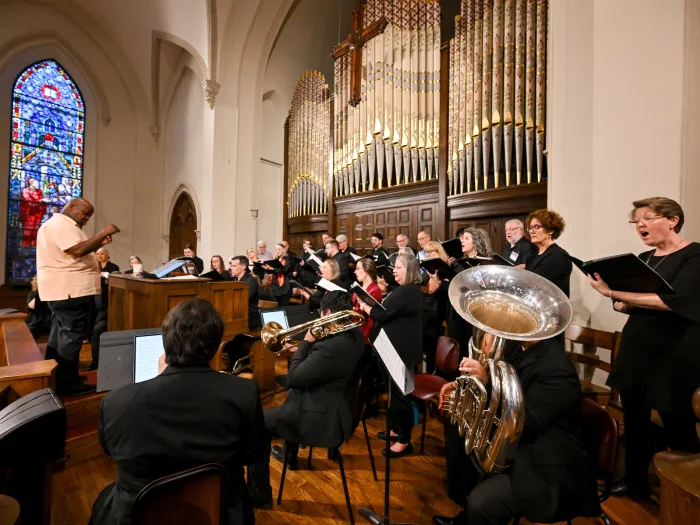
Churches “are one of the last holdouts” to such an approach, she said, but “the majority understands it’s not about sounding good.” Singing together “is a fleeting moment we can throw into the ether.”
“Modeling the joy of singing is one of my goals,” Haynes Marchesini said. “I love to sing, and I love to sing with others.” She said she also loves “to step up to the microphone with that key objective, that I am there to make sure they know how the song goes.”
“As soon as they know, I realize, I don’t need to be at this microphone. They know what they’re doing.”
She also touted Music That Makes Community, which, its website points out, practices “communal song-sharing that inspires deep spiritual connection and brave shared leadership and sparks the possibility of transformation in our world.”
“It’s my favorite way of doing congregational music,” she said. “You can do things well beyond people’s expectations.”
“You watch [singers’] transformation,” she said. “It’s one of the most magical experiences of my life. … We can step into being willing to be foolish and be wrong.”
Go here to enjoy previous installments of “Sounding Board.”
You may freely reuse and distribute this article in its entirety for non-commercial purposes in any medium. Please include author attribution, photography credits, and a link to the original article. This work is licensed under a Creative Commons Attribution-NonCommercial-NoDeratives 4.0 International License.