Following the prophet’s call to do justice
One Great Hour of Sharing Offering addresses unjust systems at a grassroots level to help neighbors in need

LOUISVILLE – When Chanda Williams and nine young adults from the First Presbyterian Church of Salem, New Jersey, reached hurricane-impacted Western North Carolina last May, neither she — nor they — knew what to expect. Least of all, how deeply their hearts would be broken by the devastation yet simultaneously uplifted by the region’s resilience.
When Hurricane Helene made landfall in September 2024, the catastrophic storm quickly created a path of destruction through the southern Appalachian Mountains.
“Shortly after the hurricane hit, the basic infrastructure was down, with no water in Asheville (North Carolina) for 53 days and no power in many locations as well,” said Anne Waple, the Presbytery of Western North Carolina’s disaster recovery coordinator. “It was just the bare minimum we could do at first trying to get people the basic necessities,” she said. “It took us until last spring to assess what kind of rebuilding work would even be possible since so many residents live in hard-to-reach valleys and on steep slopes.”
Yet Waple, with both hands-on and financial assistance from local and national organizations — including the Presbyterian Church (U.S.A.)’s disaster recovery ministry — was able to get three host sites up and running by spring 2025 to help restore and rebuild lives and damaged homes.
Such critically needed support for those affected by Hurricane Helene was made possible, in large part, through Presbyterians’ generous gifts to One Great Hour of Sharing.
Centered in the prophet Micah’s call to do justice, One Great Hour of Sharing has been helping neighbors in need around the world for over 75 years. The annual Offering gives the PC(USA) and other Christian denominations a tangible way to share God’s love by joining together to help eliminate the root causes of the world’s injustices.
In addition to addressing disaster relief and recovery, One Great Hour of Sharing (OGHS) also benefits such causes as food insecurity, community development and immigration/migration.
Although the Offering may be taken anytime, most congregations receive it on Palm Sunday or Easter Sunday, which this year fall on March 29 and April 5, respectively.
The New Jersey group of 19- to 32-year-olds was placed last May at the New Hope Presbyterian Church, a PC(USA) host site in Asheville.
Williams, who works with youth and young adults at the First Presbyterian Church of Salem, said, “Ours is a historic, small, primarily older congregation in a once-flourishing, historic town, which is now a small city surrounded by farms. Because Salem struggles with poverty, drug addiction and gang violence, there’s plenty to do in our hometown. But I plan trips like this because a lot of our young adults are already involved with serving our community, and I think it’s important for them to see what God is doing in other parts of the world.”
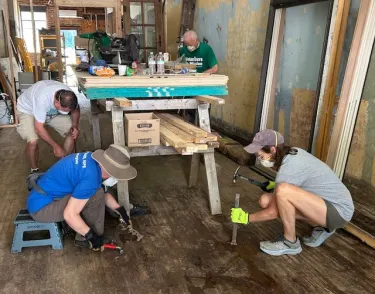
New Hope Church is similarly a community of mainly retirees, one of whom, Elsie Reid, a retired attorney, was on hand to welcome and shepherd the volunteer group from New Jersey.
“Although we knew that raising funds was one way that our church could contribute to the recovery effort, we yearned for a tangible way to get involved to help our community heal,” said Reid. “Being selected as a volunteer host site was an answer to our search for engagement.”
Reid said that she and her husband, Cal, were particularly fortunate to have led the host team for the volunteer workers from Salem, who inspired them with their hard work and generous spirit.
Yet the young adults’ journey to volunteer in the region was not without its challenges.
Primarily assigned to work nearly every day with one homeowner, with whom the group had bonded, they were asked on their last day to report to a different site.
“Because we studied different Scripture passages each day related to service, one of the main things that came up for us was that there are never any answers ahead of time,” said Williams, “so we just showed up and said, ‘Yes.’ We didn’t know what would happen on any given day because things could change. But on that last day we said, ‘OK, whatever you need us to do most, that’s where we’ll go.’”
The group ended up going to the side of a mountain, where they were asked to help move a man and all his belongings out of transitional housing in an RV into an area campground. He was badly injured, with broken ribs, and struggling.
Williams recalled how everything that could go wrong that day did go wrong.
“We spent the morning having a difficult time,” she said. “The trailer hitch didn’t fit. It was raining the whole time. And then, by the time we got to the storage unit where he was supposed to store his tools, it was filled with someone else’s belongings.”
The man broke down in front of them and told the group they could leave.
“He told me he just couldn’t handle the stress anymore and was ready to end things. He didn’t even have the down payment he needed for the campground,” said Williams.
Williams went to the truck with him, stayed with him, and messaged his caseworker with a partner organization. And although working together they were ultimately able to get him into another storage unit, there was still the matter of the down payment, which he simply didn’t have.
“On our trip,” Williams explained, “our group had been collecting money we called ‘God’s money.’ These young adults don’t have a lot of money to spare, but they wanted to give. Then we prayed about how God wanted us to be generous and to use this money. When I told them what our new friend had said to me, everyone gasped, and a couple people started crying. ‘I think God’s money is for him,’ and everyone agreed that this was where God was leading us.”
It was almost exactly enough for his first month’s rent.
“We gathered around him and gave him an envelope labeled ‘God’s money,’” said Williams. “We got to share with him how much God loves him and sees him. It was a very emotional moment for him and for our group.”
And the story didn’t end there.
Looking over at the church van, the man confessed that because he had an abusive experience growing up in the church, he got out but always felt that he was missing something in his life.
“Today I have witnessed a true miracle in my life,” he told the group. “I am seeing God pull me back to him.”
Williams marveled at how all of this was totally unplanned.
“We didn’t even want to go move this man, but we just said yes,” she said. “It turned out to be one of the most impactful moments of the trip, a life-changing moment that showed them how God used our group. It was something we never could have planned. One of the most impactful themes of service was saying yes to God and being available to witness what he does.”
Looking back, Williams said that their group wouldn’t have had this experience without One Great Hour of Sharing.
“Gifts to the Offering make disaster relief and recovery work in partnership with Presbyterian Disaster Assistance very accessible for young adults from the inner city,” she said. “We paid a small fee per person for our lodging, and our oversight and project materials were all covered by the PC(USA). That had a big impact on allowing everyone to participate.”
Making just housing a human right
Elsewhere in the U.S., the disastrous impact of a hurricane also changed the life of Adrian Alberto Madriz.
After Hurricane Andrew — a 1992 Category 5 storm that left close to 100 people dead and several hundred thousand homeless — destroyed his family’s suburban Miami apartment building, 4-year-old Madriz and his parents were forced to evacuate to Orlando.
They later returned to a horrific scene — and a smell — forever seared into the young Madriz’s memory.
“When we came back to Miami, all of the windows in our apartment house had been completely destroyed,” he recalled. “The furniture that was inside had been sucked out because of the enormous amount of pressure from the wind, and the entire parking lot was littered with mattresses and insulation. I’ll never forget the smell of rotting insulation after the storm. Every single time I smell it now, it brings me back to that day and the painful memories of that moment. That was my first experience of housing insecurity.”
And, for Madriz, that was just the first of three defining moments that led him to make housing “his life.”
As a 17-year-old, he again experienced housing insecurity after coming out as gay to his religiously conservative parents.
“I was told at the time that God was not going to accept me,” said Madriz. “I had to choose between my ‘lifestyle’ and being someone who believed in God and was a good Christian.”
Because he couldn’t give up his faith, he ran away from home.
When his parents finally found him staying at a friend’s house, he went to live with his grandparents because his parents would not allow him to return home.
Madriz’s third pivotal episode took place during his first job after college as a housing organizer with the Miami Workers Center, whose mission is “to build the power and self-determination of South Florida’s most oppressed communities.” His first job for the nonprofit was “to go knocking on doors in a poor, historically Black neighborhood called Liberty City.”
Approaching the assignment with what he later realized was an unfounded fear of violence based on the area’s high crime rate, he experienced the people as “incredibly open and hospitable.”
He wondered why his neighbors in Miami were living in unsafe housing in one of the richest cities in the richest country in the world.
Because the whole situation struck Madriz as immoral — with “forgotten neighborhoods” being allowed to fall into neglect while landlords avoided prosecution— he decided to take action.
And that’s when SMASH, for which Madriz serves as co-executive director, was born.
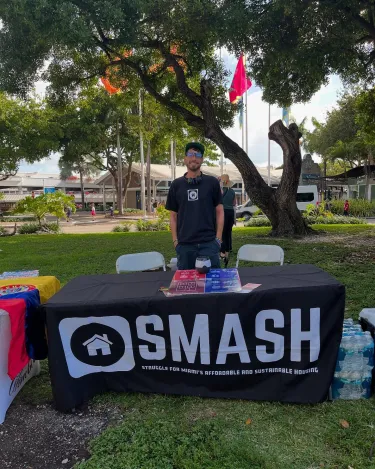
SMASH (Struggle for Miami’s Affordable and Sustainable Housing), the first community land trust and affordable housing cooperative in Liberty City, began in 2015. Madriz and Berlinda Dixon got together with Porgie “Gigi” Town, Sharice Taylor, and Trenise Bryant — also a co-executive director and co-founder — and other residents of Liberty City to do something about slumlords who were taking advantage of the neighborhoods.
Using a community land trust model, SMASH provides sustainable and preserved land that the community controls and builds power to make housing a human right in Miami.
Since its founding, SMASH has been successful in acquiring three properties, with its first housing project becoming operational in 2022. The third property will eventually become the kind of LGBTQ+ housing that Madriz dreamed of since his teenage years.
But the founders’ collective dreams might not have become a reality without the community development grant they received from the Presbyterian Church (U.S.A.) through OGHS.
“By repairing the breaches of access and sustainability and promoting the restoration of dignity through self-determination,” said the Rev. Dr. Alonzo Johnson, manager of the Presbyterian Committee on the Self-Development of People, “SMASH does powerful community development work that lifts up quality affordable housing, human dignity, the power of voice and the engagement of justice.”
And SMASH’s role in addressing the unjust systems that perpetuate poverty doesn’t end with the provision of housing.
In exchange for affordable housing, renters are trained to be housing justice organizers and also volunteer some of their time to do outreach, to put together events and to manage campaigns.
Johnson believes that OGHS is “one of the most direct and engaged ways that Presbyterians can do the work of repair and healing” through a broad network of mission partners.
“Presbyterians should support OGHS because the ministries that receive it truly live the calling of Christ in bringing hope, transformation and healing to the world,” he said. “Supporting OGHS is the Presbyterian way of saying yes to God’s work of repair and justice as they live out their calling as Christians.”
Rebuilding lives and restoring hope across the globe
In war-torn South Sudan, Mama Nyayier [nya-yeer] knows that the casualties of war are not only those on the front lines.
Those who remain behind also fight for their survival.
As a girl in South Sudan, Mama Nyayier had a good life until civil war broke out in 2013, exposing the then-15-year-old to unimaginable horrors. All around her, countless lives were lost to the armed conflict. Among them were her father and nearly all of her nine siblings.
Everywhere across the fledgling nation — which had only gained independence in 2011 — farms, homes and livelihoods were being destroyed, while abductions, detentions and gender-based violence were everyday occurrences.
An unrelenting onslaught of natural disasters soon followed, causing the United Nations in 2017 to declare famine in parts of South Sudan, with 100,000 people experiencing starvation and another million on the brink of death. In the wake of such an unprecedented humanitarian crisis, millions of desperate residents were displaced from their homes, many to South Sudan’s already overcrowded highlands as well as internal settlements and refugee camps in neighboring countries.
Even when Mama Nyayier was forced to move from the village where she was born to another town in Leer County, she still had no guarantee of safety, protection or provisions.
As she and her family fell deeper into desperation and hopelessness, “hope” reentered their lives in the form of Hope Restoration South Sudan (HRSS), a nationally registered, women-founded and women-led nongovernmental organization that is a partner of the Presbyterian Church (U.S.A.).
Founded in 2010 by Angelina Nyajima Simon Jial — herself a former refugee who lived in Kakuma Refugee Camp in Kenya from 1991 to 2008 — HRSS seeks to empower vulnerable populations affected by conflict, displacement and natural disasters in South Sudan.
Financial support from the PC(USA), primarily through generous gifts to One Great Hour of Sharing, has helped further HRSS’s mission to alleviate hunger and bring restoration to the people of South Sudan.
“I chose the name ‘Hope Restoration’ because it speaks to my life journey,” said Jial, whose own family has remained in Kenya while the conditions in South Sudan improve. “Having been away from my home, it was out of a sense of hope that I believe one day things will change.”
Mama Nyayier considers herself “lucky” to be among the women who were identified and registered in January 2024 to benefit from the agricultural project supported through HRSS’s partnership with the PC(USA).
“Since our group focused on vegetable farming, we received vegetable kits that comprised assorted seeds like okra, onions, tomatoes, kudhura, sukuma and other types of vegetables,” she said. “I chose to plant onions because many people like them. I was able to sell my production in humanitarian compounds and in the market. I have been able to earn an income to sustain myself and family and to afford basic needs for my children and even take them to school.”
Jial continues to stand in awe of Mama Nyayier, not only because of her resiliency but also because of her initiative.
“She is entrepreneurial,” Jial said with admiration. “She did not allow her past to define her.”
As for Mama Nyayier, although she currently has dreams of expanding her farming into cereals and other cash crops, she acknowledges that, due to flooding, there is limited land for such extensive farming.
“I am grateful to the kindhearted people supporting us through the PC(USA) and Hope Restoration for giving me a second chance to a relatively normal life,” she said. “Because of your kind hearts for humanity, my children have a chance to a future and a better life.”
The assistance that HRSS receives through One Great Hour of Sharing is more important now than ever.
“When Presbyterians give to One Great Hour of Sharing, their gifts directly support communities facing hunger, conflict and disaster,” said Eileen Schuhmann, associate for Global Engagement and Resources for the Presbyterian Hunger Program in the Interim Unified Agency of the PC(USA). “And even more than that, gifts to the Offering help sustain grassroots partners like Hope Restoration South Sudan, who are restoring dignity, building resilience and offering hope where larger systems have failed. Giving is a faithful act of solidarity in a world where compassion and justice are urgently needed.”
You may freely reuse and distribute this article in its entirety for non-commercial purposes in any medium. Please include author attribution, photography credits, and a link to the original article. This work is licensed under a Creative Commons Attribution-NonCommercial-NoDeratives 4.0 International License.