The Rev. Dr. Bill Phillippe, a key figure in reuniting two branches of Presbyterianism, dies at age 96
Phillippe labeled himself ‘providentially predestined Presbyterian’
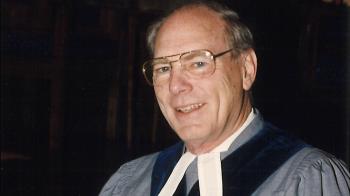
LOUISVILLE — The Rev. Dr. William Ralph “Bill” Phillippe, a Presbyterian minister who spent seven decades bringing divided people together and making faith feel human, joyful, and within reach, died on Oct. 6 in Madison, Connecticut. He was 96.
He was born on July 17, 1930, in Pittsburgh, Pennsylvania, to Mary (Angloch) and Ralph R. Phillippe. A curious young man who won the Senior Physics Award of Western Pennsylvania in 1948, he found his calling in theology instead. He graduated from Muskingum College in 1952 and earned his divinity degree from Pittsburgh-Xenia Theological Seminary in 1955. At Princeton Theological Seminary, he pursued doctoral studies under the renowned theologian Dr. John Hick. His thesis subject, the concept of creativity in the work of Paul Tillich and Nicolas Berdyaev, proved fitting for a man who would spend his life finding creative ways to share the faith.
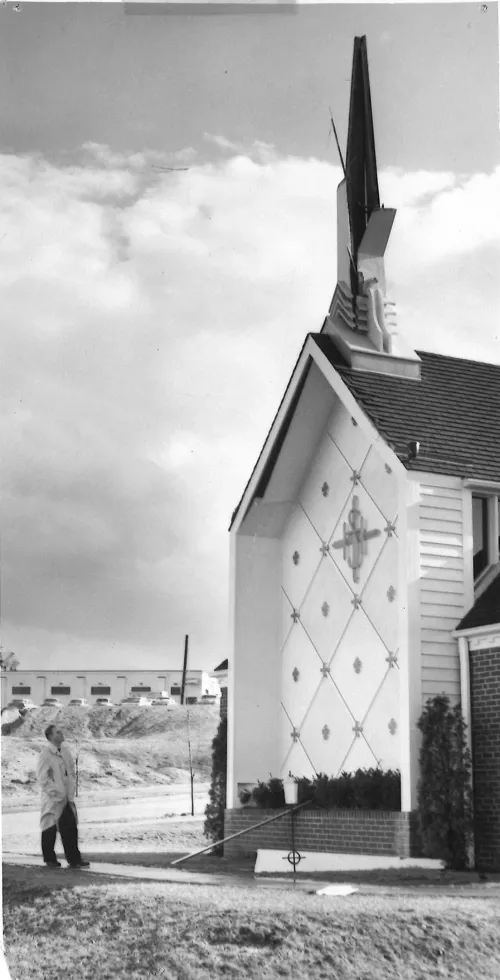
Ordained on May 22, 1955, in the United Presbyterian Church of North America, Bill began as the organizing pastor of Valley Forge Presbyterian Church in King of Prussia, Pennsylvania, a place he said had “more cows than people.” Seven years later, he left behind a congregation of 1,200 members.
In Monmouth, Illinois, he united four congregations into one, the first of many times he would make one out of many. After serving as Director of Continuing Education at Pittsburgh Theological Seminary, he was elected in 1968 as the youngest synod executive in the church. He led the Synod of the Chesapeake and later the Synod of the Piedmont, serving congregations from Delaware to North Carolina. He arrived just as the region’s cities were torn by the unrest that followed the assassination of the Rev. Dr. Martin Luther King Jr. In those turbulent years, he testified in defense of campus ministers, served on the Baltimore School Board, and worked alongside interfaith clergy to improve race relations and bring communities together. He later returned to Pittsburgh as senior pastor of the Bower Hill Community Church.
The Presbyterian Church was Bill’s lifelong love. Like any true love, it sometimes exasperated him, and he quarreled with it only to make it more open, energized and engaged with the community outside its doors and the world beyond. He called himself a “Providentially Predestined Presbyterian,” and the church entrusted him with some of its most delicate work. He was one of the original members of the Joint Committee on Union, whose efforts brought about the 1983 reunion of the United Presbyterian Church in the U.S.A. and the Presbyterian Church in the United States, healing a division that dated to the Civil War.
Abroad, he chaired the Civil and Religious Liberties Committee of the World Alliance of Reformed Churches (now the World Communion of Reformed Churches), joined a fact-finding mission to the Middle East, and represented the church at the Helsinki Accords review conferences in Belgrade and Madrid. In 1992, he served as Acting Executive Director of the General Assembly Council, the chief executive of the denomination.
Closer to home, his gift for healing made him the interim pastor that churches in trouble, conflict or transition hoped for. At Grosse Pointe Memorial Church in Michigan; Central Presbyterian Church in Summit, New Jersey; First Presbyterian Church of Lake Forest, Illinois; Fifth Avenue and Brick Presbyterian churches in New York City; Westminster Presbyterian Church in Alexandria, Virginia, he soothed division, did away with anything that was “un-Presbyterian,” provided a steady hand through the tempest of change while mentoring and empowering his associates and staff. His aim was always to prepare the way for the pastor who would follow, removing any impediments which might hamper their success. He broke down any factionalism, rivalries and fiefdoms that sometimes develop in congregations.
There were some ruffled feathers along the way, but he was known to say “The seven last words of the church are: We never did it that way before.” He left behind healed relationships, a cohesive staff, stronger budgets, growing membership and a reenergized congregation. His last act at each church was to sweep its front steps, so the new pastor could begin with a clean slate. He was honorably retired in 1994 but kept serving for another decade, including as parish associate at the Old Presbyterian Meeting House in Alexandria and as interim executive of National Capital Presbytery.
Bill believed the Gospel was too good a story to be told dully. He taught that the Bible was a living, breathing word, not a relic frozen in time, and that it still spoke to the lives of ordinary people. A brilliant and inventive preacher, he might leave the pulpit to act out every role in a scene from “Our Town,” “Fiddler on the Roof,” or his favorite, “Man of La Mancha.” His course “A Romp Through the Bible” taught to many hundreds of people over the years, became a book of the same name. Vic Jameson, longtime editor of Presbyterian Survey, wrote that some would find it “blithe and brash. That’s the best part.” By peeling off the dusty old trappings, Jameson said, Bill revealed “an enchanting story about people, and a God, we’d like to know better.”
In 1991, the two collaborated on Jameson’s “The Human Face of John,” a musical comedy that revealed the warmer side of John Calvin, with Bill singing and acting in the title role. It remained one of the joys of his life. His success in strengthening church giving led to “A Stewardship Scrapbook,” funded by Helen Walton, widow of Walmart founder Sam Walton, and sent to every Presbyterian congregation in the country. He kept writing well into his nineties. His books include “The Pastor’s Diary: How a Conventional Conservative Became a Theological Liberal,” “Bible Stories You Never Heard Before – Or Not Like This!,” and, at age 93, a novel, “The Mt. Washington Seven.”
He received honorary doctorates from Muskingum College, which also named him a Distinguished Alumnus, and from Monmouth College. Monmouth’s citation summed up his life’s work in a single line: “a ministry of bringing persons together and two decades of work in the field of human rights.”
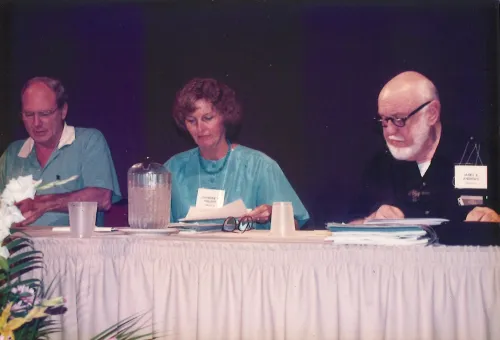
The work of reunion brought Bill a union of his own. On the Joint Committee on Union, he met Catherine “Kay” Shipley, an Associate Stated Clerk of the General Assembly and Head of General Assembly Operations from the Presbyterian Church in the United States (P.C.U.S.), a role she continued in the reunited church. Two years after the two churches became one, so did Bill and Kay. They married in 1985. She was the love of his life, and together they formed a wonderful partnership, each supporting the other’s work in the church they both loved. Kay was the consummate pastor’s wife. Bill deftly served as her platform manager at numerous General Assemblies. They traveled the world, from Europe to Israel, Turkey, Egypt, China and Cambodia. They led groups of pilgrims to the Holy Land and to Turkey, where Bill guided travelers in the footsteps of the Apostle Paul, bringing Scripture to life on the very roads Paul walked.
Between pastorates, Bill turned his creativity to the homes they shared. He had been a licensed electrician in Pittsburgh as a young man, he loved working with his hands and was gifted at it. In Louisville and in Old Town Alexandria, Virginia, he and Kay renovated their homes together, with Bill doing the vast majority of the work himself.
For all of it, Bill’s greatest joy was his family. He was a wonderful father: steadfast, devoted, and the best cheerleader his children ever had. He delighted in his children and grandchildren.
Bill was predeceased by his beloved wife, Kay; his son, David; his daughter, Diane; and his companion of his later years, Rita Davis. He is survived by his daughter-in-law, Maria Phillippe, and her son, Christopher Phillippe; his daughter, Elizabeth “Beth” Shipley, and her sons, Henry and Lawson Roach; and his son, Brice Shipley, together with Kristin Geenty and their son, William Shipley.
He often closed worship with a charge, and his family offers it now in his memory: “Go forth and make that love real in concrete ways. Reach out and touch — to lift, to heal, to love.”
A service celebrating Bill’s life will be held at 1 p.m. Eastern Time on Saturday, Nov. 14 at Nassau Presbyterian Church in Princeton, New Jersey.
You may freely reuse and distribute this article in its entirety for non-commercial purposes in any medium. Please include author attribution, photography credits, and a link to the original article. This work is licensed under a Creative Commons Attribution-NonCommercial-NoDeratives 4.0 International License.