Consensus, clarity and courage
A workshop at Stewardship Kaleidoscope identifies the three Cs of property discernment

Decisions about church property are fraught with emotion, theology, tradition, history, finance, stewardship and a range of other concerns.
It is the sacred responsibility of pastors, elders and church leaders to seek the guidance of the Holy Spirit and to use their spiritual gifts to lead their congregations through the process.
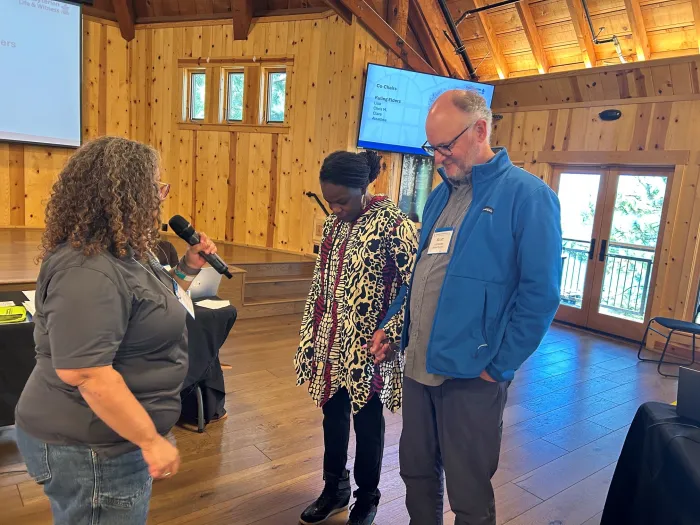
That was the message in a workshop presented by the Rev. Sandra Moon, Vice President of Church Finance and Property and Adaptive Initiatives at the Presbyterian Foundation, and Dr. Corey Schlosser-Hall, Senior Director at Presbyterian Life and Witness. They spoke at Stewardship Kaleidoscope 2026, a conference presented by the Presbyterian Church (U.S.A.) and Evangelical Lutheran Church in America; this year’s conference was held in Baltimore, Maryland, Sept. 20-23.
“Church property is a hot topic and you may be wondering about alternate uses for your church property or making decisions about the future,” Moon said. “As servants of Christ, we are called to be good and faithful stewards of God’s gifts, and that includes church property.”

The good news, Schlosser-Hall said, is that one need not be a real estate agent, property manager, developer or other expert in the field to be involved in these important decisions. “I’ve seen it happen many times,” he told attendees. “When a property matter comes up in church, they turn to somebody who knows about property; they defer to the experts. But you do not have to be an expert to help discern the vision for your church property. God’s property needs God’s people to seek God’s vision for stewarding God’s property.”
Both urged church leaders to start early so that they will be prepared to make the best decision. They outlined an alliterative process — consensus, clarity and courage — to guide churches.
Consensus
Moon recommends assembling a small group of church leaders and key stakeholders to lead the process and make recommendations to the congregation. This group is charged with engaging in careful and prayerful discernment to reach agreement on the congregation’s path forward.
- Engage in a group book study to bring clarity to the process. (Recommended: “Sailboat Church” by Joan S. Gray, “Neighborhood Church” by Krin van Tatenhove and Rob Mueller, and “Gone for Good: Negotiating the Coming Wave of Church Property Transitions” edited by Mark Elsdon).
- Assess your congregation’s strengths, challenges and mission. Ask “How is God calling our congregation?” Let the answer guide the property decisions instead of property concerns driving the vision.
- Have an honest conversation about the current status of your church property, your goals, needs and the energy level of your church leaders.
- Inquire into the community outside the church’s walls. What needs do your neighborhood have, and can your church help meet those needs? Walk the neighborhood in small groups and talk to you neighbors.
- Pray, pray, pray.
- Once the group has completed the consensus process, “it is time to discern with your heart and your eyes open,” Schlosser-Hall said. Determine where you are and decide what options might be viable. Prepare to make a recommendation to your church.
Clarity
Another part of the process is clarity, and this step is integrated into the discernment process to help you reach consensus.
- Schlosser-Hall and Moon shared resources available through denominational agencies to help churches make these decisions, including a Property Health Assessment worksheet, a giving analysis and more. This is available through the Presbyterian Foundation’s Project Regeneration program; start this robust process with your regional Ministry Relations Officers, and you can find yours here. From Presbyterian Life & Witness, the Good Futures Accelerator discernment process and “How to” Guides, Partnering, Renting, Developing, Selling, Ending and What About Taxes? can be found here. PL&W’s Office of Innovation also convenes cohorts 10 presbytery teams at a time of 4-5 people each to build a proactive property re-invention strategy in partnership with their congregations.
- Project Regeneration at the Presbyterian Foundation helps a congregation to discern among eight options for most church properties: Age in Place, Dissolution, Sell the Campus, Share the Campus, Redevelop, Reinvent, Merger, and Death and Resurrection. Through the discernment process churches should aim to narrow the options down and do further discernment on the selected potential options. The program is more than 15 years old and brings an experienced team to the table.
Courage
- “Courage is a community as well as individual characteristic that requires exercising courage to grow it. It can be grown and nurtured in a community. The capacity to nurture courage in one another is essential” to the process of discerning the right path for your church property, Schlosser-Hall said.
- In the PC(USA), Ministry Relations Officers at the Presbyterian Foundation have a set of resources to guide property decisions. “Go to your MRO and try everything else before selling the property,” Schlosser-Hall urged. The ELCA offers the Church Property Resource Hub.
Schlosser-Hall shared the concept of “urgent optimism” from the book “Imaginable” (2022) by Jane McGonigal. It requires mental flexibility, realistic hope and future power, all assets that serve the property discernment process well. “When you start looking 10 years out, many more things become possible,” he explained. “You can see beyond the next session meeting or even the next year. The constraints of the present don’t follow you 10 years into the future. You are building imaginative musculature.”
The two presenters then shared several examples of churches which have reached imaginative solutions to property challenges:
The Wilmington (Delaware) Kitchen Collective
A Methodist church had a commercial kitchen in its building that was not used to capacity. The leadership wondered if there was a way for others in the community to use it. They knew that there were people who wanted to start food businesses but couldn’t raise the capital or meet Health Department certification. They offered their kitchen; eight entrepreneurs began using it. Then a nearby Presbyterian church began offering their commercial kitchen for food business partnerships. Now there are four congregations in the Kitchen Collective. And a year or so ago, there had been 28 businesses on the waiting list to partner with these congregations or others that might take that step in the future. The church met a community need and the congregation discovered new partners, relationships and a new revenue stream.
Hand-in-Hand Business Center, First Presbyterian Church of Gulf Shores, Alabama
The church had 10 underused classrooms, and asked, “What does our community need?”
In conversation with the local Chamber of Commerce, they learned the answer: Daycare and a place for start-up businesses. Currently, there are nine new businesses called the Hand in Hand Business Center using those 10 spaces, with a waiting list. A woman came to the church with a vision for a daycare. So First Presbyterian Church now has a small business incubator and a day care partnering with their community. And the church campus experiences the human energy buzz of loving their neighbors seven days a week.
Fairlington Presbyterian Church, Alexandria, Virginia
Located on a large campus with unused space, the church asked, “What does it mean to love our neighbors?”
In consultation with government and community leaders, church members learned that there was a need for affordable housing, and built The Waypoint on their campus, which offers 81 units of income-based housing in partnership with a local developer who honored their values and discernment. “We invited the congregation to imagine bigger than they ever had before,” said Rev. Juli Wilson Black.
Evergreen Presbyterian Church, Memphis Tennessee
The building was an “old classic columned church,” Moon said, “with a lot of deferred maintenance. The question they faced was, ‘Should we put more money into this building?’”
Nearby Rhodes College had expressed an interest in the property, and the church decided to sell. The congregation “wandered in the wilderness” until a two-unit storefront in a strip mall became available for purchase. Located in a growing part of the city, the new location has become flexible worship, art, music, and event space. The church draws revenue from renting out this space to other church organizations and to the creative community.
Decisions about the future of church property can be anxiety-inducing, but by leading with prayer, seeking the guidance of the Holy Spirit, and following a proven process, church leaders can make wise decisions that serve their congregations, their communities, and Christ our Savior.
“Use your church property to spread Christ’s love and grace to a world that so desperately needs it,” Moon concluded.
You may freely reuse and distribute this article in its entirety for non-commercial purposes in any medium. Please include author attribution, photography credits, and a link to the original article. This work is licensed under a Creative Commons Attribution-NonCommercial-NoDeratives 4.0 International License.