Presbyterian profile: Matilda 'Tillie' Paul Tamaree (1863-1952)
In honor of Indigenous Peoples Day, Presbyterian Historical Society shares the story of the first native Alaskan woman to be elected to eldership
In a piece of correspondence dated November 9, 1920, Mrs. Matilda K. Paul Tamaree wrote with urgency to the Rev. James H. Condit, the Alaska representative of the Presbyterian Board of Missions. "You have received your invitation to be present at the annual convention of the Alaska Native Brotherhood which meets here [Wrangell, Alaska] from Nov. 21st to Nov. 27," Tamaree reminds Condit, before stating that "you must come. We need you now. You cannot afford to make other plans."
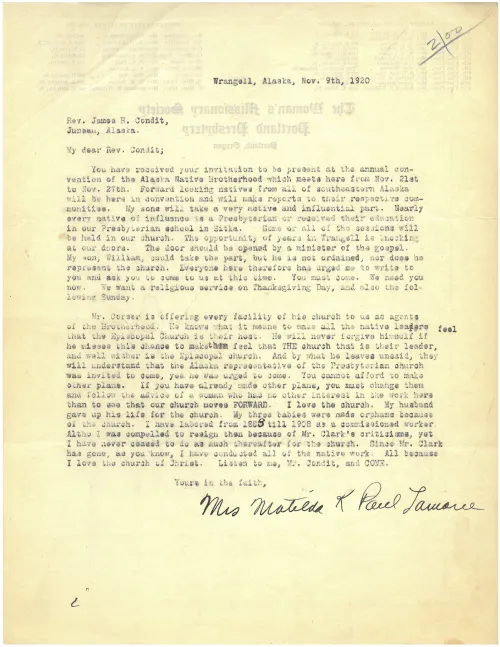
Tillie Tamaree continued with her blunt candor and passion into the conclusory paragraph. "If you have already made other plans, you must change them," she wrote, "and follow the advice of a woman who has no other interest in the work here than to see that our church moves FORWARD. I love the church. My husband gave up his life for the church. My three babies were made orphans because of the church. I have labored from 1883 till 1908 as a commissioned worker. All because I love the church of Christ. Listen to me, Mr. Condit, and COME."
Condit did not heed Tillie’s advice. In a piece of correspondence written by Tillie’s son, William Paul, in late January 1921, he mentions that "Rev. Condit, the pastor in charge of the territory, has been here once or twice for a period of not more than three days …and the importance of the work last November when the Convention of the Alaska Native Brotherhood met here certainly should have merited different treatment than its utter neglect."
"She endured many, many slights and on one occasion an open insult, because of her love for the church … Mother frequently built the fires, she rang both bells, she led the singing, she preached the sermon. She was the church," William urged. "The native church and the Sunday school is in the best condition is has ever been in during the past twenty years. There is no doubt in the mind of any one here that this is due entirely to her character and ability and devotion."
Less than a decade after this letter was sent, his mother, Tillie Paul Tamaree, would become the first native Alaskan woman to be elected and ordained as a ruling Eeder.
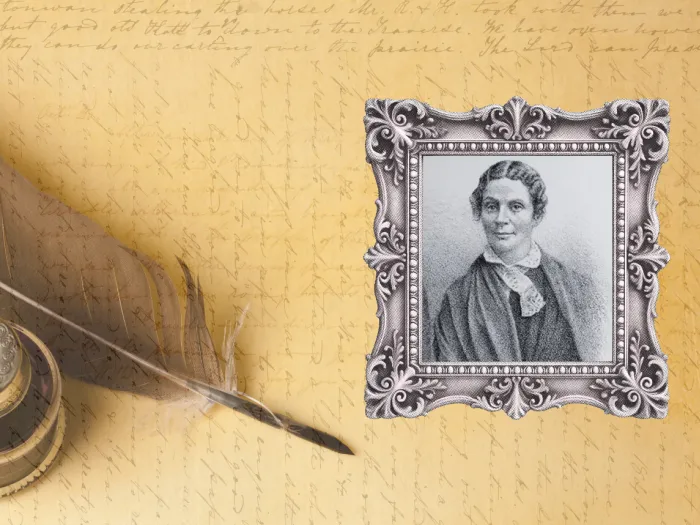
Matilda Kinnon “Tillie” Paul Tamaree was a passionate and persevering missionary who held immense influence in the Alaskan mission field. Born in British Columbia on January 18, 1863, to a Tlingit mother named Kut-Xoox and a Scottish father named James Kinnon, Matilda lived to the age of 90 and left an inimitable legacy in her wake.
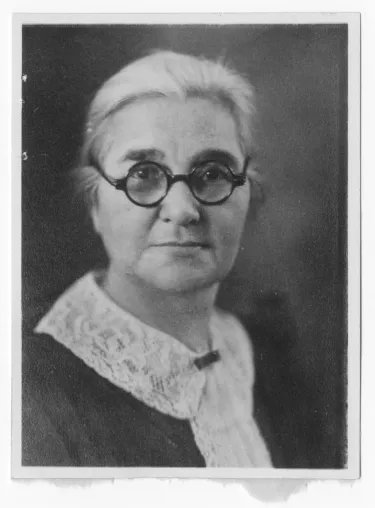
Her missionary service began in 1882, when she and her first husband became the first Native couple to be commissioned by the Presbyterian Board of Home Missions to found a new missionary school. From then onward, for more than four decades, Matilda worked as a translator, civil rights advocate, and missionary educator within the Tlingit community in the Pacific Northwest.
In 1930, she made history by becoming the first female ordained as an elder in the Alaska Northwest Synod of the PC(USA). She would spend the rest of her life in service of the church of Christ and the indigenous Tlingit peoples.
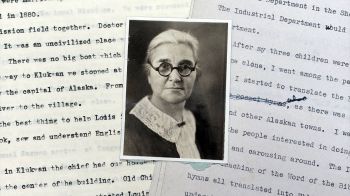
Thanks to materials held in the archives of the Presbyterian Historical Society, the details of Matilda "Tillie" Paul Tamaree’s life come into focus. Two documents wealthy with biographical information were found within Tillie Paul Tamaree’s vertical gile, both penned by the woman herself, that offer inimitable insight into her life and work. At the top of both documents are handwritten notes in pencil. One is a note to the receiver encouraging edits. The other reads: "Once I was Blind but now I Can See the Lord has led me all my life not easy way but hard way. And that is God’s way and I am happy now living in Seattle almost at the end of my life and I am happy … ." She passed from this world a few years later, in August 1952. This is her story — told in her words.
Before we begin, a quick note: throughout these primary sources, "Tlingit" is misspelled as "Thlingit." This is reflected in the quotations included in this article.
"The Presbyterian church is a mother church because they first brought the light to our schools in Alaska," Tillie began. "Mrs. A. R. McFarland was the first Christian teacher in Wrangell … Mrs. McFarland … organized a home for young girls. I was one of them that first entered that home, when I was about 14 years old."
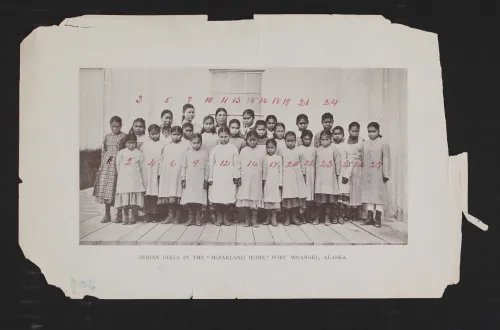
After the death of her mother from tuberculosis, Tillie was raised by her maternal aunt. At the age of 14, she enrolled at Amanda McFarland’s Presbyterian Home and School for Girls. There, she started to go by Tillie, and she acted as Mrs. McFarland’s interpreter and aide. When the first Presbyterian congregation was organized in Wrangell in 1879, Tillie was among the charter members.
From a Board of National Missions article published after her death, we learn that "When she was sixteen, she fell in love with a young Christian man, Louis Paul, of French and Thlingit background, and the two were married. The young couple dedicated their lives to Christian service and were appointed to mission work among the Thlingits … " The two were wed in 1880. Eight years later, tragedy struck Tillie's life when her husband left for a trip and never returned. They had been sent by Dr. Sheldon Jackson to survey land for a new town, had left by boat on the 14th of December, "and as it was but a three day trip they were expected to return before Christmas. They never returned and no one knew for many a long year after their disappearance what had happened to them. But one man confessed on his death bed to have been an accomplice in the murder of Louis and Mr. Saxman," Tillie wrote in hindsight.
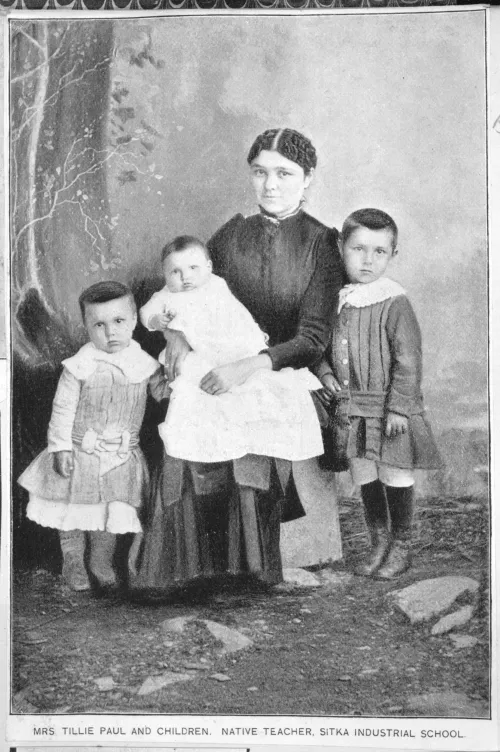
One month after her husband's disappearance and supposed drowning, Tillie gave birth prematurely to her third son. She named the baby after her lost spouse and, with sorrow weighing on her heart, continued on. "I arrived in Sitka in 1888, my youngest son was but six months old and I was alone to raise three sons," she wrote of this period in her life. She entered the Sheldon Jackson Training School there, where she remained for 18 years, teaching "sewing and cooking and later on I did the interpreting of sermons."
Of her early years at the training school, Tillie wrote, "We had meetings every Friday evening at the school house which was full of the people ready and waiting for me to give them a new lesson which I had prepared in my heart … I enjoyed my work immensely. This work kept me from losing my mind in sorrow of my husband losing his life for the cause just before his third son was born."
She served in Sitka for almost two decades before heeding a call to return to Wrangell, Alaska. While there, in 1905, Tillie married again. She and William Tamaree were wed that year by the Rev. Dr. S. Hall Young — the same man who had married her to Louis Paul in 1880. (One of Tillie’s sons had been named Samuel in honor of Doctor Young.)
Tillie had three children during this second marriage, all girls — unfortunately, according to Tillie’s autobiographical entry, "the youngest died when only three days old and the next to the oldest, Gladys June, died when she was sixteen years old." When Gladys fell ill, Tillie and William were in Kake, attending to the struggling congregation there. It was during this time that their daughter, left in the care of friends, "wasted away" as Tillie put it.
Tillie and William returned to Sitka, where their remaining daughter, Frances, was attending school. They remained for a year before heeding a call to Petersburg. "This was during the time that my two sons William and Louis Paul were fighting for the Indians right to vote and to own their own property," Tillie recalled.
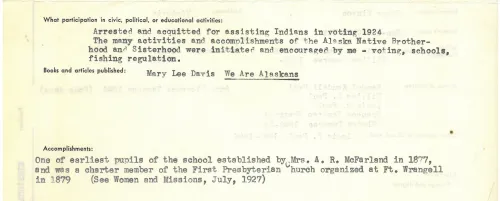
In 1922, she assisted a Tlingit relative, Charlie Jones, in voting, which was considered a felony. Charlie Jones was known to her as Chief Shakes. Tillie writes that "Chief Shakes thought that since he was a natural born citizen he had a perfect right to vote if he chose … I knew that there would be trouble as the chief could not speak English." She’d accompanied Chief Shakes/Charlie Jones to city hall, where "The judge rejected the Chief’s vote on the basis of the Chief’s inability to write his own name," she recalled. "While we talked, a foreigner, a Norwegian, ambled onto the scene and asked the Hon. Judge if he was eligible to vote. The judge immediately said, 'of course you can.' It seemed that a man newly arrived in our country had more right to vote than a man born and reared in this great land of ours."
Her son defended both Charlie Jones and Tillie Paul at trial as American citizens, and won, setting a precedent that was soon solidified in the Indian Citizenship Act of 1924.
Tillie and William Tamaree spent the next four years serving in Petersburg before declining health led them to return to Wrangell, where Tillie continued to serve the community and her church with vigor and passion.
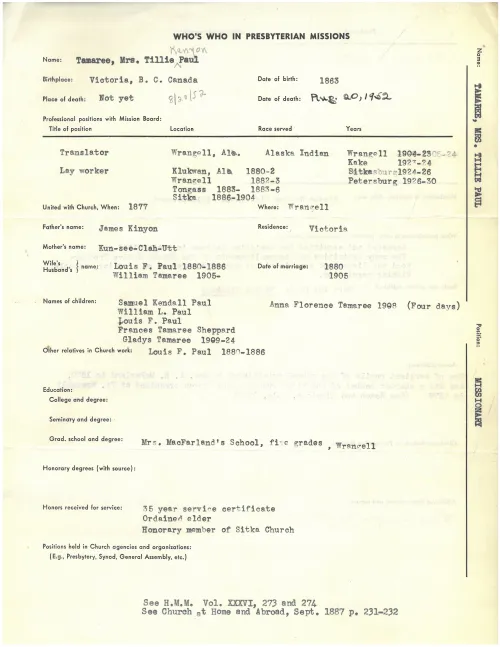
The Rev. Russell F. Pederson was serving as the pastor of the Wrangell Presbyterian Church at the time of Tillie’s election as Ruling Elder in 1930. After the ceremony, he sent news to the Board of National Missions, sharing that "Yesterday the First (Thlingit) Presbyterian Church of Wrangell elected Mrs. Tillie Paul (William) Tamaree a Ruling Elder and as the missionary I had the pleasure of ordaining her." The recipient of that letter then forwarded the news, asking "could we not give some publicity to this?"
Indeed, after her historic ordination, Tillie became the subject of various press releases, letters, and news headlines. In a March 18, 1931, letter sent from Ketchikan, Alaska, to the Witherspoon Building in Philadelphia, Pennsylvania, Tillie’s son William Paul offers a few corrections to the February 18 press release published by the Board of National Missions. He corrected the misspelling of his father's name, as well as the misinformation provided regarding Tillie’s founding of the Alaska Native Sisterhood (she did not) and her sons’ founding of the Alaska Native Brotherhood (they did not) — "None of us had anything to do with the beginnings of these organizations. It would be a matter of pride to us if we had, but the A.N.B. had been running six years before my brother joined and eight years before I did."
The press release made brief mention of Tillie’s second husband, William Tamaree, declaring that he was "of the Stickeen tribe, an elder in the native church at Wrangell." William Paul commented on this, writing, "Another thing is your use of the word 'Stickeen.' I know Dr. Young uses that name in referring to Wrangell Indians, but it is not commonly in use here, and would be considered as meaning the people who live up the Stickine River, who are of an entirely different language." William’s clarification of diversity and his advocacy for the indigenous peoples of the Alaskan coast is both admirable and necessary.
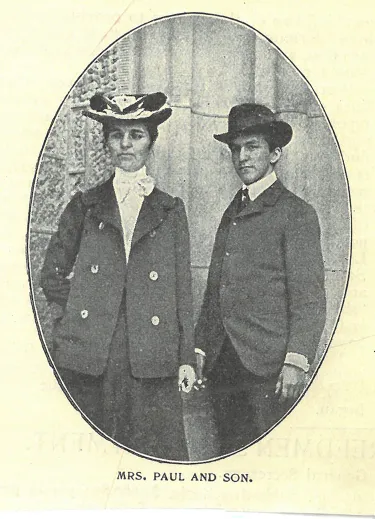
By 1948, Tillie and her husband had relocated to Seattle, where Tillie would spend the rest of her years. She died on August 20, 1952.
Tillie Paul Tamaree laid the groundwork for many of the phenomenal indigenous leaders who shape the PC(USA) today, like Ruling Elder Elona Street-Stewart, who was elected Co-Moderator of the General Assembly in 2020. Street-Stewart is a descendant of the Delaware Naticoke Tribe and was the first Native American to serve as a Moderator of the PC(USA), as well as the first to serve as a synod executive.
The Presbyterian Historical Society is fortunate to hold several records related to the Tlingit community, including digitized records from the Memorial Presbyterian Church in Juneau, Alaska, a congregation with a mostly Tlingit population. PHS is honored to carry materials written in Tillie Paul Tamaree's own hand, and to be able to share her story with you in honor of Indigenous Peoples Day.
Enjoy these glimpses into Presbyterian history in years past? Donate to the PHS Annual Fund, which supports the efforts of the Presbyterian Historical Society to collect, preserve, and share the past in order to transform your current perspective on church history.
You may freely reuse and distribute this article in its entirety for non-commercial purposes in any medium. Please include author attribution, photography credits, and a link to the original article. This work is licensed under a Creative Commons Attribution-NonCommercial-NoDeratives 4.0 International License.