PC(USA)’s Office of Public Witness helps create new clergy resource on gun violence prevention laws
The resource focuses on Extreme Risk Protection Orders, which remove temporarily firearms from at-risk individuals
In the work to reduce and prevent gun violence, extreme risk protection orders offer a crucial legal pathway to intercede during dangerous moments involving firearms. ERPO laws vary by state, but understanding how these laws work helps faith leaders support their communities when such circumstances arise.
Now, the Office of Public Witness of Presbyterian Life & Witness, an agency of the Presbyterian Church (U.S.A.), has partnered with others to produce Extreme Risk Protection Orders: A Clergy Resource Guide, designed to “help faith leaders recognize warning signs and understand how to connect congregants with life-saving intervention resources.”
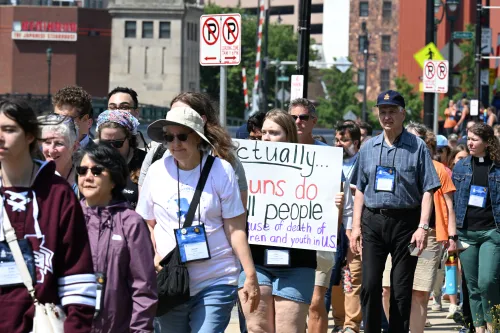
Commonly referred to as “red flag laws," ERPSs are civil court orders that prevent someone from being able to buy or possess a firearm if they are deemed to be a danger to themselves or others. An ERPO also requires a person to surrender any firearm or concealed carry permit they already possess. There are two types of ERPOs — ex parte and long term — but both are ultimately temporary, valid for several weeks, months, or up to a year or more.
The new resource for faith leaders was developed as a collaborative effort between the Office of Public Witness, Johns Hopkins Center for Gun Violence Solutions, Jewish Women International, Faith Leaders for Ending Gun Violence and Faiths United to Prevent Gun Violence. It is available online for free through Johns Hopkins.
On Tuesday, Johns Hopkins hosted a webinar to introduce and discuss the resource and help participants understand how it can be used to help clinicians reduce gun violence. The panel discussion was moderated by Spencer Cantrell of Johns Hopkins. The panel included Dr. Andrew Peterson, the Representative for Peacemaking in the PC(USA)'s Office of Public Witness.
Twenty-two states, as well as Washington, D.C., currently have ERPO laws in place. But the exact parameters of who can request an ERPO, the legal requirements for one to be granted and how long they last vary significantly by state. In every state with an ERPO in place, law enforcement officers are qualified to request one, and in most places, close family members are also qualified. Some states extend that circle to include co-workers, educators and medical professionals. Currently, no states include clergy among those eligible to petition for an ERPO.
However, the webinar emphasized that clergy have a crucial role to play in the successful implementation of ERPOs due to their ability to recognize warning signs and connect people with needed resources.
The Rev. Hope A.J. Christensen, who is an Episcopal priest and the Executive Director of Faith Leaders for Ending Gun Violence, emphasized that even though clergy are not often thought of as “first responders” in the traditional sense, they are often among the first people contacted when a community member is in crisis.
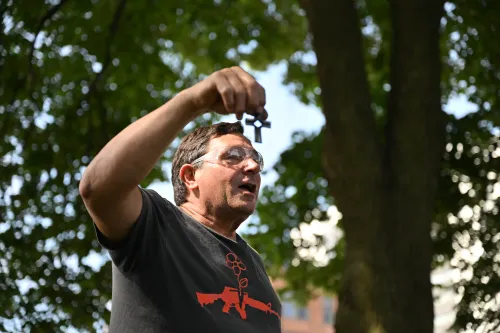
“This is due in large part to the special, often longitudinal relationships clergy have with members of their communities,” Christensen said. “In most communities, we’re seen as trusted partners and often also as skilled communicators and public speakers. So, in pulpits and podiums in every corner of the country, we’re able to communicate and connect the moral foundations of our faith traditions to the circumstances of people’s lives and the issues facing our communities and our country.”
She went on to say that clergy who are informed about ERPOs can support people who are qualified petitioners and are concerned about loved ones, providing both pastoral care and necessary connections to resources throughout the process.
Cantrell acknowledged that ERPOs, which were first developed in the aftermath of the 2012 Sandy Hook massacre, are one part of a larger effort to address the gun violence epidemic in the United States, In 2024, 44,447 lives were lost to gun violence in the United States. The large majority were suicides, followed by homicides, accidents and legal interventions.
ERPOs have the potential to prevent violence in numerous situations including self-harm, domestic violence, school shootings and workplace and community violence. According to the webinar, a 2024 study found that one life is saved for every 17 to 23 ERPOs issued. And often, subjects of ERPOs are grateful for the intervention. Cantrell emphasized that ERPOs are issued based on concerning behaviors, not mental health conditions.
Panelists shared that the resource was developed through listening sessions with church members and community stakeholders to learn what kind of support they wanted. People felt overwhelmed by how much information there was to know about ERPOs. They also wanted to better understand the role that clergy can play and how to engage their congregations around the topic.
The resource includes guidance on the ERPO petitioning process and how to discuss ERPOs and gun violence with your congregation, as well as information on other gun violence prevention strategies.
The PC(USA) has a longstanding commitment to gun violence prevention efforts. In 2022, the 225th General Assembly launched the “Decade to End Gun Violence” which called for ongoing policy and action commitments across all levels of the denomination. Just this past month, the Presbyterian Peace Fellowship included gun violence prevention as a major part of its the James Atwood Institute for Congregational Courage in Kansas City.
At that event, Peterson explained the decision to collaborate on the new ERPO resource for clergy.
“There are a lot of folks doing good work on this already. We don't have to have our own Presbyterian version of every piece of it," Peterson said. "Instead, what we could do is be good partners in ministry.”
In addition to a digital copy of the resource being available for free online, a recording of Tuesday’s webinar is also available to watch on the Johns Hopkins Center for Gun Violence Solutions Youtube channel.
You may freely reuse and distribute this article in its entirety for non-commercial purposes in any medium. Please include author attribution, photography credits, and a link to the original article. This work is licensed under a Creative Commons Attribution-NonCommercial-NoDeratives 4.0 International License.