This is the second article in a two-part series. Click here to read part one.
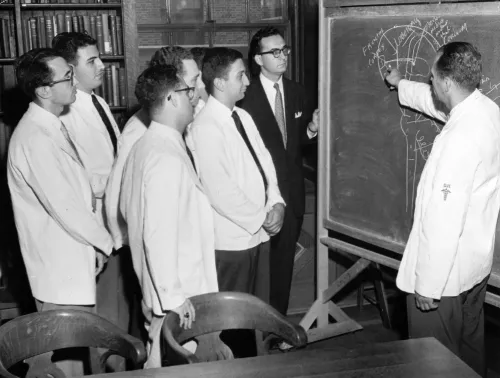
Attempts to explore, understand, and manipulate the human mind, individually and collectively, shaped mid-century culture and the Cold War. Professional mental health treatment, such as these hospital chaplain interns learned in 1955, included chemical and electrical therapies alongside environmental and behavioral ones in order to change personality, activity, and beliefs.
LSD was considered a potential psychiatric wonder drug in the 1950s, capable of opening minds resistant to therapeutic manipulation. The hallucinogenic drug was synthesized in 1938 and first found to have psychoactive properties in a commercial pharmaceutical lab in 1943. Its chemical structure was the intellectual property of Sandoz, based in Switzerland; its existence was a trade secret until Sandoz began drug trials in 1947.
The medical profession at the time thought LSD might be a legitimate treatment for psychiatric illness. Capable of opening minds resistant to therapeutic manipulation, LSD was considered a potential psychiatric wonder drug in the 1950s. Covert CIA funding attracted reputable researchers, fueling a boom in LSD experiments (and informal, exploratory use) in hospitals, universities, and prisons across the United States.
Ironically, if the 1960s are remembered as psychedelic, it’s because the CIA seeded new strains of drug traffic in the US.
The more formal experimentation took place in prisons. Harris Isbell, the director of the Addiction Research Center in Lexington, Kentucky, had previously requested and was denied a federal grant for an addiction treatment research project. By the standards of the American government, the project he'd outlined was insupportably unethical. However, with CIA backing and pressure, Isbell's project of clandestine human experimentation on mostly black incarcerated people in Kentucky ended up federally approved and funded.
The CIA bought LSD from Sandoz labs in Switzerland and shipped it, along with other narcotics, to American prisons to be given to unwitting incarcerated people under the guise of trying to cure them of opioid addiction and other psychiatric conditions.
Prisoners did not know what they were taking, and some participated in the projects only because project leaders like Isbell bribed them with CIA-supplied heroin. If the CIA genuinely believed LSD might help treat addiction, it was only as a side effect of the mind control they were seeking.
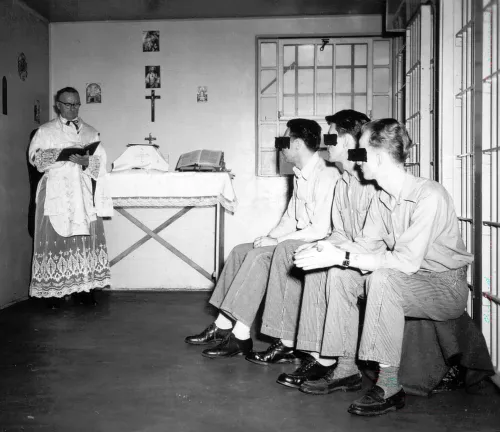
As chaplains and prison missions attempted to treat criminality with religion, the CIA used incarcerated Americans for human experimentation. The most ‘expendable’ prisoners, including black drug addicts and death row inmates such as these photographed in 1952 in Utah, were convenient populations for experiments that, without behind-the-scenes CIA backing and Cold War justification, might have been considered medically unethical and unacceptable. Like refugees adrift in a confused, war-torn continent, the CIA considered incarcerated people unlikely to be believed, unlikely to be missed, and unlikely to elicit public sympathy.

Similar CIA-backed, supposed-psychiatric treatment projects happened in many American prisons, and in other sites of instructional care. Some were horrific in their impacts--a decades-later investigation of just one research project described it as “comparable to Nazi medical atrocities” (quoted in Kinzer, 140).
Researchers and their sponsoring institutions did not always know they were working for the CIA, which is legally prohibited from operating on American soil. The CIA did not routinely inform anyone in the government of their activity, nor were they asked to give account. Without oversight, the CIA flagrantly violated their written limitations. To avoid public scrutiny of their domestic activity, Gottlieb established multiple front organizations to distribute grants for LSD research to dozens of hospitals, universities, and military bases. The glut of cash around LSD attracted interest and helped fuel medical exploration of the drug. Any ethical qualms researchers or administrators might have about using it on vulnerable people faded in comparison to the urgency to win the Cold War.
At the same time as this formal experimentation, there was also an explosion of informal LSD experimentation. Gottlieb had tried LSD prior to becoming the head of MKULTRA, which was why he was convinced of its potential. He continued using it, as did many CIA officers and those who had access to LSD via the CIA. As Stephen Kinzer summarizes agents’ recollections, "They spiked each other’s coffee and liquor; they spread it on their food. They tripped out in their offices and in safe houses […] They were stoned for days at a time" (101). This profligacy might have had the official excuse that agents needed to be able to recognize and handle being drugged unexpectedly. But the truth is that the CIA found out first what so many counterculture youth would: hallucinogens can be fun.
Soon after CIA operatives were their high society contacts. Ambassador to Italy when photographed in 1955, Clare Booth Luce was a familiar face with the religious press, which had covered her 1940s conversion to Catholicism while she was serving in Congress. During her affair with CIA director Allen Dulles, Luce was encouraged by her lover to visit Los Angeles psychologist Sidney Cohen. It was in Cohen's care that she took LSD during psychotherapy--a treatment which she credited with changing her life. Many elites of the 1950s tripped on LSD dozens and even hundreds of times before it became a sensation in the counterculture.
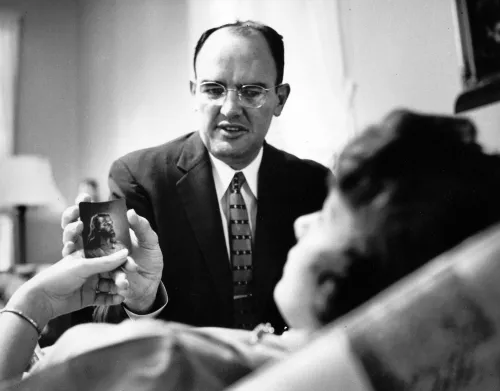
Many doctors promoted LSD as a psychotherapeutic tool in the 1950s. They hoped LSD, along with hypnotism, meditation, and other mental therapies, could help individuals return to the hegemonic fold from a broad range of antisocial pathologies like substance abuse, depression, schizophrenia, and juvenile delinquency. These practices permeated so far that in 1960, this minister in Conyers, Ga., promoted hypnotism as a part of pastoral counseling for challenging cases.
LSD exploded in popularity as the enjoyable, atomic age cure for any psychiatric condition before it jumped to recreational use. And then, LSD became a focal point of, and scapegoat for, youth counterculture.
MKULTRA's LSD research began contracting just as LSD took drug culture by storm. It took a decade of largely pointless and sometimes destructive experimentation, but by 1962, Sidney Gottlieb and the CIA were disabused finally from believing LSD was the key to mind control. American LSD use and oppositional public pressure were both high enough that the American government tried to choke off the supply, pressuring Sandoz to stop manufacturing LSD in 1965 and legislating the drug out of legitimate medical use.
Since virtually nobody in American government outside the CIA knew about MKULTRA, they treated the introduction of hallucinogenic drugs and growth of the counterculture as a threat to American society. They saw it as a communist plot.
By the time the CIA finally gave up on it for their Cold War arsenal, LSD had exploded in recreational use. Churches joined other institutions in alarm about drug use, particularly LSD. At the time of this 1967 photo, the American government had already classified LSD as a Schedule 1 drug and limited its commercial production to try to stem the supply to meet CIA-created demand in America. Unwitting of its origins, clergy and other civic leaders tried to educate away the demand with dire warnings about "the harmful effects drugs have both on the users and society."
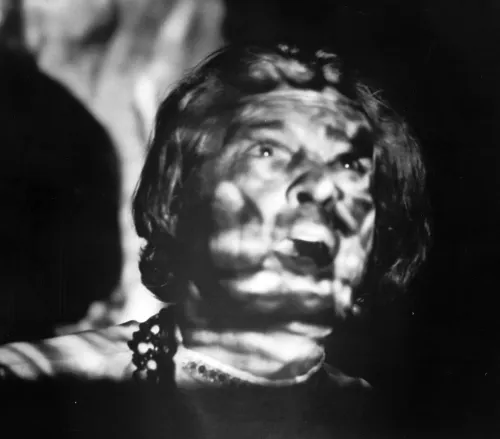
Whereas the CIA tried to use LSD to protect the status quo, out of its control in the counterculture, LSD became synonymous with hippies, radical imagination, and social critique. Dr. Tim Leary, seen here at a 1967 religious service in New York City, advocated sacramental use of hallucinogenic drugs. This was an attempt to use freedom of religion to legitimate such drug use, and to try to reframe social justice movements derided as communist plots instead as spiritually inspired efforts to bring society closer to God through self-knowledge and peace.
The full extent of MKULTRA and CIA abuses in pursuit of mind control remains unknown. The CIA as an institution and many individual leaders, including Allen Dulles and Sidney Gottlieb, cited national security and faulty memory to obfuscate the CIA’s actions. They went so far as to destroy project files during Congressional investigations in the 1970s, attempting to conceal MKULTRA's existence or at least render specific accusations against the CIA legally unknowable. It might be obvious that the MKULTRA files had been destroyed to obstruct justice, but the CIA pretended otherwise, and Congress held neither the agency nor any individual to account.
As Congress investigated CIA misconduct and abuse, the Cold War mindset remained firm. Congress had to look like it cared about alleged abuse of power; they railed against Communist governments for abusing their citizens. But they saw the CIA as too important to the war effort against those Communist governments to put any oversight in place, let alone reform the agency. It was better to look busy but not look too closely, to avoid being implicated in anything that might one day be described as a coverup.
During these investigations, President Ford told Allen Dulles’ successor as CIA director that he didn’t need to hear about the CIA’s activities to approve them: "I automatically assume what you did was right unless it’s proven otherwise" (quoted in Kinzer, 215). The investigations made front page news, tantalizingly vague about CIA malfeasance and domestic operations, but the world moved on. Congress’s promised further investigations never came.

Officially, MKULTRA ended before these 1970s investigations began. LSD wasn’t the key, but Sidney Gottlieb didn’t give up on mind control just yet. In the 1960s, his department pivoted from funding misrepresented pharmaceutical experiments in prisons to committing war crimes in Vietnam. In the CIA’s calculus, far-off suspected communists are more expendable than American citizens--just as they had been in the aftermath of World War II. Like the LSD experiments on American soil, these attempts to chemically, surgically, and/or electrically compel specific behaviors failed. It’s unknown how many prisoners of war and civilians caught up in counterinsurgency operations suffered and died in this new, fruitless CIA project.
Gottlieb retired from the CIA in 1973, having finally lost faith in mind control. He lived out the remainder of his life in anonymity, even appearing under a pseudonym and giving testimony remotely during the toothless Congressional investigations. Gottlieb died at home in 1999. MKULTRA hovers in American memory as something more than a myth, but mysterious enough to be suspected anywhere.
And what of the man who inadvertently set off the brainwashing panic at the CIA?
Sentenced to life imprisonment at his show trial in 1949, József Mindszenty was imprisoned in Hungary throughout the MKULTRA years. He was a rallying cry for diasporic Hungarians and Catholics outraged at communist control of Eastern Europe; Cardinal Mindszenty, alongside other imprisoned and killed Church leadership, remained popular among American Catholics for their suffering behind the Iron Curtain.
From 1956, Mindszenty was confined to the American embassy in Budapest; perhaps this helped finally persuade the CIA he hadn’t been brainwashed after all, only conventionally tortured into his 1949 confession. Regardless, American government and press could still use his case as evidence of the evils of communism, attempting to snuff out political opposition and belief in God.
Mindszenty remained in the embassy until 1971, when the Vatican made a deal with the communist government that allowed him to leave Hungary and never return. Hailed as a nationalist, anti-communist hero, he died in exile in 1975.
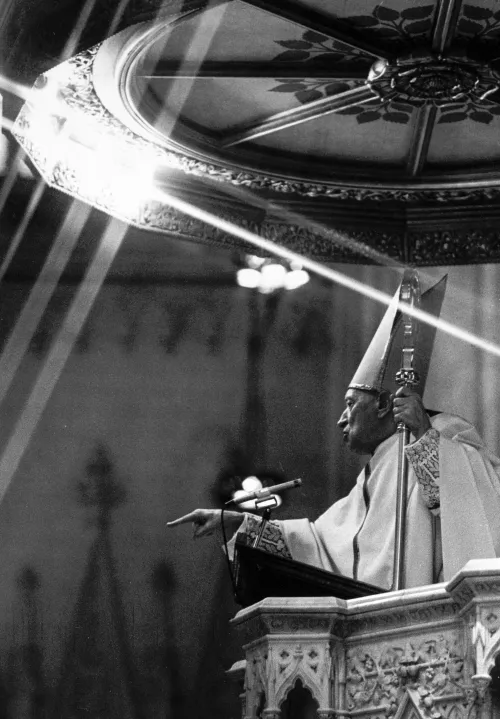
Photographed while on tour in 1974, three years after his exile from Hungary and just a year before his death, Mindszenty was a staunch Cold Warrior, resisting liberalizing and secularizing forces from within and beyond the Church. Though he may have supported their goals, it’s unlikely Mindszenty ever knew he had set off the CIA’s quest for mind control and MKULTRA experimentation with LSD.
Further Resources & Reading
Kinzer, Stephen. (2019). Poisoner in chief: Sidney Gottlieb and the CIA search for mind control. New York: Henry Holt and Company.
O’Neill, Tom & Piepenbring, Dan. (2019). Chaos: Charles Manson, the CIA, and the secret history of the sixties. New York: Back Bay Books.
Breen, Benjamin. (2024). Tripping on utopia: Margaret Mead, the Cold War and the troubled birth of psychedelic science. New York: Grand Central Publishing.
Evans, Robert. (Host). (2022, October). MKUltra: When the CIA tried to destroy free will [Audio podcast episodes]. In Behind the bastards. Cool Zone Media.
You may freely reuse and distribute this article in its entirety for non-commercial purposes in any medium. Please include author attribution, photography credits, and a link to the original article. This work is licensed under a Creative Commons Attribution-NonCommercial-NoDeratives 4.0 International License.