On September 23, PHS Records Archivist David Staniunas spent the day with the archives team and members of session of First Presbyterian Church, Dallas, Texas – a church with great skills and resources, in need of a small dose of niche expertise. We’re grateful to former PHS Board chair Ernie Higginbotham for bringing us in. Because your congregation might have some of the same experiences as First Dallas, here’s some of what we did.
The church’s most essential records – session minutes and registers – are held in an upstairs office with climate control and are well organized. Extensive work on organizing the church’s newspaper and bulletins was also done in the late 1990s. So, we focused our attention on essential records of groups other than the session and commemorative records of the congregation, housed below ground in wooden and metal cabinets.
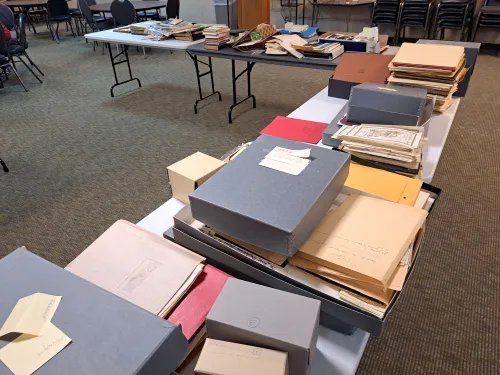
Before the event, on the 22nd, every cabinet was opened to survey the collection. We found a couple of groups clearly belonging to one creator, including a cabinet of Presbyterian Women’s records and a cabinet documenting the tenure of John F. Anderson, long-serving pastor of First Dallas who was the very last moderator of the PCUS. We laid these out to work on first, as they’d likely be easiest to conceptualize.
We then laid out for the group a couple of tranches of material in need of sorting, and not clearly belonging to any distinct group other than the whole church. These were the “messes” we would deal with once we got a handle on the easy stuff.
Presbyterian women in First Dallas have organized themselves for mission at least since the 1920s and kept reliable minutes since the mid-1920s. Most of the minutes of the Women’s Auxiliary (later Women of the Church) and the Business and Professional Women’s Circle were held in three-ring binders, most of which had some mold exposure. Women in the church also produced scrapbooks, histories, and photographs – we sorted those separately from the minutes.
We rehoused each volume of minutes in acid-free folders, labeled and dated the folders, and got them into boxes. This habituated us to simplicity: controlling big groups first, so that more care can be applied later if needed. There is some date overlap across our boxes, and we didn’t spend time perfectly calendaring everything. In a world where you have keyword search across text files online, arrangement matters less than description.
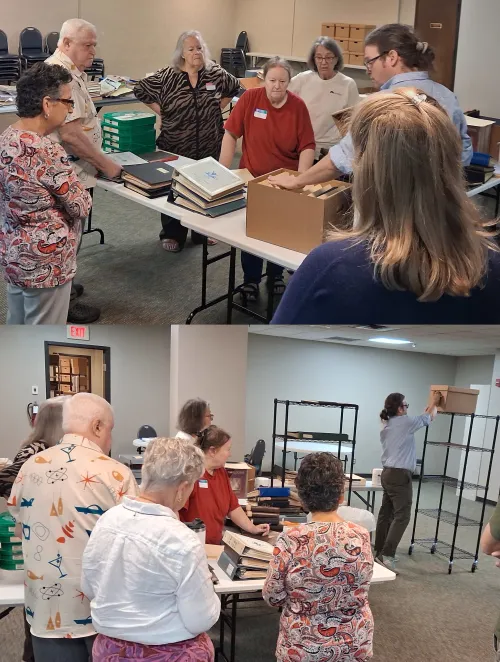
While a group of us worked on Presbyterian Women records, another group applied themselves to John Anderson’s material. They likewise grouped like things with like, described date ranges relatively broadly, and took minimal preservation interventions – removing any metal that could hurt a person, removing vinyl or plastic sleeves where it wouldn’t harm the content, and getting things into folders.
By noon or so we had about 12 cubic feet of material rehoused and given temporary box labels, and it would soon be time to move on to thornier work.
The group had skilled and experienced people in it, and over lunch they spent time thinking about what the next steps for their archives would be, and they had questions.
“Should we keep all these photographs? Lots are from the 1990s, used for church directories, they’re not all great.”
If you’re not under space constraints, you don’t have to solve that problem right now. What will help is if you can locate all the photographs you have, and group them roughly by decade – clothing and hairstyles are your guides. That way you know what you have, and can get a sense of which among the group are the best quality aesthetically, or which ones document important mission work, or which ones highlight important moments in the life of the church. But you can’t know any of that until you have basic physical control of them.
“How can we get a handle on all the images of the congregation that are produced digitally? There must be thousands every week!”
Even if you could collect a great many images of the congregation as a whole, you probably couldn’t manage them in a meaningful way. You could however collect documentation around special themes or events – a new pastor’s installation, the church’s accompaniment with migrants, a month in the life of your homeless ministry. Keep folders in your remote storage with meaningful titles, get images and audio and video into them, and add a text document that tells what the documentation is of, when it is from, and who made it.
“Where can we put our records up online? What about the Internet Archive?”
You sure could do that, if the things you scan are already published, or if your clerk of session signs off on publishing unique things like your session minutes and registers. We at PHS apply a lot of care in describing digitized content, and that’s important to avoid ambiguity. We love the Internet Archive, but community-contributed digital collections can get a little fuzzy in their descriptive practices. Good description makes good search. Take a look for yourselves. Among the top hits for “first presbyterian church dallas” are a church in South Dakota, and the Methodist and Unitarian churches of Dallas, Texas.
“We could digitize our audio and video at the Dallas Public Library Heritage Lab.”
You totally could. DPL is one of a network of Memory Labs -- public do-it-yourself digitization studios. If you use them, you should make sure that whatever you digitize is captured at a resolution, sampling rate, and bit-depth that is robust enough to be useful going forward. You should save in lossless formats if at all possible. And you should find space in the church’s own digital storage to house all your digitized content.
With our sorting skills flexed by the afternoon, the very mixed batches of material left to us turned out to be comprehensible, so long as we moved from the general to the specific. We tried to separate out material that had a clear subject or theme – councils of the church other than the Women, biographical files on significant people, mission focuses of the church. Then, looking at everything else, we divided published from unpublished content – flyers, brochures, postcards, pamphlets separated from photographs, audio-visual material, subject files, and correspondence. And we modified our assumptions. If we found, in a pile of publications, that many of them were on fundraising, we developed a “Fundraising” folder. If there were newspaper clippings that spoke to the content of the photographs near them, we kept all that material together.
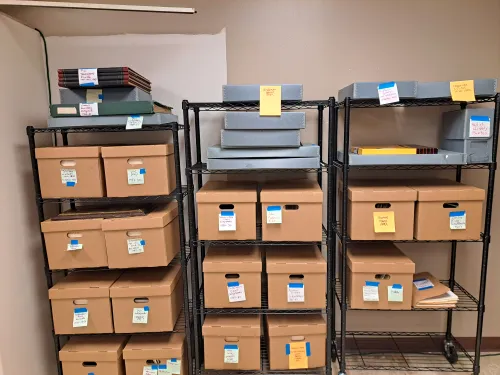
By 5PM we had a collection of about 24 cubic feet in 30 boxes, with box-level description in a shared Google Doc. And we knew our next steps. David took back to PHS, with the group’s affirmation, a selection of material for digitization – just to show off our digitization services. And some time soon, the group, with its muscle memory for categorization developed, would sort out the rest of the lower level’s storage, and would apply folder-level description to their inventory, putting them in position to reliably share more of their church’s mission and history with the wide world.
Learn more by visiting the following links:
You may freely reuse and distribute this article in its entirety for non-commercial purposes in any medium. Please include author attribution, photography credits, and a link to the original article. This work is licensed under a Creative Commons Attribution-NonCommercial-NoDeratives 4.0 International License.