Did you know that you can see MKULTRA at the Presbyterian Historical Society?
Archives are extraordinary resources for exploring history, often in ways you wouldn’t expect and the original collectors couldn’t have imagined. The Presbyterian Historical Society is the oldest denominational archive in the United States, and everything we collect relates to our mission of preserving and sharing Presbyterian history. And yet! Our collections can tell so many stories that you might think have nothing to do with Presbyterians.
Sadly, PHS doesn’t have a trove of hidden CIA files. But with the power of hindsight, MKULTRA wasn’t as sneaky as you might think a secret mind-control-project run by the US government would be. I work with the Religious News Service collection, which is a photojournalism archive spanning 1945-1982. RNS wasn’t meant to tell the story of MKULTRA, but it does. And by using RNS images to illustrate this essay, I hope to show how archival material can be put to surprising uses, and encourage you to explore PHS collections and use them to tell unexpected stories.
During World War II, because we believed Japan and Germany were doing so, the United States government secretly began studying and developing biological weapons. Using bioweapons is a war crime, but the United States reasoned that if their enemies had bioweapons, they needed to know how they worked. The war ended in 1945, but the weapons project continued as a chemical development division.
The postwar geopolitical landscape quickly balkanized into the Cold War, a long, semi-veiled competition between the United States and the Soviet Union for power, influence, and legitimacy. The Soviet Union quickly developed atomic capabilities and imposed totalitarian control over previously independent European countries. In 1947, American organs of wartime espionage and sabotage, including the chemical division, were reorganized into what would become the Central Intelligence Agency, a perpetual foreign intelligence and influence operation. The CIA was like any secret service operation, but the enemy was not merely the Soviet Union. The enemy was the idea of communism.
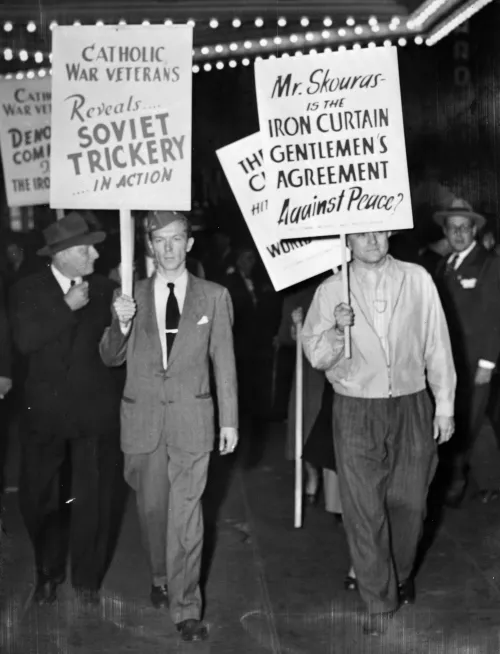
The Soviet Union and United States were allies in World War II, but irrepressible antipathy led to a conflict that would define the mid-century. Seen here picketing what they saw as an anti-Soviet movie in 1948, American communists called foul on the about-face about their wartime ally, but they were a tiny minority held in great suspicion. A Catholic association for war veterans led a counterdemonstration that voiced the persistent idea in American culture that there could be no peace because communism anywhere threatened Americanism--capitalism, democracy, Christianity, and consumerism.
Living in 2026, we know that the Soviet Union collapsed around 1990, and the proxy wars in which the United States intervened against the Soviet Union, with all their horrific atrocities and death tolls, could not kill ideas. But in 1949, no one knew that. At least, no one in the government was willing to believe it. They believed “monolithic Communism, directed from the Kremlin, was a demonic force that mortally threatened the United States and all humanity.” They assumed that Soviets thought the same of the United States. And therefore, “no sacrifice in the fight against Communism--of money, morality, or human life--could be considered excessive” (Kinzer, 31).

The CIA wanted to influence minds, and not in just a metaphorical way. At first, they were after a truth serum. Scientists who had been working on bioweapons during the war had begun, under the names MK Naomi and MK Bluebird, developing drugs for the CIA. The CIA used suspected Soviet agents captured and interrogated in East Germany as guinea pigs. It should be said that it’s not clear that these victims were agents of communism. It’s not clear that there were that many agents of communism to catch--but regardless, the CIA was convinced it was better to be safe than sorry.
Many victims of these early drug experiments were refugees, plucked from among the millions dispossessed during the war. RNS puts a cheerful face on its coverage of church work with World War II refugees from 1945 through the late 1950s, when thousands still were displaced and living in camps 15 years after the war had ended. On the lighter side of this humanitarian disaster, these children at a Bavarian orphanage received food from the United States in 1951. Other refugees suspected of being communist agents instead saw imprisonment, torture, and medical experimentation at American black sites in Europe.
And to be clear, these experiments were failures. Reactions to drugs and torture were not and are never predictable or replicable. But new drugs are exciting, drug experimentation was fascinating, and it seemed like it might be possible. And soon, the CIA became certain it was possible.
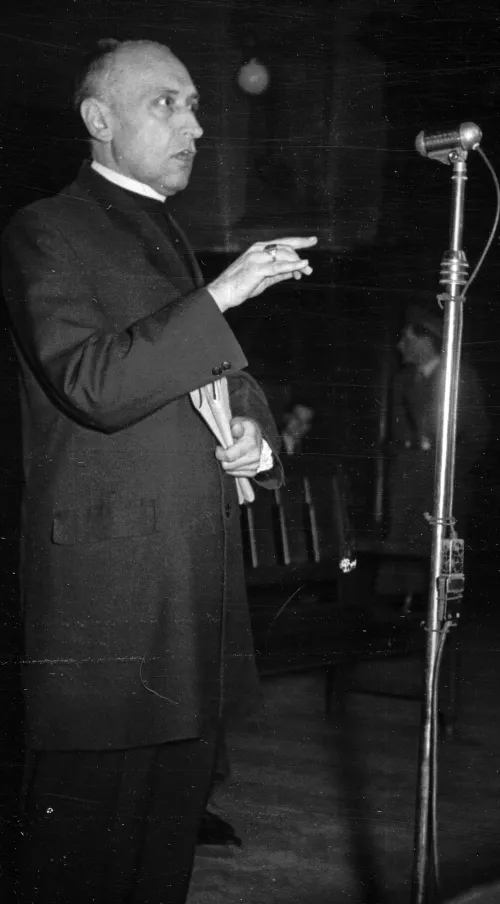
Enter a Catholic archbishop.
József Mindszenty, the face and voice of the Catholic Church in Hungary, was on trial for treason. On February 3, 1949, the Hungarian government arranged a television broadcast of his confession to “attempting to overthrow the government, directing black market currency schemes, and seeking to steal the royal crown […] to re-establish the Austro-Hungarian Empire” (Kinzer, 32).
It was obvious to everyone at the time that the government had coerced this confession for propaganda purposes. Any former prisoner of war, of which there were many in the late 1940s, could have told you that such coercion is easily accomplished with physical and mental torture of the type Mindszenty had faced since his arrest in December of 1948. Mindszenty, after suffering under Nazi occupation in World War II, had spent four years under the pressures of both the communist government in Hungary and the humanitarian crisis in postwar Europe. Immediately before this trial, he endured over a month of imprisonment, solitary confinement, and torture.
But in the CIA, they made the unsupported leap to conclude the Soviets must have cracked mind control. The CIA couldn’t imagine any reason other than brainwashing that he would plead guilty.
And if the communists had mind control, then the United States needed mind control.
One of the true believers in Washington was Allen Dulles, who had helped establish the CIA and was made its director in 1951. Dulles soon elevated chemist Sidney Gottlieb to head an expanded drug project called MK Artichoke. Under Artichoke, the US is known to have secretly dosed, tortured, and killed political targets at black sites in Germany, Japan, and the Panama Canal Zone. The full extent of the project remains unknown.
It’s instructive to examine one case closely to see how delusional this project was on premise. The first subject the CIA tortured in Fort Clayton in the Panama Canal Zone was a Bulgarian politician named Dmitri Dimitrov. The Panama Canal Zone was a colonial outpost of the United States and its Cold War efforts in Latin America. Dimitrov had been a CIA informant in the Communist government of Bulgaria, but the CIA suspected he was going to work for the French intelligence agency instead of them.

France is an American ally, but secret services do not like to share. The CIA orchestrated Dimitrov’s kidnap and torture in a Greek prison for six months. The Greeks didn’t get any worthwhile information out of him, and sent him back to the CIA. It was by then 1952, and a CIA officer noted Dimitrov “has become very hostile toward the United States, and our intelligence operations in particular” (Kinzer, 52), concluding that he'd be a good subject on whom to test new mind control techniques.
The CIA held Dimitrov in Fort Clayton for three years, with absolutely nothing to show for it. Unlike many held in Europe and Asia, Dimitrov was lucky enough to survive and eventually be released--though the CIA was not yet done with him. They quashed his attempts to publicize CIA activities by pressuring American media to ignore Dimitrov as a “disreputable, unreliable” fantasist (53).
Brigadier General William K. Harrison, seen here in 1955 shaking the hand of a bookstore employee, arrived in Panama in 1954 as the commander in chief of military operations in the Caribbean. He probably knew something of the CIA holding Dmitri Dimitrov since 1952 at Fort Clayton, one of the military installations under his command and located only a couple miles away from his headquarters. The CIA sent Dimitrov back to Europe around 1956, and Dimitrov eventually entered the United States as a refugee.
In 1953, Alan Dulles made a speech to fellow Princeton alumni about the Cold War he was waging. “The Soviets are now using brain perversion as one of their main weapons […] Some of these techniques are so subtle and so abhorrent to our way of life that we have recoiled from facing up to them. […] We in the West are somewhat handicapped in brain warfare” because of the commitment to freedom. Even as Dimitrov and unknown others were being tortured under his direction, Dulles said, “We have no guinea pigs to try these extraordinary techniques” (quoted in Kinzer, 72). Three days after this speech, Dulles approved the expansion of MK Artichoke into MKULTRA, with the lofty goal of giving the American government the ability to dictate people’s deepest held moral and political beliefs, and even their actions without their knowledge.
Dulles placed Sidney Gottlieb at the head of MKULTRA, and tasked him with solving mind control in the background of a long series of proxy fights with the Soviet Union. Throughout these clandestine operations, Gottlieb was also charged with helping maintain the lie that the United States was a moral actor--unlike the godless, communistic Soviets, who do such terrible things in violation of God-given human dignity and freedom.
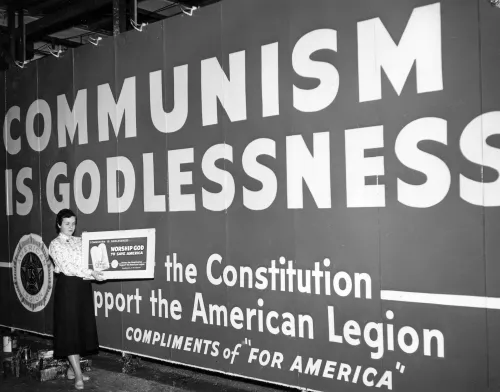
In this project, the American press was a willing collaborator, viewing all allegations against the US through the lens of threatened national security and communist plots. The Soviet Union was not merely a geopolitical antagonist during the Cold War, but the root of a destructive, demonic force in the world--communism--which Americans could and must combat on all fronts. The same logic that led the CIA to unethical and illegal human experimentation for what they saw as the greater good also led to panics about Americans not attending church often enough, children not going to Sunday School, and increasing secularism. Campaigns such as this 1955 billboard urged Americans to monitor their own and others’ activities to be aligned with the anti-communist crusade. Later, the CIA admitted to having, but did not identify, hundreds of “assets” in the American media that helped manipulate public opinion and quash unfavorable stories.
When former American servicemembers claimed they had used biological weapons during the Korean War (1950-1953), Gottlieb prepared a “press pack” to shape news coverage. He cited friends and associates as neutral experts who said that believing the American military would use illegal bioweapons was as ridiculous as believing that “flying saucers have landed.” Surely, he suggested, and the press parroted, the best explanation was that dastardly communists had brainwashed these poor American servicemen.
Communist brainwashing was the go-to explanation for any behavior Americans, particularly those at the top of the hegemonic order in the halls of power, saw as disturbing the status quo.
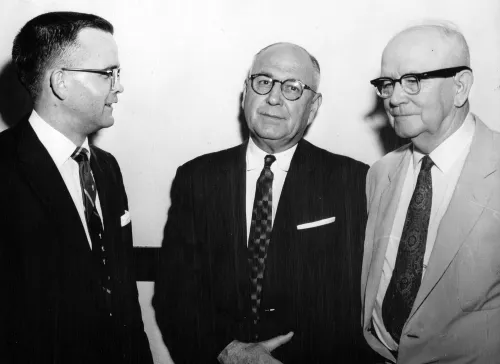
But since anything mildly critical of the status quo looked to the US government like a domino in the imagined communist bid for global conquest, the brakes soon fell off. The CIA and its domestic intelligence counterpart, the FBI, treated civil rights movements, labor organizing, and even anti-poverty programs as Soviet plots. In 1958, Arkansas Governor Orval Faubus alleged a "large number" of Presbyterian (Southern) clergy had "been brainwashed by leftwingers and Communists," probably because they pushed back against his attempts to maintain segregation in Arkansas schools. State and denominational leadership seen here demanded an apology; RNS doesn’t record whether they got one.
Internationally, this meant the CIA sabotaging communists and socialists in European elections and undermining leftist and nationalist movements in the decolonizing ‘third world.’ Any illegal, immoral, or unsportsmanlike conduct was excused because they were saving the world from Soviet conquest. Throughout the 1950s, social upheaval at home and abroad seemed to be accelerating. The CIA thought it urgent that they find the key to mind control.
Sidney Gottlieb was convinced that key was LSD.
Stay tuned for Part II...
Further Resources & Reading
Kinzer, Stephen. (2019). Poisoner in chief: Sidney Gottlieb and the CIA search for mind control. New York: Henry Holt and Company.
You may freely reuse and distribute this article in its entirety for non-commercial purposes in any medium. Please include author attribution, photography credits, and a link to the original article. This work is licensed under a Creative Commons Attribution-NonCommercial-NoDeratives 4.0 International License.