PHS Records Archivist David Staniunas spent July 24 through 27 in Western North Carolina, speaking and conducting trainings, and meeting the devoted members of that presbytery. The trip included PHS’s first visit to the Presbyterian Heritage Center since it was re-established in 2008. Our special thanks go out to presbytery leaders Byron Wade and Schaap Freeman for making this trip possible.
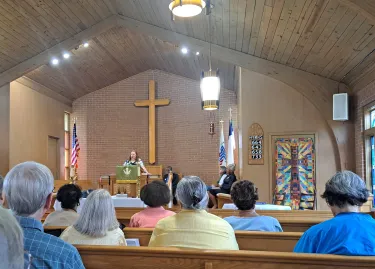
On Saturday morning, I joined the Central Neighborhood gathering at Greenway Presbyterian Church in Lenoir. After a set of greetings from the presbytery’s mission partnership groups for Guatemala and Malawi, I did a quick five minute set from the pulpit, speaking on the capacity of the archives to gather people’s voices in common cause. Just before the greetings, Kevyn Amos of Dulatown Presbyterian Church--the co-moderator of the gathering--had led the group in song, initially alone, until the crowd gathered its voices to join him. I think our work here does something similar.
The Neighborhood then spent time sharing short passages from each church on their mission work. Commissioners told of community gardens that grew tons of food for local pantries, of ongoing relief efforts in the wake of Hurricane Helene, and of accompanying imprisoned women in the Western Correctional Center at Black Mountain. One of the presbytery’s new worshiping communities, House of Mercy, spoke about their work with Deep Time, a coffee shop employing recently incarcerated people. Throughout, the people of the presbytery showed urgency for feeding the hungry and freeing the prisoner.
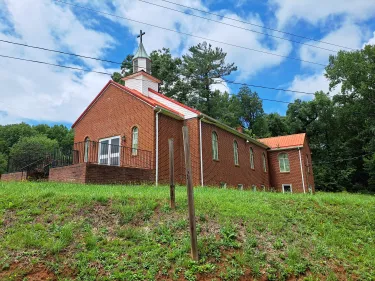
I met members of Dulatown Presbyterian at that gathering and signed myself up for worship with them on Sunday. The church, in the southern reaches of Lenoir proper, has been in its current building since the early 1980s, originally built as a regional high school during segregation. Dulatown’s previous building, a brick structure built in the 1950s, is just up the hill. That building in turn replaced a 1920s wood plank church. And before that, according to church members, the community worshiped in a brush arbor. That community, in turn, are descended from Alfred Dula and Harriet Dula, a woman he owned. Upon his death, Alfred deeded the land he owned to his descendants, and that land-holding helped keep his descendants whole in the post-Reconstruction south. The tight-knit group of cousins gathers every other year to celebrate Harriet, and their story is commemorated in a 2019 PBS documentary.
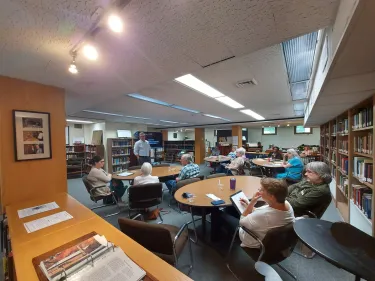
On Monday, with the gracious hospitality of the Presbyterian Heritage Center at Montreat, I did a 90-minute records-keeping training for about 15 local clerks and keepers and then stuck around to tour the stacks and commune with the volunteer staffers about the work we have in common – learning to say no to collection donations, directing researchers to records of value, providing public spaces for reflection on the past.
Among the artifacts and records I got to see was a wooden sign marked “No Admittance -- Immigration Border Control” – and that was my introduction to Montreat’s status as a World War 2 detention compound, where German and Japanese citizens were held. Among those held at Montreat’s Assembly Inn were Japanese-American children and members of the Nazi Party active in South America.
My time in the region left just enough time to climb Lookout Mountain that Sunday – evidently this is a rite of passage for visitors to Montreat, and one Montreat hand told me “You’re ours now!”
It’s our hope that many more Presbyterians in Buncombe, Burke, McDowell, Caldwell, and Catawba counties think of this archives as theirs too.
You may freely reuse and distribute this article in its entirety for non-commercial purposes in any medium. Please include author attribution, photography credits, and a link to the original article. This work is licensed under a Creative Commons Attribution-NonCommercial-NoDeratives 4.0 International License.