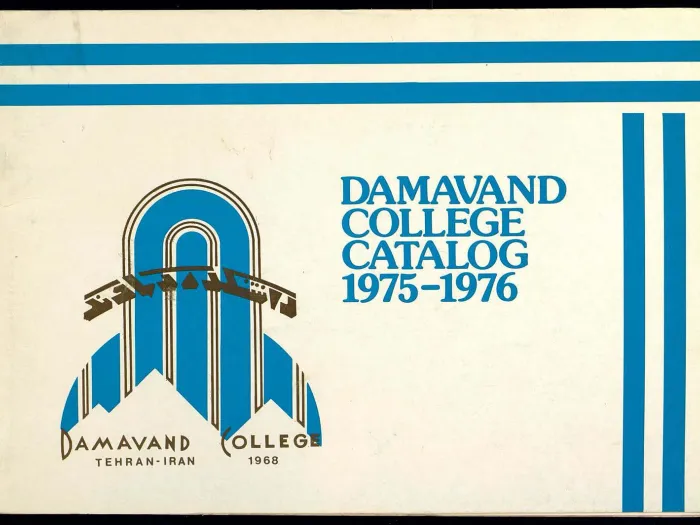
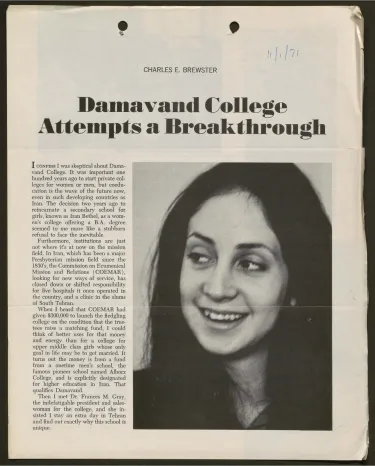
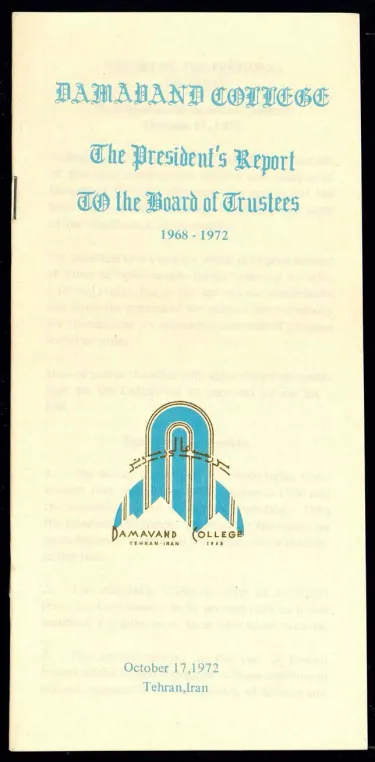
The Presbyterian Historical Society (PHS) staff have recently processed four small collections documenting Damavand College (Tehran, Iran), a private women's college and the successor entity of the Iran Bethel School. The collections include the Mary Christine Thompson Papers (RG 559), the Carolyn D. Spatta Papers (RG 560), the Damavand College Foundation Records (RG 561), and the Frances Mecca Gray Papers (RG 562). Staff previously wrote about Damavand College when PHS received Gray's photographic slides in 2017, which are now part of her processed collection.
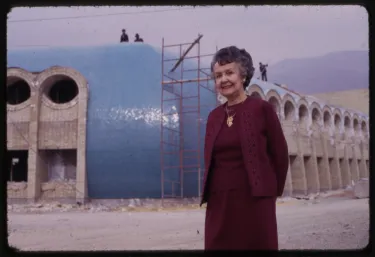
Mary Christine Thompson Papers (RG 559), 0.75 cubic feet (2 boxes, 1 oversize folder):
Mary Christine Thompson, Presbyterian missionary and educator in Egypt and Iran, was born on March 4, 1913 in Oil City, Pennsylvania. Thompson graduated with a B.A. from Muskingum College (New Concord, Ohio) and was appointed to the Egypt Mission by the Presbyterian Church in the U.S.A. (PCUSA) Board of Foreign Missions (BFM) on May 8, 1939. She sailed for the field that December and taught in the Tanta Girls School until 1965, when mission schools began to be administered by the Synod of the Nile (of the Evangelical Church of Egypt). The outbreak of the 1967 Six-Day War kept Thompson from work in Egypt. In 1968, she was appointed to an educational position by the Synod of Iran, where she encountered Frances Mecca Gray, who offered her a position as dean of Damavand College. Thompson worked at Damavand until the Iranian Revolution in 1979. She returned to the United States and settled in New York City, becoming an active member of Fifth Avenue Presbyterian Church. She died in 2005.
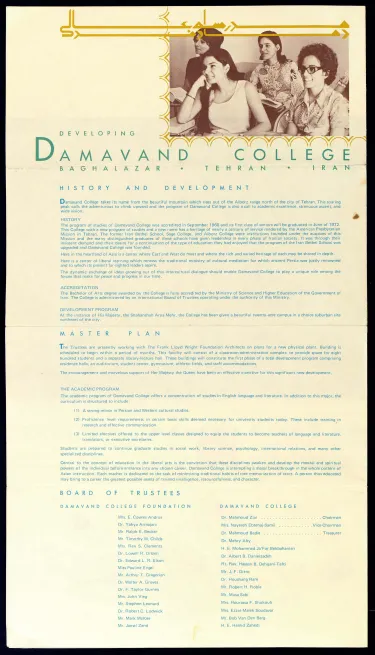
This collection contains correspondence, photographs, printed materials (including newspaper clippings and publications), yearbooks, meeting minutes and other administrative records (specifically of the Damavand College Foundation), and other materials that chiefly document Damavand College and Thompson's work there as dean. Photographic materials include photographic prints of students, graduations, constructions of buildings, and gatherings and photographic slides of the Shah's birthday celebration, groundbreaking of the new property by Princess Farahnaz Pahlavi, extracurriculars, and celebrations. The collection also holds autobiographical materials (like Thompson's reminiscences regarding her trip to Mount Sinai in Egypt in 1950) and a Damavand College pin.
Carolyn D. Spatta Papers (RG 560), 1.20 cubic feet (2 boxes):
Carolyn Davis Spatta-Eckhart was born on January 20, 1935. She earned a B.A. degree from the University of California Berkeley in 1964. She was awarded a National Defense Foreign Language Fellowship in Persian at the University of Michigan, where she went on to earn an M.A. degree and continued to earn her Ph.D. from the same institution in 1974.
Carolyn taught at Schoolcraft College in Livonia, Michigan, while she completed her graduate school degrees. She then went on to accept a dual administrative position at Oberlin College in Ohio, serving as the corporate secretary of the college and assistant to the president. In 1978, she accepted an offer to serve as president of Damavand College, and served in this position until January 1979, when the Iranian Revolution led to her returning to the United States. She returned to Michigan to serve as vice president for administration at Eastern Michigan University. In 1981, she resigned from there and moved to Washington, D.C. While in Washington, D.C., Carolyn held the position of director of institutional grants and programs and of the Consultation and Advisory Service at the Association of Colleges. She then went on to serve as president of administration and business affairs at California State University, Hayward. She taught as a professor of geography at the same institution. She was awarded a Fulbright Scholarship to Malaysia, where she worked as an administrative consultant to Universiti Teknologi Malaysia. She ultimately retired and moved to Ocala, Florida.
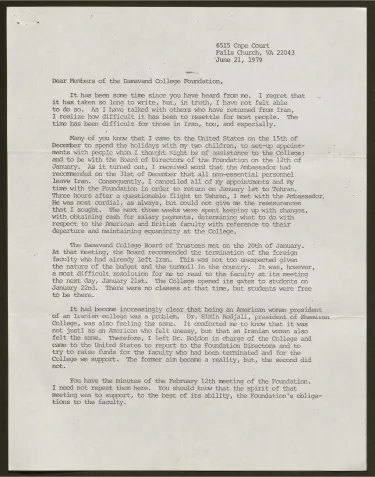
This collection contains correspondence, photographs, printed materials (including newspaper clippings and publications), meeting minutes, and other materials that chiefly document Damavand College, its dissolution, and Spatta's work and tenure there. There are letters of recommendations for colleagues, acceptance letters, and offers from different colleges relating to international faculty needing to leave Iran following the Iranian Revolution. Postcards and correspondence from fellow faculty at Damavand document their lives immediately following the revolution. Other materials include photographs from conferences and a typescript draft and published copy of "Asian College Women's Aspirations: A Comparative Study of the Effects of Maternal Employment" by Susan Seymour and Spatta.
Damavand College Foundation Records (RG 561), 2.40 cubic feet (3 boxes):
Damavand College Foundation was formed in Washington, D.C., and its purpose was to be a United States-holding corporation for Damavand College. Damavand College's board of trustees had been established in February 1969. In an October 15, 1970 letter to Stephen Leonard (who would become treasurer-secretary of the Foundation), Damavand College president Frances Mecca Gray stated that "we are establishing this Foundation in the States for several necessary purposes ... the most important of these is to have an American corporation through which we can provide social security benefits to our American staff ... We are also hopeful that we can secure income tax deductibility for gifts received in the States." Gray also explained that "We are no longer under the Presbyterian mission but we were given a challenge gift by COEMAR [Commission on Ecumenical Mission and Relations] of $300,000 to be matched from funds raised here and elsewhere." The Foundation was established soon after this communication in November 1970. Foundation members actively sought funding opportunities, facilitated endowment funds and disbursed gifts and investments, did development work, and recruited and hired employees/staff for the College. The Foundation also received and managed ASHA/USAID (American Schools and Hospitals Abroad, United States Agency for International Development) grants for the College.
Foundation secretaries included: Robert C. Lodwick, who was also secretary for education of the United Presbyterian Church in the U.S.A.'s (UPCUSA) COEMAR and Program Agency; Esther L. Hawkins; and Haydn O. White, who was also associate for global education of the UPCUSA's Program Agency. Additionally, lawyer Stephen Leonard served as both secretary and treasurer of the Foundation. After the Iranian Revolution and the creation of the Islamic Republic of Iran in 1979, the College was nationalized. The Foundation oversaw repatriation costs of the College's American teachers. The Foundation continued to operate throughout the 1980s, mainly as an account holder for dedicated funds. At the annual meeting of 1988, the board of directors voted to dissolve the Foundation.
The collection contains administrative records (mostly bylaws, constitutions, and minutes), correspondence, employment and personnel records, financial records, printed materials and publications, reports, and other records created, collected, and maintained by Damavand College Foundation secretaries and treasurers, chiefly Lodwick, Leonard, Hawkins, and White. The records primarily document communications between Foundation members and Damavand College administrators and staff, especially Gray, Carolyn D. Spatta, and Mary C. Thompson; the Foundation's fundraising, development, publicity, and financial management activities for the College; and the Foundation's recruitment of College personnel and staff. Records from the late-1970s and early-1980s document the Foundation's response to the nationalization of Damavand College after the Iranian Revolution. Records from the late-1980s document the dissolution of the Foundation and its assets.
Frances Mecca Gray Papers (RG 562), 2.30 cubic feet (3 boxes):
Frances Mecca Gray of San Francisco, California was a Presbyterian educator and missionary to Iran and Lebanon. Gray was born in Little Rock, Arkansas in 1910 and graduated from Southwestern, The College of the Mississippi Valley (now Rhodes College), in Memphis, Tennessee in 1930. She received master's degrees from The Biblical Seminary in New York (now New York Theological Seminary), the University of Chicago Divinity School, and the New York School of Social Work at Columbia University. She left an early career in social work for two years of service in the American Red Cross in Europe at the end of the Second World War (WWII). She was appointed as the Presbyterian Church in the U.S.A. (PCUSA) Western Area Secretary for Women's Work in 1946 and worked as Board of Foreign Missions (BFM) portfolio secretary for Africa and the Middle East from 1950 to 1956. In 1956, she was assigned by the BFM to Beirut College for Women (BCW) in Lebanon as a professor of biblical literature. She became president of the college in 1959 and held the role until BCW's transfer to Lebanese national leadership. In 1965, she transferred to Iran Bethel School in Tehran, at that time a Presbyterian girls' finishing school. She presided over the school's transition to the B.A.-granting Iran Bethel College, which later became Damavand College. Gray worked as Damavand College president from 1968 until she retired in 1975. She hired Mary C. Thompson as dean of Damavand. Frances returned to the United States after retirement, settling in the San Francisco Bay Area, California. She taught in the humanities at New College Berkeley from 1978 to 1984 and in Art History at the Fromm Institute of the University of San Francisco from 1985 to 1997. She died of cancer on December 15, 2001.
The collection contains articles, audiocassettes, correspondence, manuscript volumes (chiefly diaries and journals), oral histories photographs, printed materials and publications, reports, subject files, writings, yearbooks, and other materials that document the professional career and personal life of Gray. Materials cover Gray's educational work at BCW and at Damavand College, her general life and experiences in Iran and Lebanon, and her work in continuing education at the Fromm Institute. While most of the manuscript volumes are Gray's, two are Ruth Sherman Hyde's (Gray's childhood friend).
Carolyn D. Spatta is featured prominently in the collection, and some materials throughout include her contextual notes. Included in the collection are audiocassettes, research notes, and transcripts of interviews that Spatta conducted with Gray, Margaret Ellis, and Ada Black.
You may freely reuse and distribute this article in its entirety for non-commercial purposes in any medium. Please include author attribution, photography credits, and a link to the original article. This work is licensed under a Creative Commons Attribution-NonCommercial-NoDeratives 4.0 International License.