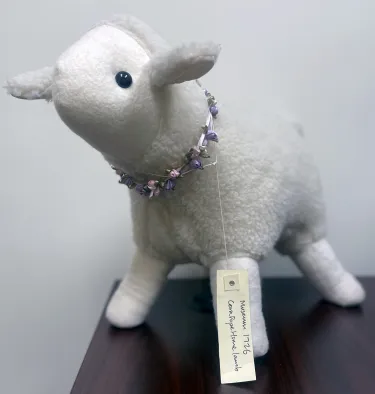
I'd like to introduce you to a special little creature who I have come to adore. Meet Lamby.
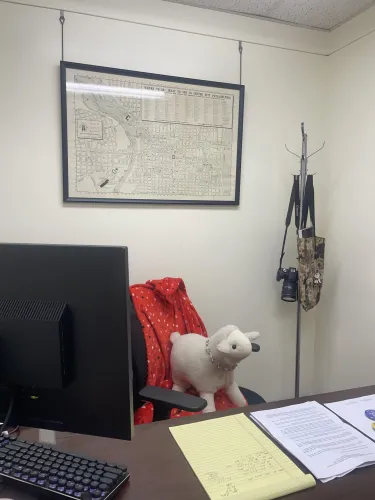
Lamby is a stuffed animal that lives in the PHS Museum Collection. She’s hung out in the Communications office for years, offering comfort on hard days and weeks full of meetings. She’s sturdy and perfect for holding and wears both a purple-and-green faux-flower wreath around her neck as well as a tag with her accession number on it: 1726. When I finally thought to scour the Museum Database for clues on her origins, I discovered that she hails from Illinois. More specifically, from the Cora J. Pope Home in Ottawa. Further information offered by the database entry is limited to a note that tells us the "retirement community organized in 1945 by the Presbyterian Church in the U.S.A. Synod of Illinois was dissolved in 2013."
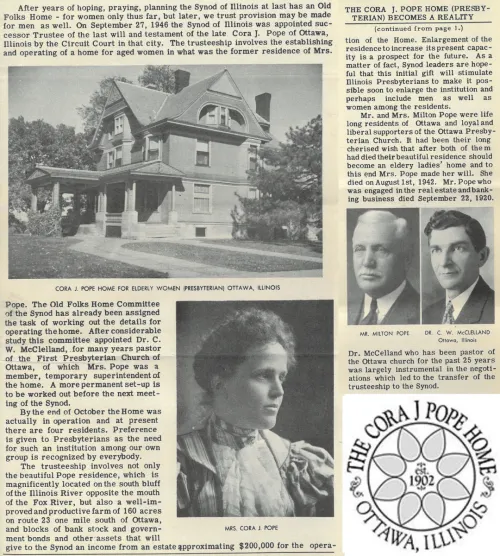
I then took this knowledge over to Sheppard, PHS’s research tool that allows you to search across multiple databases at once. By searching through Sheppard and Calvin, the library catalog, I was able to identify a handful of records to dive into. As I did so, I discovered a periodical that featured an article on the house that Lamby once called home. The headline article of the January 1947 edition of 'Presbyterian Progress in Illinois' opens with this introduction to the newly established Cora J. Pope Home: "After years of hoping, praying, planning, the Synod of Illinois at last has an Old Folks Home – for women only thus far, but later, we trust provision may be made for men as well. On September 27, 1946 the Synod of Illinois was appointed successor Trustee of the last will and testament of the late Cora J. Pope of Ottawa, Illinois…The trusteeship involves the establishing and operating of a home for aged women in what was the former residence of Mrs. Pope."
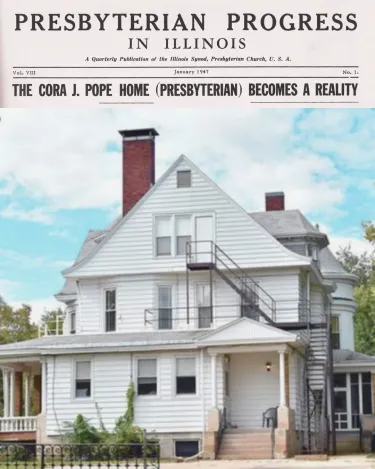
The home was in operation within a month—by late October, four residents had settled into their rooms at the Cora J. Pope Old Folks Home. All were welcome, though preference, of course, was "given to Presbyterians as the need for such an institution among our own group is recognized by everybody."
The Pope residence itself was not the only property bequeathed to the Synod of Illinois by the Pope estate. It also included a "well-improved and productive farm of 160 acres on route 23 one mile south of Ottawa, and blocks of bank stock and government bonds and other assets that will give to the Synod an income from an estate approximating $200,000 for the operation of the Home."
But who were the Popes? More importantly, who was Cora Pope? All we learn from 'Presbyterian Progress' is that "Mr. and Mrs. Milton Pope were life long residents of Ottawa and loyal and liberal supporters of the Ottawa Presbyterian Church. It had been their long cherished wish that after both of them had died their beautiful residence should become an elderly ladies’ home and to this end Mrs. Pope made her will. She died on August 1st, 1942. Mr. Pope who was engaged in the real estate and banking business died September 22, 1920."
Only a death date, but it’s enough. This information serves as a push-off point—now, other details begin to trickle in. Cora Pope was born Cora Justene Pickens on July 13, 1860, in the same place she is buried: Ottawa, Illinois. Her parents were James Henry (1834-1914) and Clementine Lavelia Ashley (1839-1918). She married Milton Pope (June 5, 1852-September 22,1920) on November 24, 1897, during her 37th year of life.
In the 1906 History of La Salle County, Illinois, by U.J. Hoffman, we learn that Cora’s father, James H. Pickens, grew up in South Ottawa "from the age of seven or eight years." He met Cora’s mother in Massachusetts, where they were wed; Miss Clementine Ashley was just seventeen when she and James married. "Two children were born of this union: Mrs. Cora J. Pope, who is living on the south side of Ottawa; and John A., who is residing in South Ottawa and is engaged in the fruit and asparagus business," the book shares.
As of 1900, Milton Pope was the owner of 500 acres of land in LaSalle County, Illinois, and another 320 in Kansas. He was serving as the director of the First National Bank of Ottawa. He and Cora had been married for three years; Cora was 40 years old.
On October 16, 2018, the property at 116 W. Prospect Avenue in Ottawa, Illinois, was designated a Local Historic Landmark by the city. From the information provided by the Historic Marker database, we learn that Milton and Cora built their 18-room Victorian home on the south bluff of Ottawa, Illinois, in 1902. It is reported that Cora herself oversaw much of the construction. Though the couple did not have children, they each had a deep interest in the local community—when Cora passed in 1942 at the age of 82, she wrote in her will that her home be used, together with all the furnishings, furniture, equipment, and the like, "To establish and perpetually maintain a home for the comfortable support and maintenance of aged, respectable, indigent women, who may be incapable of self-support...the said home to be always known and named 'The Cora J. Pope Home.'"
The Cora J. Pope Senior Grant Fund, a ministry of the Synod of Lincoln Trails and the PC(USA), allocates grants to applicants aged 55 and older—an offering born from the vision and generosity of Cora J. Pope, "who sustained an active ministry for women through her home and endowment for 75 years so that residents could live with dignity and comfort," their website explains. "Cora J. Pope spent her life helping others and opening her home up to those in need."
In April of 2021, the Cora Pope Trust made headlines for a generous donation made toward the Ottawa YMCA building fund. As gratitude for the half-million-dollar donation, the building would have an area named after her: The Cora J. Pope Presbyterian Commons. In the article, we are offered a glimpse of Cora’s legacy, as we are told that, "The trust’s mission has adapted to changing times. The Cora J. Pope home used to provide rooms for elderly women to live in when they couldn’t be on their own but also couldn’t afford hired help. Now, it offers up to $2,500 per year per person for things that help a man or woman age 55 or up continue living with comfort and dignity in his or her own home." In 2024, it was announced that the Cora J. Pope Trust Senior Grant Fund and the Ottawa YMCA were to collaborate on this endeavor moving forward, with the YMCA now serving as an additional application site for the grant program.
The Pope’s residence was purchased in 2018, lovingly restored, and now functions as a bed and breakfast, where you can stay in Cora’s Room. Previous to the purchase, the building had been vacant for years, starting in 2013.
Lamby and her beady black eyes remains at the Presbyterian Historical Society, where she serves, for all extents and purposes, as a mascot of eerie cuteness. Though she may never see her home-state of Illinois again, Lamby will always have the memory of Cora Pope, whose legacy she carries with her. This piece of material culture has opened the door of the Cora J. Pope Home once more.
Enjoy this glimpse into the PHS archives? Donate to the PHS Annual Fund, which supports the efforts of the Presbyterian Historical Society to collect, preserve, and share the past in order to transform your current perspective on church history.
You may freely reuse and distribute this article in its entirety for non-commercial purposes in any medium. Please include author attribution, photography credits, and a link to the original article. This work is licensed under a Creative Commons Attribution-NonCommercial-NoDeratives 4.0 International License.