From the archives: Effie Sidebotham's 'ghost-barrel'
The 20th century missionary couple who ferried their piano to Korea
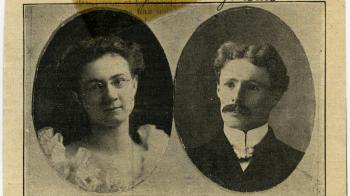
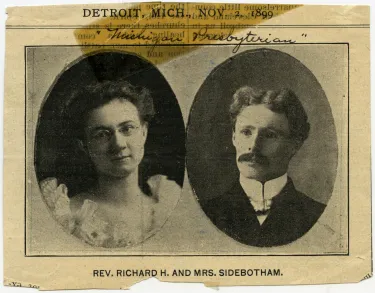
Mission workers often serve as cultural conduits, bringing together differing customs in unexpected ways. Take the case of the Sidebothams, for instance — the missionary couple who have been credited as introducing the piano to the Korean Peninsula.
Daegu is considered the birthplace of modern Korean music, and a big factor in this categorization was the arrival of the Sidebothams' piano in March 1900. The instrument had been ferried up the Nakdong River by Richard Sidebotham on behalf of his wife, the more musically talented of the pair. At first, locals were unsure about the instrument, calling it the "ghost-box" or "ghost-barrel" due to the strange sounds it emitted. Their title for the piano, guishintong, would later be engraved onto the instrument.
In 2013, the "Daegu Ilbo," a regional newspaper publication, declared this piano to be the first in Korea. In an article published in "The Korea Times" in March 2022, author Robert Neff offers proof to the contrary, arguing that a decade before the arrival of the Sidebothams, "there were at least a couple of pianos in Seoul ― and not just in the homes of missionaries." The Sidebothams' guishintong may not have been the foundational introduction of the instrument, but it did garner attention throughout Daegu upon its arrival. Today, we are sharing the story of the Sidebothams, and the piano they shipped overseas at the turn of the 20th century.
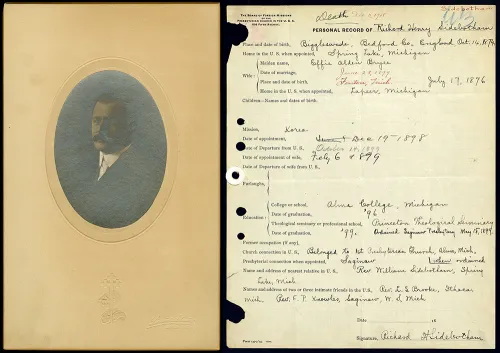
Richard Henry Sidebotham was born in England and immigrated with his family to the United States in 1883. After graduating from Princeton Theological Seminary, he was ordained into ministry by the Saginaw Presbytery in 1899. That same year, he married Effie Alden Bryce of Lapeer, Michigan. She'd grown up in the area and was well-loved across Lapeer society for her musical talents. Her family, understanding that after her marriage to Richard the couple would depart for the Korean mission field, presented her with a piano "seasoned for ocean travel" as a farewell gift ahead of their voyage. The newlyweds arrived in Daegu in November, with the piano following a bit slowly, arriving at the Samunjin Port in Hwawon, Daegu, what is present-day Hwawon-eup, Dalseong-gun, on March 26, 1900. From there, the piano took another three days to finally arrive at the Sidebothams' house in Jongno, Daegu. Porters were photographed transporting the piano from the ferry to the family’s downtown home.
The piano quickly became a part of the city’s legend and culture. Since its arrival over a century ago, Daegu has celebrated the instrument, creating piano-themed monuments and public art and hosting an annual "100 Piano Concert" in commemoration of Korea's first piano. The first concert installment was in 2012, and it continues to this day. The instrument itself now resides in the Dongsan Medical Missions Museum.
Unfortunately, other portions of the Sidebothams' legacy would contain tragic notes. Like many of the early missionaries to Korea, the pair faced opposition from the local population. Effie recounts some of the family’s struggles in a brief article published in “Woman’s Work for Woman,” a publication of the Women’s Foreign Missionary Societies of the Presbyterian Church. Despite these difficulties, the Sidebothams were able to establish 23 churches during their eight years in Korea. In 1908, the family returned to the United States, as Richard had been granted a sabbatical. While back in Lapeer, Michigan, Richard worked extensively, fundraising for the mission until his sudden death on December 3. An obituary published in “The Westminster” reported that he mistook a can of gasoline for kerosene and poured it on a fire he was kindling. The explosion was immediate, and Richard was severely burned. A passer-by helped Effie drag Richard from the burning home, but he succumbed to his injuries later that evening. Surviving Richard, and later Effie, would be their two children, Alfred and Margaret.
The Sidebothams' legacy of cultural connections and mission work continues through the present day. The materials in the PHS collection were donated by Richard and Effie’s granddaughter, Dr. Sarah Curtice Greenfield, who later returned to South Korea to donate the Sidebothams' effects to the Busan Modern and Contemporary History Museum. The museum hosted a special exhibition in 2009 titled "Sidebotham's One Hundred Years Of Promise," which featured 100 objects from the donated collection, including a picture book introducing Korea in English, photos of Busan Port and Busanjin Market, and Korean-style embroidered socks.
Further Reading
Cho, Yejin, "The Development of Western Classical Piano Culture in Postwar Asia" (2016). Theses and Dissertations. 5937.
Jun-deok, Lee, The Yanggeum: Tracing the Piano's Ancestry in Korean Music, DONG-A SCIENCE, 2009.
Neff, Robert, Daegu and the legend of Korea's first piano, The Korea Times, March 2022.
You may freely reuse and distribute this article in its entirety for non-commercial purposes in any medium. Please include author attribution, photography credits, and a link to the original article. This work is licensed under a Creative Commons Attribution-NonCommercial-NoDeratives 4.0 International License.