US Presbyterians call for action in the face of humanitarian crisis in Cuba
Following action by the 227th General Assembly, partners respond through advocacy, accompaniment and community ministries
The Presbyterian Church (U.S.A.) is renewing its longstanding commitment to its Cuban neighbors as a worsening humanitarian crisis threatens access to food, medicine and other basic necessities across the island. At the denomination’s 227th General Assembly in Milwaukee in June, commissioners voted in favor of a churchwide call to action supporting the people of Cuba and the PC(USA)’s sister-denomination, the Presbyterian-Reformed Church in Cuba.
Item RIW-11, “Reaching out in Concern for the Presbyterian-Reformed Church and People of Cuba,” directs the Stated Clerk and Executive Director of Presbyterian Life & Witness, the Rev. Jihyun Oh, to declare a churchwide Sunday of Prayer with the IPRC. It also requires denominational agencies to respond to Cuba’s economic crisis and report on their progress at the 228th General Assembly (2028).
The Presbyterian Ministry at the United Nations and Office of Public Witness within PL&W were directed to advocate for policies reducing barriers to food, medicine and basic necessities, enabling humanitarian aid without obstruction, supporting diplomatic engagement and rejecting military action against Cuba.
Cuba’s economic challenges involve overlapping pressures including longstanding U.S. sanctions, trade restrictions, fuel shortages, inflation, deteriorating infrastructure and domestic struggles. The Trump administration has intensified sanctions and raised the prospect of military action, according to Catherine Gordon, OPW’s representative for International Issues.
At the end of September, the United States Treasury Department expanded restrictions on transactions connected to Cuban military, intelligence and security services. It also eliminated authorization for group educational travel and certain professional meetings.
The General Assembly’s action reflects decades of partnership with Presbyterians in Cuba and acknowledges the country’s escalating crisis. In February, the PC(USA) and Cuba Partners Network joined other faith-based organizations in signing a letter urging policymakers to reduce hardships for ordinary Cubans and barriers to basic necessities. In June, OPW staff joined ecumenical partners for a webinar on U.S.-Cuba relations and advocacy.
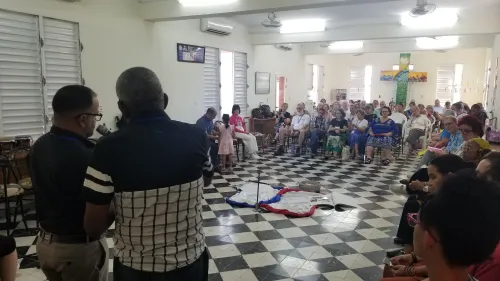
Despite challenges to travel, the Cuba Partners Network gathered in Matanzas, Cuba, earlier this month for its annual meeting, “Encuentro." Founded in 1996, the volunteer-led organization is part of a legacy of relationship between U.S. and Cuban Presbyterians that dates back more than a century.
Roughly 35 U.S. attendees and 40–50 Cuban partners gathered to worship, study Scripture and discuss the realities facing the IPRC. CPN co-convener the Rev. Jeremiah Lange of Marion Presbyterian Church in Kansas said conditions were hard to ignore: the Havana airport lost power five times while his group waited to depart.
Lange has been involved with CPN since 2016 and has watched needs escalate. On his first trip, visitors brought thumb drives and office supplies. Later requests included over-the-counter medications and food. This time, the list ranged from batteries and prescription medicines to Sunday school materials and nearly any usable essentials. Visitors increasingly are asked to organize their own food in advance.
Lange said the sentiment expressed was, “If you can put it in a suitcase, please bring it."
Despite scarcity, IPRC churches continue to serve their communities. CPN member Dr. Marilyn Seiber of New York Avenue Presbyterian Church in Washington, D.C., described First Presbyterian-Reformed Church of Havana’s feeding ministry, which has long provided meals to seniors and recently began serving children as well.
Partner churches in the U.S. are able to support the ministry by ordering food online and having it sent directly to the church in Havana. Seiber emphasized that while U.S. churches provide material support, “they’re the ones that are doing the mission.”
In the past year, all but two IPRC churches across Cuba have been outfitted with solar panels, providing crucial energy amid power outages. International partners helped fund the project.
Presbyterian leaders in Cuba are ardent in their commitment to ministering to their communities regardless of obstacles, but the ongoing challenges are taking their toll. During Encuentro, Lange asked a Cuban colleague, Anier, how he was doing. Anier said, “I’m tired.” When Lange asked how they could support him, Anier said pastors, co-pastors and their families needed a retreat together to rest physically and spiritually.
While U.S. CPN members offer material support, the network’s heart is the relationships between congregations, bonded by a common faith. CPN member Sorrel Ann Alburger of The First Presbyterian Church in the City of New York said attendees at this year’s gathering made time for worship, dance and karaoke, despite the weighty circumstances.
“It’s truly a family in Christ,” said CPN co-convener Kathy Wennerstrum of the Presbyterian Church of Western Springs, Illinois.
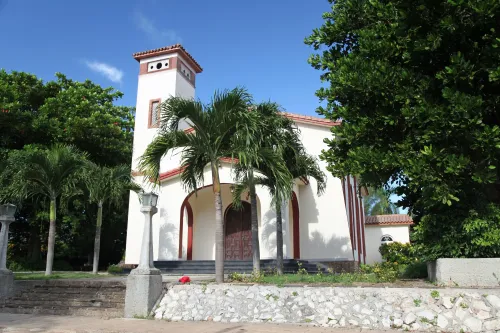
Seiber said their Cuban colleagues urged, “Don’t stop coming. Don’t stop visiting.”
Cuban Presbyterian colleagues also visit the U.S., though restrictions have made travel difficult. The Rev. Alison Infante Zamora, pastor of First Presbyterian-Reformed Church of Havana, visited New York Avenue Presbyterian Church and Fourth Presbyterian Church in Chicago around World Communion Sunday. He also met with members of Congress and State Department officials to discuss conditions facing Cuban congregations.
Seiber said that, when asked how political change might impact what Infante and his colleagues do, Infante noted they would continue to do what they’re doing: ministering to their people.
On Wednesday, the United Nations is expected to vote on its annual nonbinding resolution calling for an end to the U.S. embargo against Cuba. The resolution has passed repeatedly, but the embargo remains in place. A Cuba War Powers resolution addressing potential U.S. military action is also under consideration in Congress.
OPW has launched a social media campaign, “Cuba Is Our Neighbor, Love Is Our Call,” drawing attention to the humanitarian crisis. The campaign reflects the relational theology undergirding the denomination’s advocacy alongside Cuban partners. Like Infante and his colleagues, the PC(USA)’s support of Cuban neighbors and the deep relationship between U.S. Presbyterians and their Cuban siblings-in-Christ will continue, regardless of how the political landscape shifts.
You may freely reuse and distribute this article in its entirety for non-commercial purposes in any medium. Please include author attribution, photography credits, and a link to the original article. This work is licensed under a Creative Commons Attribution-NonCommercial-NoDeratives 4.0 International License.