Syrian-Armenian PC(USA) pastor faces ministry disruption after TPS termination
Thousands lose legal residency in the US as the Department of Homeland Security terminates Syria’s protected status
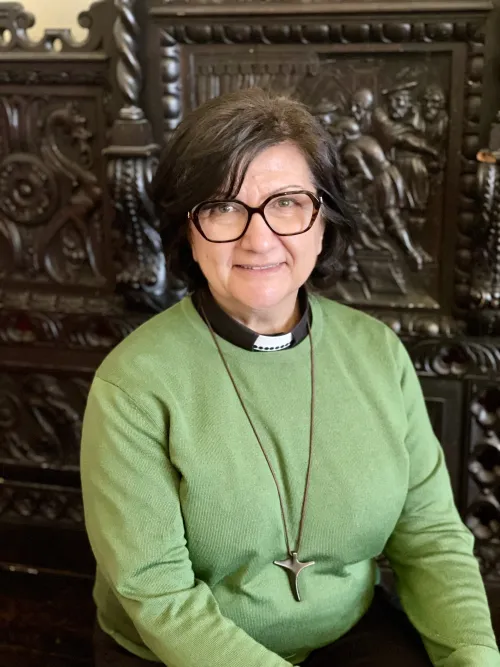
When Syria’s Temporary Protected Status was terminated by the Trump administration this summer, it affected approximately 6,000 Syrians living and working in the United States. Thousands of families. Hundreds of communities across the United States. Countless people who know and love their Syrian neighbors, coworkers, and friends. Six thousand Syrian lives. One of them is a Presbyterian Church (U.S.A.) pastor, the Rev. Dr. Tamar Wasoian.
“We were one of the most vetted immigrant categories, and suddenly, we were given two months to adjust our status or self-deport,” Wasoian said.
That news came in September 2025. A Supreme Court case delayed the termination, but it went it effect this past July.
For nearly 20 years, the United States has not only been the place Wasoian lived, but where she has studied, discerned her calling, and pursued her vocation as both teacher and pastor. She is was born in Aleppo, Syria — the descendant of Armenian genocide survivors — and first came to the United States under a student visa, pursuing graduate and doctoral degrees in religion.
In 2012, Syria was designated with Temporary Protected Status due to an ongoing violent civil war that put anyone returning to Syria in danger. TPS gave Wasoian both legal residence and authorization to work in the United States.
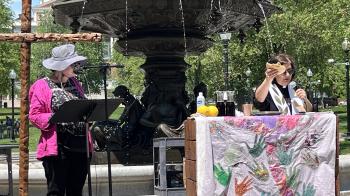
Wasoian has spent the years since teaching and doing ministry, helping seminarians and others pursue their own calls to ministry. She was ordained by the Presbytery of New Covenant in Houston, and currently serves as an associate pastor at Boston’s common cathedral, a church for the unhoused that gathers in the Boston Common.
Meanwhile, Wasoian has dutifully kept up with the legal process necessary for someone in the U.S. under TPS. That includes reapplying every time the TPS designation is extended, generally every 18 months — a laborious process that includes mountains of paperwork, months of uncertainty and significant financial cost.
An American life, upended
When Syria’s TPS was terminated, Wasoian, like thousands of others, suddenly faced the terrifying possibility of being forced to give up the communities she serves in the U.S. and return to a country where she would be at significant risk.
“None of the Syria I knew is left to return to,” Wasoian said. “The overall situation is not safe for anyone to return.”
The Department of Homeland Security claims that the conditions that originally led to Syria’s TPS designation no longer apply. However, the United Nations and other organizations report that the country is still in a major state of crisis with more than 70% of the population in need of humanitarian aid. Seven million Syrians are internally displaced, with another 4 million currently residing as refugees in neighboring countries.
For Wasoian, there are additional layers.
“As an ordained woman minister, I will not be able to live my calling to ministry if I return.
I built a life here and found a home at PC(USA). I have a ministry here that I am called to. How can I leave everything behind and just leave? How can I leave my church?”
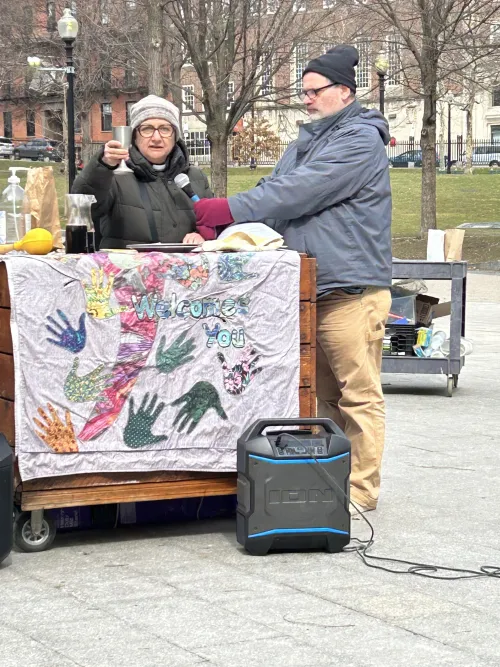
Wasoian has not faced the uncertainty alone. She’s had ongoing support from various PC(USA) denominational ministries, and the congregation she serves has also stepped up to help with the legal process and cover the significant financial cost. The board and executive director of common cathedral applied for an R1 Religious Worker visa on her behalf, and it was ultimately granted, but not without complications. Initially, the change in status was not approved.
“A lesser-known truth about TPS status is that it locks the holder in a non-immigrant status and the only way to change status is to leave the U.S., travel to their birth country, have an interview at the U.S. embassy there, and re-enter U.S. with approved status,” Wasoian explained. “In my case, this meant traveling to Syria, but there is no U.S. embassy in Syria, and the designated embassy is in Jordan. Jordan didn’t grant me the visa.”
In the midst of all of this, a travel ban was enacted for Syria, among other countries, and Wasoian was unable to leave the U.S.
“Thanks to the insightful knowledge of my legal team, and the mercy of a judge, I was able to obtain an active R1 visa and change of status with no requirement of traveling to Syria or Jordan,” Wasoian said.
She’s relieved to have an R1 visa now, but the process came at a staggering cost. Her legal fees have amounted to tens of thousands of dollars, so far. She emphasized that an R1 visa also has significant limitations: It is only valid for five years and confines her employment to the organization that petitioned for her visa. That has forced Wasoian to give up the teaching portfolio she has spent years building.
A historic connection made personal
Wasoian sees her place in the PC(USA) and the denomination’s support for her as an echo of a relationship between the denomination and Christians in Syria that stretches back more than a century.
The PC(USA)’s partner church in Lebanon and Syria, the National Evangelical Synod of Syria and Lebanon, was founded in the mid-1800s by Presbyterian missionaries from the United States. After the Armenian genocide, which led to the displacement of Armenians throughout the Middle East and beyond, the PC(USA) helped establish the Jinishian Memorial Program in the 1960s. Its efforts initially focused on Armenians in Aleppo, Syria, and Beirut, Lebanon, but it has expanded to support Armenians throughout the Middle East and Europe. Meanwhile, the PC(USA) maintains a close relationship with the the National Evangelical Synod of Syria and Lebanon and several seminaries in the region, including the Near East School of Theology (NEST) and Lebanese American University (LAU).
In the past year, the National Middle Eastern Presbyterian Caucus has published multiple letters urging the denomination to continue its support of Christians in Syria and Lebanon, and at the 227th General Assembly this past June, the General Assembly approved an overture from the Racial Equity Advocacy Committee calling for continued denominational support for religious minorities in Syria.
Wasoian said she’s grateful for the invaluable support she’s received from her congregation and from the denomination to which she is ordained. However, she lamented the “lost time, resources, and energy that would have been better invested in ministry to those who needed hope.”
Facing a fraught future
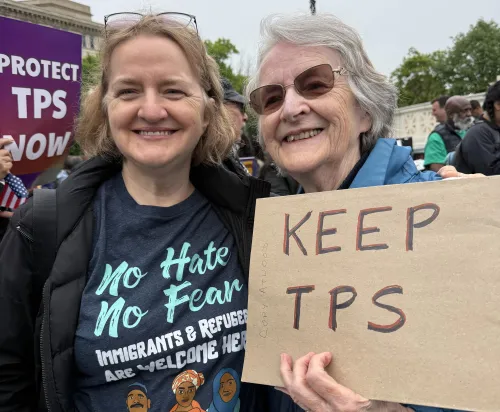
Even with support, and especially for the many Syrians in the U.S. without it, the path ahead without TPS is fraught. Those affected are being asked to “self-deport” and return to their country of citizenship on their own terms. In the meantime, they’re fitted with ankle monitors to track their movements. They are not provided with instructions or guidance on how to move forward, which Wasoian says has been a major issue from the beginning.
“There is no plan and DHS is figuring out things as it comes, and meanwhile, lives are uprooted in such a haphazard manner, with no consideration to human dignity," Wasoian said.
A particular challenge they face is that TPS was not designed to lead to permanent residence or citizenship. When a country’s TPS is terminated, its citizens who are living in the U.S. revert to whatever status they would have had without the TPS designation. Wasoian said the irony is that lawyers she consulted in the past always told her that TPS is “one of the most reliable categories” to stay and work “without concern.”
The termination of TPS for Syria as well as Haiti is part of the Trump administration’s ongoing “immigration crackdown,” which has also included imposing major limitations on asylum claims and the recission of sensitive locations policy that protected people from deportation efforts while at churches, schools, hospitals and other essential social services.
The church’s call to immigration justice
The PC(USA) has a decades-long history of supporting immigrants and refugees through its ministries and General Assembly policies. This year, the Presbyterian Hunger Program and other PC(USA) ministries have advocated for the extension of TPS. This past spring, the Rev. Jihyun Oh, Stated Clerk of the General Assembly and Executive Director of Presbyterian Life & Witness, joined other faith leaders to sign an amicus brief in support of asylum-seekers as the U.S. Supreme Court considered a case concerning “turnback policy” at the U.S. border.
“For me, the journey of permanent residency is still to unfold. I am thankful for the legal and relational support I have from PC(USA), the prayers and support of the Presbytery of Boston and my congregation,” Wasoian said.
She added that she worries for those who don’t have the same privileges and resources.
“U.S. immigration laws were never straightforward, and now it is even more complicated," she said. "Every day there is a new regulation and new twist to the plot that requires legal guidance. Millions are left to navigate these demands by themselves.”
She urges the church to continue upholding its values and reflecting its own history by proactively providing support to those who need it, like Syrians reeling from TPS termination.
“We need to remember that we as denomination and churches are called to do God’s work in the world," Wasoian said. "This is a time that calls for solidarity, and for us to work for justice for all.”
You may freely reuse and distribute this article in its entirety for non-commercial purposes in any medium. Please include author attribution, photography credits, and a link to the original article. This work is licensed under a Creative Commons Attribution-NonCommercial-NoDeratives 4.0 International License.