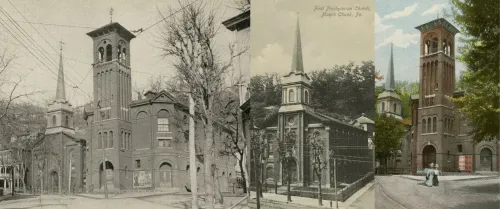
We stumbled upon these three images of the Mauch Chunk Opera House while browsing Pearl Digital Collections. All three are postcards; all three have varying titles.
The widest image lists the church first—Presbyterian Church and Opera House, Mauch Chunk, Pennsylvania—while the colored postcard lists the theater first—Opera House and Presbyterian Church, Mauch Chunk, Pennsylvania.
This is how we learned that Jim Thorpe, Pennsylvania, is home to one of America's oldest vaudeville theaters. "Nestled between lush intersecting mountains along the Lehigh River, the Mauch Chunk Opera House stands out as one of the largest structures in the picturesque Victorian village of Jim Thorpe," the theater website explains. This beautiful remnant of a bygone era was built in 1881, adjacent to what was then known as Millionaire's Row. Seated next to it is the Presbyterian Church of Mauch Chunk.
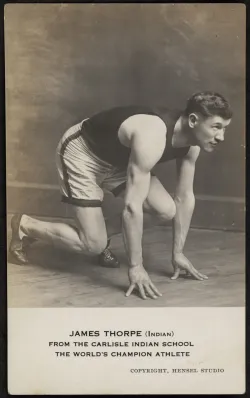
Jim Thorpe, Pennsylvania, was a town known as Mauch Chunk until it changed its name in 1954 to honor James Francis "Jim" Thorpe, the first Indigenous American to win an Olympic gold medal for the United States. He actually won two of them, at the 1912 Olympic Games in Stockholm, Sweden.
The request for the organization of a Presbyterian Church in Mauch Chunk came before the Presbytery of Newton in 1835. In November 1867, that Presbytery celebrated the fiftieth anniversary of its organization, and the historical discourse was delivered by the Rev. David X Junkin.
In his address, the text of which is included in the 1895 compiled history of the congregation, he shared that, “Previous to November 1st, 1835, there was no Presbyterian church north of Pottsville, in that vast and rich mountain country…In the year 1835, a man whose wife had been a member of the Presbyterian Church became concerned for his soul, and so deep was his anxiety that, having heard of Dr. Gray of Easton, he wrote to him for counsel. The correspondence resulted in his coming to Easton to be received by the Session of that church to its membership...This man went back to Mauch Chunk with his heart aglow with the fervors of first love, and was the instrument of kindling a desire for Church privileges and a Church organization in the minds of a few in that town and vicinity."
And so, the request was sent, favorably considered, and, on the first day of November 1835, the Presbyterian Church of Mauch Chunk came into being, with twenty-four members and three Elders. Five weeks later, Rev. Junkin returned to Mauch Chunk, bringing with him "his beloved friend and classmate, the lamented Rev. Richard Webster." The pair spent the weekend preaching and administering the Lord's Supper, "the first dispensed by Presbyterian hands in the Carbon coal field," and Junkin watched as "Mr. Webster immediately entered upon indefatigable missionary work in that mountain region, and proved one of the most laborious and successful laborers" he had ever known.
"The twenty-four communicants of which his Church was at first constituted were gathered from Mauch Chunk and Summit Hill, nine miles apart...But with the blessing of God upon his toil, zeal, and self-denial, and upon the fostering care and liberality of this Presbytery and her churches, the cause prospered in the coal field….The Apostle of the Coal Fields, the lovely and lamented Webster, toiled on until he preached his last sermon on his death-bed, on June 19th, 1856.” So wrote his faithful friend, Dr. Junkin, in the History of the First Presbyterian Church of Mauch Chunk.
Reverend Richard Webster, the Apostle of the Coal Fields, began preaching in Mauch Chunk once a month in 1835. He traveled across the Pennsylvania region on the other weekends, offering his services as an itinerant pastor. In July 1837, he was officially installed as pastor at Mauch Chunk, with one-fourth of his time being employed at Summit Hill. "His attachment to the Church was very great. It was his only pastoral charge. The Church was very dear to him, and the very walls seemed graven on the palms of his hands," the Rev. Ferrier, a later Mauch Chunk pastor, wrote of his predecessor Webster.
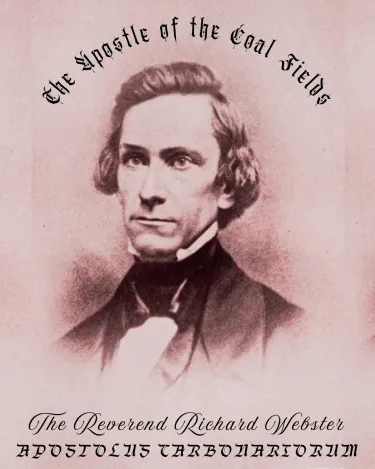
Webster was only twenty-four when he first arrived in Mauch Chunk, the small rural town in Pennsylvania that would become his Eden. Dr. Junkin assures us "That the sacrifice was made lovingly, joyfully is evident from his whole life, and we have his own testimony in a letter written to his brother in 1838."
In that letter, Webster writes to his brother: “I love the place, the people and all about it, and have as completely identified myself with it in interest and affection, as if I had first breathed here, and as if it were Earth’s only spot of brightness and of rest. I came to this little field, and here I began to love and to be loved, and every part of the village is connected with some delightful remembrance.” In Richard's opinion, Mauch Chunk was heaven on earth. He'd remain there until his death in 1856.
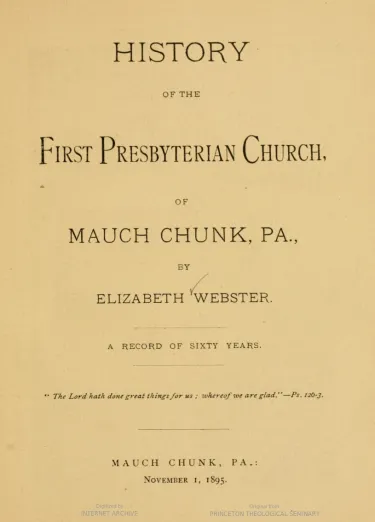
The 1895 history of the Mauch Chunk congregation was compiled and created by none other than Richard's daughter, Elizabeth Webster, who was approached and asked by the church session to prepare a report to be submitted to the General Assembly.
The week of his death on June 19, a special meeting of the Presbytery of Luzerne was held "to take into consideration matters connected with the death of Rev. Richard Webster, Stated Clerk of Presbytery and Chairman of the Committee on Domestic Missions." The resolutions adopted at that meeting were read at the next worship service of the Presbyterian Church of Mauch Chunk and copied into the session book, in which they record their "grief at the loss of our greatly beloved Brother, valued co-presbytery and Stated Clerk, an able and judicious counsellor, a warm-hearted and zealous fellow-laborer and the founder of this Presbytery…the Church of Christ has been deprived of an erudite historian, as well as earnest and faithful minister; this great missionary field, of a fearless and indefatigable pioneer-missionary; and humanity, of a willing and trust friend." (From Session Book Volume 2, p 54; quoted from 1895 History of the First Presbyterian Church of Mauch Chunk).
Webster was succeeded by the Rev. J. Aspinwall Hodge of Philadelphia, who was installed on April 22, 1857. Rev. Aspinwall Hodge was the nephew of Princeton Theological Seminary's Rev. Charles Hodge. Rev. J. Aspinwall served for eight years; he announced his departure in early 1865, and the pulpit was manned by the Rev. Charles J. Collins of Wilkes-Barre during the interim, as the congregation searched for a new leader. That new leader was the Rev. Jacob Belville of Holmesburg, installed on November 1, 1866.
In 1870, upon the reunion of the Old and New Schools of the Presbyterian Church, the Presbytery of Luzerne was dissolved. It was essentially replaced by the newly-organized Presbytery of Lehigh, created by the Synod of Philadelphia. The Presbyterian Church of Mauch Chunk was transferred to the jurisdiction of the Lehigh Presbytery.
Three years later, Rev. Belville left Mauch Chunk for Pottsville, and was succeeded by the Rev. Edsall Ferrier, who wrote of Webster: "The Church was very dear to him, and the very walls seemed graven on the palms of his hands." Rev. Ferrier regretfully resigned from the pastorate after a decade due to ill health, and was succeeded by the Rev. Webster Woodbury, who was installed in November 1884. Rev. Woodbury was succeeded by Rev. W. P. Stevenson in 1888, who was succeeded by Rev. D. M. Buchanan in 1891.
The little history booklet from which this information was gleaned was published in 1895--the congregation, at that time, was still under the guidance of Rev. Buchanan. Readers are offered a glimpse into the line of preachers installed at the Mauch Chunk pulpit following Webster's death, and are told that the church reported a membership of 415 to that year's General Assembly.
The congregation formally merged with the First Presbyterian Church of Summit Hill in the 1970s, closing the doors of the original Mauch Chunk sanctuary. The building stood vacant for a time until the county government scooped it up and turned it into office space. As of 2003, the building had been bought again, and was in use as an art gallery.
Anyways. Back to where this all started--the Opera House.
Originally designed by Philly architect Addison Hutton as a nine hundred-seat concert hall with a farmers' market on the first floor, the Mauch Chunk Opera House was managed first by W. D. White, who was succeeded in 1886 by Moses H. Burgunder (1852-1900). A native of Wilkes-Barre, Pennsylvania, Burgunder had achieved fame for his management of entertainment venues across the state, including the Wilkes-Barre Music Hall.
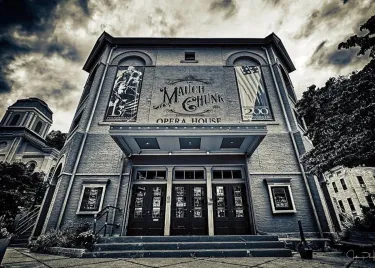
The venue was remodeled and renamed in 1927 as the Capitol Theater, which primarily served as a movie house during the early silent-screen era and the era of talkies that followed.
In 1962, the building was sold to a local purse factory, which used it as a warehouse for about a decade. Abandoned in the mid-1970s, the defunct building was brought under the auspices of the newly formed Mauch Chunk Historical Society in November 1977. The theater underwent renovations and reopened in time for its centennial celebration in 1981. In 2003, area residents acting under the name of JTAMS Productions refurbished the theater again and began booking new entertainment acts.
That's the best part of this story—the theater's box office is still open and ready to admit you entrance into the Mauch Chunk Opera House! Offering year-round entertainment ranging from classic rock and jazz to bluegrass and special events, the historic theater is one of the northeast's premiere concert venues. Check out the upcoming lineup at their website and make sure to take a gander at the historic Mauch Chunk Presbyterian Church / art gallery the next time you visit Jim Thorpe!
You may freely reuse and distribute this article in its entirety for non-commercial purposes in any medium. Please include author attribution, photography credits, and a link to the original article. This work is licensed under a Creative Commons Attribution-NonCommercial-NoDeratives 4.0 International License.