Renowned educator and singer Dr. Everett McCorvey grew up in churches important to the civil rights movement
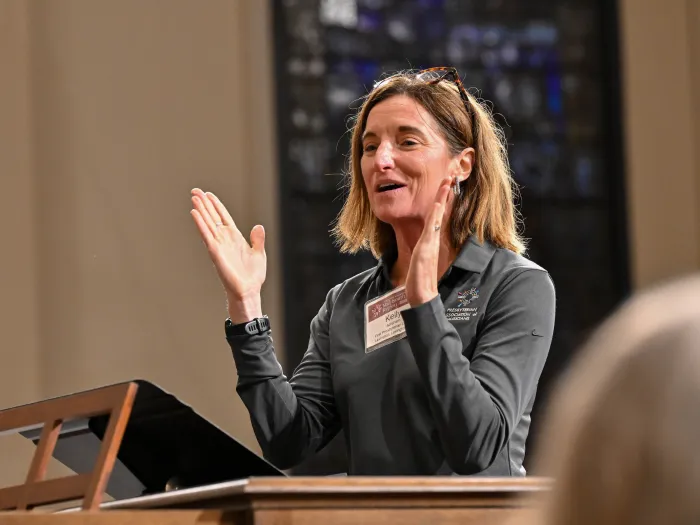
McCorvey is the most recent guest on ‘Sounding Board,’ the Presbyterian Association of Musicians’ podcast
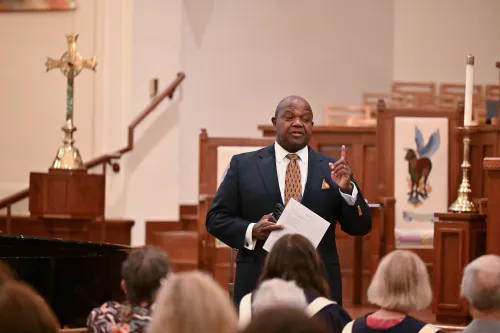
LOUISVILLE — When Dr. Everett McCorvey was growing up in Montgomery, Alabama during the late 1960s, he had no idea about the significance of the place and the era in which God had placed him.
The Rev. Ralph Abernathy, the closest friend and advisor of the Rev. Dr. Martin Luther King Jr., was pastor of the church McCorvey’s father attended, First Baptist Church. A block away, McCorvey would also attend Sunday school and the service at his mother’s church, St. John’s AME Church.
“I was able to see and experience a lot of the things going on in the late 1960s,” McCorvey told “Sounding Board” hosts Sarah Abushakra and Jeremy Roberts during the most recent edition, which can be seen here and heard here or here.
King himself lived a block from the McCorvey house. McCorvey’s father died recently, and McCorvey and his son traveled to Montgomery to clean out the house. The two also took in the National Memorial for Peace and Justice, which displayed photos of McCorvey’s elementary school teacher as well as the local mortician and a well-known store owner.
“These were people I grew up with who are now historical figures because of their work in the civil rights movement,” McCorvey told the hosts. “We’re talking 50 years ago, not 200 years ago. There are lots of people who had some of these civil rights experiences.”
McCorvey was in sixth grade when Montgomery schools began to desegregate. His father would take him to school, instructing him to walk straight from the car to the school doors without stopping. “One time I did stop,” McCorvey said, “and that one time I did stop, I felt the yanking of my father on my collar.”
“It was still a volatile time.”
A tenor who’s sung with the Metropolitan Opera and at Radio City Music Hall, McCorvey said his musical life began during the summer ahead of his third-grade year. College students boarded at his parents’ house, where one would practice his trumpet. “I thought it was the sweetest music I’d heard in my life,” he said. His father rented a trumpet for his son, and Mr. Ellis, the band director at Booker T. Washington High School, agreed to teach McCorvey how to play.
McCorvey called that first lesson “a life-changing experience for each of us. After that trumpet lesson, I knew being in music was what I wanted to do the rest of my life.”
“For Mr. Ellis, he died. He had a heart attack. I was traumatized,” McCorvey recalled. After McCorvey attended Mr. Ellis’ service, his father asked him if he’d like to find another trumpet teacher. “I said, ‘No, dad, I don’t want to kill someone else,’” McCorvey said. “So I taught myself.”
During the school year, he and another third-grader were invited to play in the high school band. “You can imagine how the high school kids treated a third-grader, but I was undaunted,” he said. “People are given gifts to do different things. Once I had that trumpet experience, I knew [music] was my gift and was going to be my contribution to the world.”
“I just hope others who have gifts like that in whatever area will follow their passion. That’s what I tell kids all the time — don’t just think about what’s going to make money. What are you passionate about? Follow your passion,” he said.
While he was still a youngster, McCorvey said he fell in love with American Negro spirituals, a love that led him in 1995 to found the American Spiritual Ensemble “because I wanted to make sure this music didn’t die.”
“I call spirituals the ‘mother music,’” he said. Enslaved people were made to make the Middle Passage without their musical instruments and were often separated from their families, “but they were allowed to sing, because slave masters realized that when they sang, they produced more work.” What the slave masters didn’t realize was that they were often singing and sending out coded messages simultaneously, McCorvey noted.
They were also allowed to attend church, with slave masters figuring it would make enslaved people “more docile,” he said. Today we have access to about 6,000 melodies produced by enslaved people, “and none of them are about hate or retribution,” McCorvey said. “They were simple melodies that were made up” by persons unknown to us today.
McCorvey distinguished spirituals from gospel music, “which didn’t come on the scene until the 1930s,” he said. Musicians who would play “at the juke joint or dance hall” on Friday and Saturday were hired to play in church on Sundays. “They would put a blue note in there, and all of a sudden, gospel music is formed,” he said. “They would take the music they were playing on Friday and Saturday nights and add spice to the music on Sunday mornings.” McCorvey cited composer Thomas Dorsey, who gave us “Precious Lord, Take My Hand,” and Mahalia Jackson, “who sang in the church all her life and took some of those songs and made them famous around the world.”
McCorvey said he’s thought about this conundrum many times: How can people who were treated so badly create such beauty?
“When the slave masters forced the enslaved to attend church, they learned about God and Christ, this person who takes even the most broken and helps them to find a way,” McCorvey said. “As they learned about the difficulties the characters in the Bible went through, they perhaps realized that if God took care of the least of these … in the Bible, surely God would take care of the least of those in the current society.”
Today McCorvey directs the University of Kentucky Opera Theatre and holds the Lexington Opera Society Endowed Chair in Opera Studies at UK. He told the story of his late friend, Dr. Pearse Lyons, who founded the Lexington firm Alltech. One day after visiting Haiti following the catastrophic 2010 earthquake, Lyons called McCorvey to tell him about Haitian children he’d seen singing in their damaged school. “I want to create a choir. Do you have graduate students who can go to Haiti?” Lyons asked him. Indeed he did, and the students went through Alltech’s auspices to Haiti to work with the children’s choir there. The choir was then brought to Lexington later that year to sing at the Alltech FEI World Equestrian Games.
“The joy those kids had for singing was something that made you cry every time you heard them sing,” McCorvey said. “In the midst of all the difficulties they had in Haiti, they were still singing.”
The American Spiritual Ensemble has performed throughout Europe, with about two dozen singers out of 125 or so rotating to do tours of countries including Spain, which has a deep affection for spirituals, McCorvey said.
“In some of these countries, they don’t understand a word, but the concerts are sold out,” he said. “It’s something about the music that touches people.”
“I try to surround myself with joyful, passionate people, and obviously very good musicians. I try not to be around energy vampires,” he told the hosts. “I love people who are passionate about what they’re doing. They understand the price they’re going to have to pay to pursue the work they’re doing.”
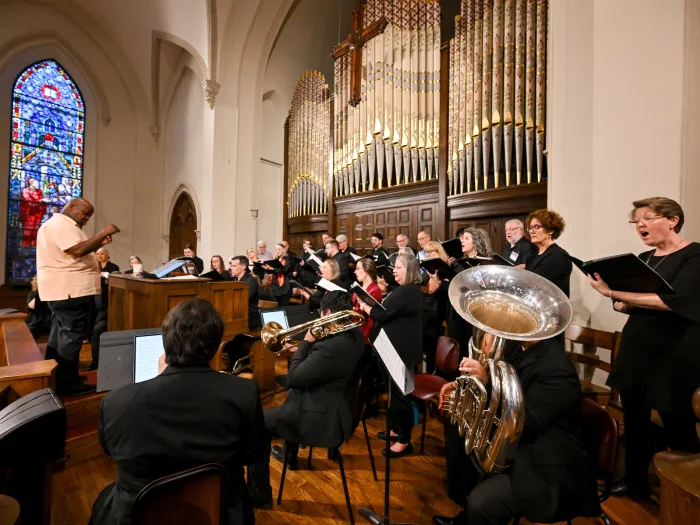
On Oct. 2-3, Presbyterian Association of Musicians’ Mid-South Region will host a festival of choirs, “In the Midst of New Dimensions: One Faith, Many Voices,” at First Presbyterian Church in Lexington, Kentucky. McCorvey is the festival director. Learn more here. The festival is part of the Lexington Sacred Music Festival, “In One A-Chord,” which runs Oct. 3-11. McCorvey is executive producer of that festival.
You may freely reuse and distribute this article in its entirety for non-commercial purposes in any medium. Please include author attribution, photography credits, and a link to the original article. This work is licensed under a Creative Commons Attribution-NonCommercial-NoDeratives 4.0 International License.