Community groups thrive in Nicaragua with help of SDOP
Pig farming provides way to empower young people and fight food insecurity
There are names for places people live that vary in size.
Metro areas, suburbs, towns, villages, hamlets … but then what? What word can be used to introduce you to the people of the "community" located in San Pedro de Los Molinas in the Department of Carazo in the country of Nicaragua?
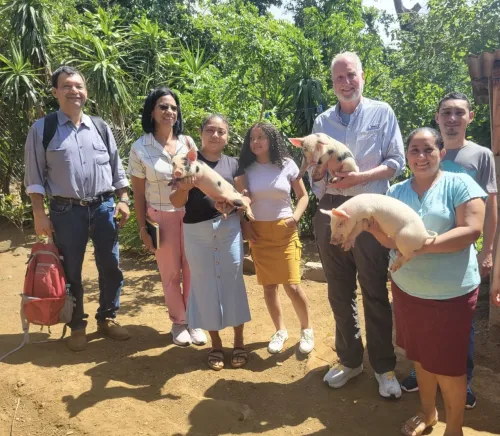
In this community of less than 500 people, there is an inspiring group that is benefiting from a decision made two years ago when they formed Youth United for the Good of the Community.
And that is exactly who they are.
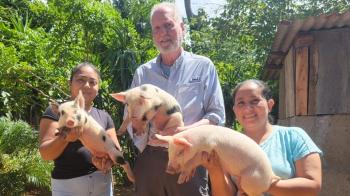
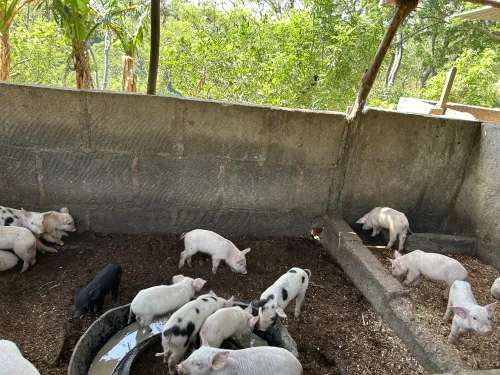
These 16 young people started raising pigs — for their tables and for sale within their area. They began by breeding four pigs. Now, after two years, they have more than 150 pigs.
The youth organization is a grant recipient of Centro Intereclesial de Estudios Teolóicos y Sociales (the Interchurch Center for Theological and Social Studies or CIEETS), which receives funding from the Presbyterian Committee on the Self-Development of People.
A team from SDOP recently visited Nicaragua to be with ministry partners and their beneficiaries, express appreciation, share curiosity and learn more about the scope of their shared ministry. The August trip also was an opportunity to celebrate CIEETS, one of two SDOP intermediary partners.
Through intermediary partners, SDOP engages in partnerships with communities in different parts of the world. The intermediary partners receive SDOP grant funding — made possible through gifts to One Great Hour of Sharing — that is distributed, in keeping with SDOP criteria, to groups in low-income, oppressed and disadvantaged communities.
“The SDOP-CIEETS partnership has benefited thousands of people directly and indirectly in Nicaragua since this collaboration started in 2020,” said Teresa Bidart, an SDOP mission specialist. “United in faith and action, we are empowering communities and seeking to change the structures that perpetuate poverty, oppression and injustice.”
CIEETS has worked in southwestern Nicaragua since 2005, reaching the most food-insecure families. The current phase involves the third group of communities they've served after two earlier successful rounds. The broader program includes conservation agriculture, fruit tree and patio-garden planting, clean water access, community advocacy and coordination with local churches on food security.
Most small-scale pig raising in Nicaragua is still done by families in rural communities, often as a subsistence or supplemental-income activity — commonly under 300 pigs per operation.
This part of the country is dry, environmentally degraded and chronically poor, with inadequate water and insufficient food. That often leads to malnutrition and subsequent health issues. There are many factors in play, including illiteracy, poor roads, high unemployment, and seasonal migration to earn remittance money that is then sent to relatives. Most households are led by women and it is common for men to travel to Costa Rica for agricultural work to generate those remittances, which are a critical source of income in many Central American countries.
Youth United for the Good of the Community provides a way for community members to earn money closer to home. Young members take on real responsibilities and share collective commitments. One young participant, Jason, said the project gives him income plus leadership, teamwork and management skills. It also helps to build a sense of family among previously loosely connected neighborhood youth.
That’s what SDOP is about: helping people, who often lack government support, to achieve their dreams and improve the living conditions of themselves, their families and their communities, Bidart said. “They own, control and benefit directly from these kinds of projects, which promote long-term change.”
The Rev. Mark Davis is a retired Presbyterian Church (U.S.A.) pastor-theologian who serves as the Chairperson of the International Task Force of the Presbyterian Committee on the Self-Development of People. Find additional pictures and more information about the Nicaragua trip here and learn more about SDOP's international work here.
You may freely reuse and distribute this article in its entirety for non-commercial purposes in any medium. Please include author attribution, photography credits, and a link to the original article. This work is licensed under a Creative Commons Attribution-NonCommercial-NoDeratives 4.0 International License.