‘We refuse to be enemies’
Bill Davnie, a retired foreign service officer and Presbyterian pastor, tells Synod Schoolers about the month he volunteered at the Tent of Nations near Bethlehem
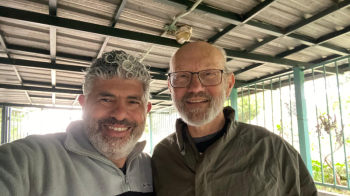
STORM LAKE, Iowa — During Synod School last week, Bill Davnie, a retired foreign service officer who worked for the State Department for 30 years, told those attending a workshop about the month he spent earlier this year volunteering at the Tent of Nations southwest of Bethlehem. The farm, which has been in the hands of the Nassar family since 1916, has this message stamped on a welcoming rock: “We refuse to be enemies.”
Daoud and Daher Nassar, whom Davnie described as “devout Lutherans,” want to “sustain a Christian presence” on their farm “in ways that are responsive to the law and their faith.” Davnie joined them for a month from mid-February through mid-March and was present when the U.S. attack on Iran occurred early on Feb. 28 local time.
Davnie and others took shelter in a Tent of Nations cave that’s used as a meeting room.
“This is a very tense area,” he said, describing Bethlehem and nearby communities. “There is a sense they are occupied. That’s not a term Israelis want us to use, but that’s how Palestinians see themselves.”
The Nassars have not been allowed to build on their land in more than 35 years. “It’s hilly and rocky. From an agricultural point of view, this is orchard territory — grapes, figs, olives, almonds and more,” he said. Every couple of days, a new wildflower would present itself, even in February, Davnie said.
Davnie displayed a Tent of Nations timeline, which included these dates:
- 1916 — Nassar family registers their land under Ottoman rule
- 1936 — During the Arab uprising, 25,000 grape vines are burned at the farm
- 1948 — Partition/Nakba. Christian refugees come to Bethlehem. The Nassars’ grandfather is active in the Christian community
- 1967 — Israel takes over East Jerusalem and the West Bank
- 1982 — Settlements go in nearby
- 1991 — Israel declares the region state property, and the Nassars go to court
- 2001 — The Tent of Nations is formed to seek outside support and defend ownership. It’s a tent because the brothers are not allowed to put up buildings.
- 2002 — The Nassars lose their case and appeal to the Supreme Court
- 2007 — They receive permission to register the deed, which is still pending
- 2014-24 — Israel Defense Forces destroy trees and restrict access
- 2024 — New settlement outposts appear on the farm’s fence line.
“The state [of Israel] is not obligated to maintain access to the property,” Davnie noted. “Access to roads may be restricted to settlements.”
Davnie laid out four options for affected Palestinians in the region, including resisting with violence when necessary, waiting “for the international community to provide a peace plan that Isarael and the Palestinians cannot find themselves,” and exiting. “Exhausted by the restrictions and lack of opportunity, the Palestinians leave, with particular impact on the Christian community [there],” he said.
A fourth way is the option the Nassars have chosen: active nonviolent resistance. “They resist legally, without violence or revenge,” Davnie said. “They steward the farm and show it is in constructive use.”
“This land is our mother,” the brothers told Davnie and others. “We would never sell our mother.”
In Davnie’s mind, that connects to “the Native American sense of land and community,” which Presbyterians often recognize at the outset of their gatherings with a land acknowledgement.
“There is something about recognizing this used to be somebody else’s,” he said.
Violence along the West Bank occurs every day, he said, and it’s gotten worse since Hamas attacked Israel on Oct. 7, 2023. “It skyrocketed after Feb. 28 [2026],” Davnie said.
More than 100 settlements have been approved in the West Bank over the last four years. Still, Tent of Nations published a message on Easter that included these words:
“We are living in a time when everything around us feels shaken and the future can seem fragile. We witness suffering and injustice, and we find ourselves asking, how do we live faithfully in such a time? Do we wait for stability before we act, before we hope, before we love? Or do we stand firm now, rooted not in the uncertainty of this world, but in the promises of God.”
“We are not called to wait in fear, but to live with faith …”
“On the farm, we are laboring, watering, seeding and pruning,” Davnie said. “You hope that your presence will mean there is more safety for the Palestinians you are with, but it’s not clear how long this is going to hold.”
Synod School is a ministry of the Synod of Lakes and Prairies.
You may freely reuse and distribute this article in its entirety for non-commercial purposes in any medium. Please include author attribution, photography credits, and a link to the original article. This work is licensed under a Creative Commons Attribution-NonCommercial-NoDeratives 4.0 International License.