Stewarding property as ministry, not just maintenance
Indianola Presbyterian Church in Columbus, Ohio, turns crumbling assets into community housing — and offers a new model for church property

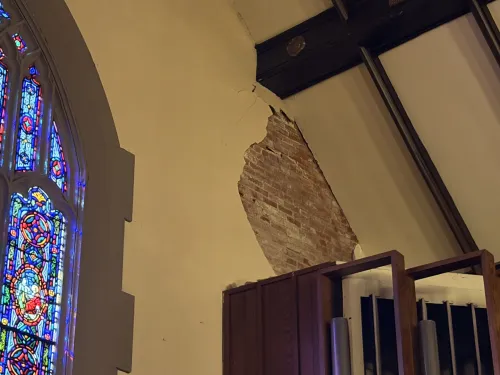
COLUMBUS, Ohio — When the plaster fell from the chancel wall at Indianola Presbyterian Church in Columbus, Ohio, it was a visible sign of what the Rev. Trip Porch had been saying since he arrived in 2020: The 30,000-square-foot building that once housed a 1,500-member congregation can no longer be sustained by about 120 members, 60 of whom worship on a typical Sunday.
Rather than ignore the cracks like these, the congregation has spent the last several years asking how its land and buildings might serve the neighborhood again.
“I keep telling my congregation if we were building a church for ourselves right now, it would not look like this,” Porch said. “You needed 1,500 members to pay for a building this big. We can’t sustain that.”
The Rev. Kathy Nice, co-presbyter of the Presbytery of Scioto Valley, supports Indianola and other churches as they survey their property and grapple with deferred maintenance. Nice warns that churches face “resource dependency,” a term she learned from “The Innovator’s Dilemma” by Clayton Christensen and understands from her background in business. “Congregations are dependent on the people to continue to give offerings, but these people are dying off faster than we can replace them,” explained Nice. “Meanwhile, the costs are going up faster than we can keep up with and the cost of living is going up.”
Indianola Presbyterian Church sits in Columbus’ University District near Ohio State University. The sanctuary seats 700 and until recently was surrounded by three former single-family homes the church bought decades ago to keep out absentee landlords and maintain some stability next to campus.
Over time, the church became a reluctant landlord. The student rentals deteriorated, and a small volunteer base could not keep up with repairs. “We kind of became the delinquent slumlord,” Porch said. “The floors were cracking; there were odd smells; bad electrical. It was out of our bandwidth.” Porch began at Indianola in July 2020 in the middle of the Covid pandemic. Most of his first year was spent building trust at a distance. As in-person life resumed, so did questions about the property.
Community-focused housing
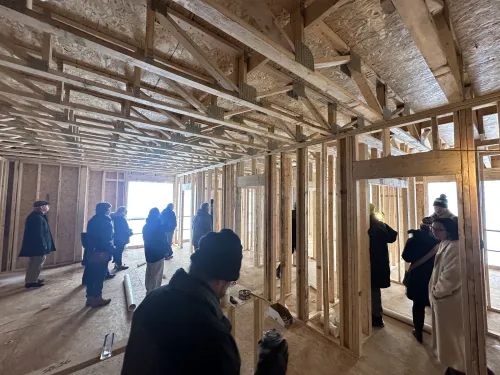
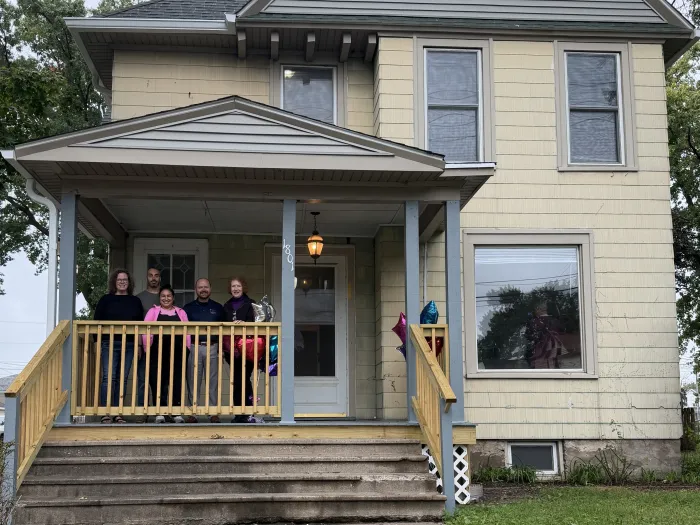
In February 2022, the church sold one of its houses to Buckeye Real Estate, a local developer with a strong record of maintaining nearby student properties. That relationship would later become a partnership focused on moving from deteriorating rental homes to a 35-bed, community-focused housing development.
In November 2022, the session and congregation began formal conversations about exploring a development project with Buckeye Real Estate focusing on the two remaining, deteriorated houses. Buckeye’s in-house architect produced an initial feasibility study, massing concept and pro forma.
For a time, the church explored developing the property on its own. Once predevelopment costs became clear, leaders realized they could not afford to do the project solo and briefly considered abandoning it.
In July 2023, Buckeye Real Estate proposed to buy into the project as a minority owner and cover the front-end costs. The church retained 51% of the ownership, allowing it to guide the project and its management with their vision of intentional community for multi-faith students.
Over the next year, Porch attended several meetings of the area zoning commission to represent the church and the project, helping to convey the church’s investment in community life and commitment to the neighborhood. Construction began in October 2024. Because student housing is in high demand, leases for the following year were signed shortly afterward and the first students moved in by August 2025.
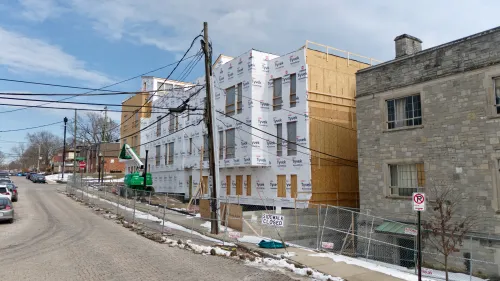
“On the same footprint that once housed about nine students, the project now houses 35 through a mix of studios, smaller units and three five-bedroom apartments designed for communal living,” said Porch. He also explained what it meant for the church to retain 51% ownership: “In 20 or 30 years, when loans are paid down, we could decide to lower rents or designate units for more affordable housing. We wanted to keep that flexibility for ministry.”
Recognizing the complexity of the project, Indianola formed a redevelopment task force rather than leaving the work solely to the pastor or a traditional property committee.
“I should say this was not just me,” Porch said. “We pulled together people who understood development, finance and our neighborhood.”
Indianola’s partners extended beyond the congregation as well. Along with Buckeye Real Estate and its in-house architect, a nearby Ohio State University architecture professor connected the church with colleagues who ran a small firm and was interested in designing housing that encouraged community and was more affordable than the luxury student units dominating new development.
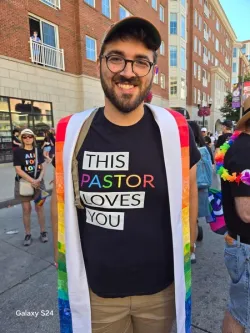
City commissions, neighborhood groups and a pro bono real estate lawyer rounded out the network of the church’s partners. For a season, Porch estimated that he was in two or three property-related meetings each week, in addition to his load of preaching, pastoral care and campus ministry. Much of his time was spent explaining the project to the congregation, attending zoning and design review meetings, and building trust with both neighbors and members who had deep emotional ties to the building and its history.
Porch acknowledged that very little of this appeared in his seminary curriculum and yet the redevelopment project opened up opportunities to use both his pastoral care skills and practice contextual theology. “A lot of this is grief work,” he said. “We’re asking people who love this place to imagine letting go of some things so that other kinds of ministry can live.” He encouraged sessions elsewhere not to assume redevelopment must be driven by a single pastor or trustee. “Ministry now is deeply contextual,” Porch said. “It depends on your neighborhood, your partners and who in your pews has gifts to bring to the table. Our job as pastors is to help convene that, not to know everything ourselves.” Porch and his team also understood the importance of telling the story as the vision and project unfolded and enlisted partners to help document their journey with photos and a video.
For governing bodies in similar situations, Porch suggests starting not with a project but with questions. “Talk to your city. Talk to your neighbors. Look at who in your church understands real estate, development, finance,” he said. “Then ask together: If we weren’t maintaining what we inherited, what would we build for ministry here now?”
A property working group for other churches, too
After watching the risks Porch and Indianola Presbyterian Church were willing to take by forming an LLC and redeveloping rundown student rentals into a mixed-use ministry space, Nice realized the presbytery needed structures to support that kind of vision more broadly.
At the invitation of Presbyterian Life & Witness’s Office of Innovation, Nice and three leaders from the presbytery joined a Mid Council Property Reinvention Cohort held in Minneapolis in late 2025. According to DeEtte Decker, manager of the Office of Faithful Innovation, these cohorts reimagine property “not as a burden to manage, but a vital resource for living out the mission of Jesus Christ in their communities.” Decker explained how a partnership with Rooted Good helps to support the mid councils as “they build shared capacity, theological clarity and practical tools for faithful property stewardship — grounding in context, aligned with polity and oriented toward innovation and sustainability.”
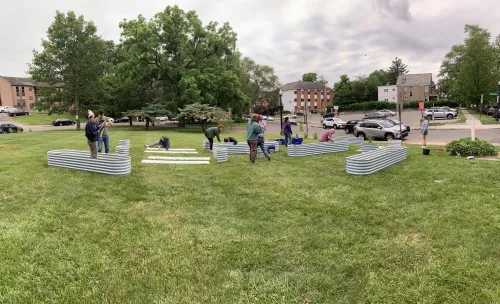
According to Nice, the Presbytery of Scioto Valley's small group intentionally included Trip “because he has such a vision,” along with the chair of trustees and both co‑presbyters. Around that table, their group asked, “Do we even have a policy for churches to guide them? We should have a team of resource people who could be on that, who should be on that,” and came home to draft what is now their “property revitalization policy” so churches don’t “wait for you to close to decide that you want to do something different with your property.”
“The presbytery can be that force to help churches,” Nice said, “but only if we know what we’re doing.”
That original cohort team has since evolved into an expanding property revitalization group, which includes an architect, a historian who has personally led a congregation through closure, a former Chase Bank property developer, a real estate attorney, Porch and the presbytery leaders.
In February 2026, the presbytery passed a policy on redevelopment that the group wrote and approved funding for its work in part by proceeds from a church sale. Nice explained that with those funds, “we could fund building inspections of churches, because we have so many churches that have so much deferred maintenance.” She described how “the team’s role is to go out, help congregations assess their buildings and options and provide both technical and pastoral guidance so that issues of cost, safety and long‑term sustainability are addressed before they become crises.”
Nice described Indianola Presbyterian Church as a visionary, risk‑taking congregation already experimenting with redevelopment and student housing that is sharing what it is learning with other churches that are also overbuilt and structurally outdated for their current attendance. At least two other similar congregations are located nearby in the same rapidly changing, highly transient university district of Ohio State University.
Through a new policy on property redevelopment and the property working group, Nice and the Presbytery of Scioto Valley are better positioned to connect congregational leaders to community partners who share their vision for serving Christ’s mission and the community. She credited the cohort through the Office of Innovation with offering the structure and support to her team of volunteers to stay on track as well as stay connected with other mid council and church leaders creatively addressing their property resources. Nice will serve as a coach in the 2026 Mid Council Property Reinvention Cohort that launches in September with a three-day in person gathering and virtual meetings over the course of six months.
Visit the Office of Innovations webpage
- For the Good Futures Accelerator Toolkit--a self guided resources to help congregations align mission and money for social enterprise,
- To join the monthly Innovation Network gatherings the third Wednesday of each month at 2 p.m. Eastern Time https://pcusa-org.zoom.us/j/99020923630t
- Get information on an innovation lab or learn about Innovation partnerships between mid councils and the national staff.
You may freely reuse and distribute this article in its entirety for non-commercial purposes in any medium. Please include author attribution, photography credits, and a link to the original article. This work is licensed under a Creative Commons Attribution-NonCommercial-NoDeratives 4.0 International License.