Want to find common ground? Look to higher ground
A pair of Presbyterian pastors share the ways that political change can come about — even in purple churches
LOUISVILLE — Two Presbyterian pastors with their feet and voices firmly in the political realm were the guests Wednesday during the “Presbyterian Principles and Political Action” webinar offered by the PC(USA)’s Poverty Roundtable. More than 175 people attended.
The guests were the Rev. Dr. Ray Roberts, whose recent book is “A Democratic and Republican Faith: A Public Theology for a Nation in Crisis,” and the Rev. David Lewicki, pastor of North Decatur Presbyterian Church near Atlanta and a leader with Presbyterians for a Better Georgia. The Rev. Rebecca Barnes, manager of the Presbyterian Hunger Program, and the Rev. Dr. Alonzo Johnson, who coordinates the Presbyterian Committee on the Self-Development of People, hosted the 75-minute webinar.
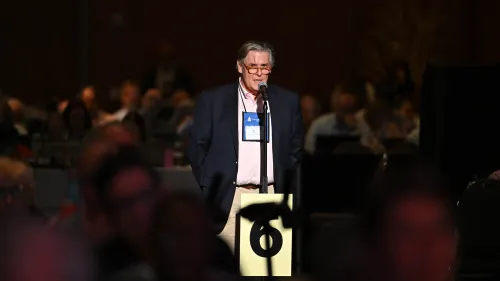
Roberts said it may sound counterintuitive to say that higher ground is the way to common ground, but reclaiming our theological tradition as Reformed Christians is “the way to we get to higher ground — how tradition helps shape how we look at the world and respond to it.”
As we walk toward higher ground, we also tread on common ground. “Let us not be afraid to offer thick theological reasons for what we advocate,” he said, encouraging webinar participants to “lean into the fact you are a purple church. We need places where people can explore ideas together. If you are a purple church, you’ve got that.”
“We underestimate the spiritual hunger that’s out there,” Roberts said, adding the “deep, deep loneliness” that’s also endemic in the culture. “People can find in our congregations deep friendships that nurture our lives and call us out of our shells.”
“We are motivated not by ambition, but because we serve a greater cause — God’s rule and reign,” Roberts said.
Lewicki centered his talk on political engagement and churches. Churches have significant latitude to engage in issue-based campaigns that align with an interpretation of their faith. Although they can’t endorse a particular candidate, they can:
- Host constituent meetings in their sanctuary or fellowship hall for those elected to state or local offices
- Host candidate forums during the election season
- Advocate or agitate about issues important at city, county and state levels
- Educate about issues that are important to your congregation.
“We brought county commission candidates together for a housing forum,” he said, “and we got them all on the record” on issues including affordable housing.
Lewicki advised congregations to “start where things are most relational with the political entity closest to your home. All politics is local. So, conveniently, is every congregation,” he said. “The most agency and efficacy and satisfaction is engagement at the local level.”
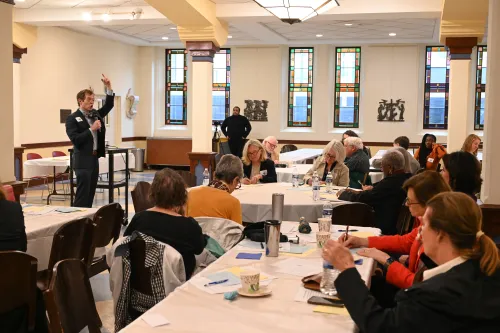
Start with the issues your church cares about, he said. “Every single ministry is touched by public policy,” including providing food aid, eradicating food deserts and strengthening SNAP benefits and school lunches. The list also includes homelessness and housing affordability, zoning decisions, mental health and addiction services, and policing, as well as poverty, wages, childcare, healthcare and education and school funding, as well as support for teachers.
Lewicki offered this process as a model: First, get a group together at your church and figure out what your congregation cares about. Focus on 1-3 ideas, and do some research about what impact you can make. Vote on the best idea, and then create a plan for policy advocacy, deciding who to partner with. Execute the plan, then evaluate the plan — and repeat.
In the North Decatur community, it was important to have housing available to people at all income levels, he noted. When a development was announced that would be right across the street from the church, the plan went before a community review board. “A couple of us asked the developers how many units are affordable? The developer said none,” Lewicki said. “We said, ‘that’s not enough.’” The neighborhood association got on board, and before the project was completed, it included affordable senior housing units.
Lewicki also shared some of the strategies that have made Presbyterians for a Better Georgia an effective lobbying group statewide. “It’s a marvelous expression of people of faith doing advocacy,” he said. “We do this year in and year out, trying to build momentum.” The work “is a marathon, not a sprint.”
The guests answered a handful of questions posed by webinar participants. Roberts advocated for churches moving the conversation “to the theological rather than the political.”
“What does it mean to say that all our lives are bound together, or that all are sinners?” he said. “We can go to what people have said in the past as a way to talk about things in the present.”
For Lewicki, “doing the work from a place of faith has softened my edges over time because of relationships with people with whom I might disagree.”
“There is a distinct flavor of Presbyterian engagement in public life. It’s kind of our brand, and it’s pretty cool,” Lewicki said. “But we work with partners,” especially those who are devoted to a particular issue.
Roberts recommended “recovering core principles that are shared,” including separation of powers and the rule of law, both of which “rest on a theological basis,” he said.
We ought to know who our local and statewide elected officials are and how to contact them, Lewicki said. “You need to know the people making decisions that affect your corner of God’s Creation,” he said.
While Presbyterians can be proud of the advocacy work going on at the Office of Public Witness and the Presbyterian Ministry at the United Nations, “the national stuff is so far away,” and many Presbyterians feel powerless to impact national issues, Lewicki said. “But at a county commissioners meeting, all of a sudden you as a person of faith are an agent in the political process.”
You may freely reuse and distribute this article in its entirety for non-commercial purposes in any medium. Please include author attribution, photography credits, and a link to the original article. This work is licensed under a Creative Commons Attribution-NonCommercial-NoDeratives 4.0 International License.