'Divine grace in a pink Solo cup'
College students learn lessons of vulnerable leadership through the lens of addiction
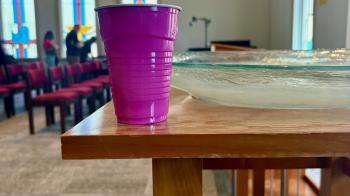
DECATUR, Georgia — At first glance, it looked like a staging mistake. On the edge of the baptismal font in the chapel at Columbia Theological Seminary sat a pink Solo cup, a cousin to the ubiquitous red cups that litter college lawns after keg parties and symbolize underage drinking and excess. But on this day, as 20 college students and their chaplains gathered for leadership training, the cup became an unintentional parable about what gets hidden in plain sight.
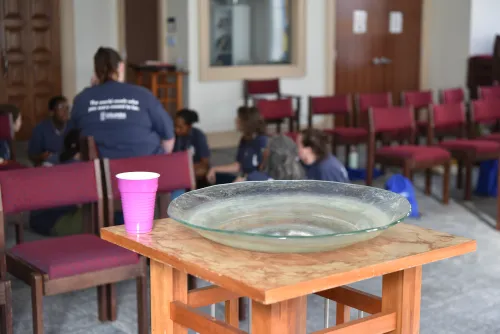
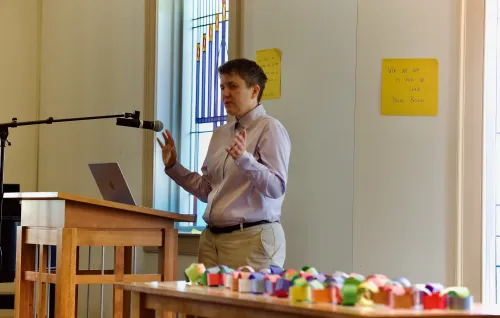
The Rev. Dr. Jenn Carlier, associate dean for academic programs at Columbia and the author of "Finding God in the Basement: Reclaiming the Theology of Addiction and Recovery," invited the participants at the inaugural UKirk Leadership Retreat for students to think about how they show up in different spaces and why it matters for Christian leadership.
"In the basement, I introduce myself as Jenn, an addict," Carlier told the group. "In the sanctuary, I normally introduce myself as Jenn Carlier, the associate dean for academic programs. Look at this fancy outfit I have on."
For years, she said, those two selves barely touched.
"I worked at a church doing youth ministry, and it looked from the outside like I was doing great," she said. "The youth seemed to like me, the parents were pleased, the pastor was pretty happy. The problem was that I was actually falling apart. I was suffering from addiction and depression, and I felt like I couldn't show any of that stuff to anyone."
When she finally sought treatment, she still couldn't bear to break the "perfect leader" illusion.
"I decided to go to rehab, but I told my family, my friends and my church that I was going on a monthlong silent spiritual retreat," she said. "Who would get mad at a youth minister for doing something so pious and wonderful?"

Carlier described "sanctuary spaces" as places where people feel pressure to present a polished, high-functioning version of themselves: work, classrooms and sometimes even family dinners. "Basement spaces" are where people can risk honesty, doubt and visible struggle: an apartment living room, a trusted friendship circle or a 12-step meeting.
"What is difficult is if you only have sanctuary spaces," she said. "If you always show up as your very best self and try to make sure that no one ever finds out whatever it is about you that you don't want people to find out, that's problematic because it puts a tremendous amount of pressure on yourself. It's exhausting."
Yet the goal, she cautioned, is not to turn every room into group therapy.
"It's also not good to make every space into a basement space," Carlier said. "Starbucks is not a great place to walk in with everything hanging out. There are appropriate spaces and inappropriate spaces to be fully open."
What changed her life and her understanding of leadership was what she experienced in recovery circles.
"I walked into my first 12-step meeting and just stared at the carpet," she said. "I was terrified they were going to ask me questions about myself. But people around me did this really beautiful thing. They started sharing the story of what brought them there ... and the more they told me, the more I realized that all this stuff I was carrying was actually pretty normal and average."
"In that moment, their vulnerability was this act of hospitality," Carlier added. "They paved the way for me. Their vulnerability invited me to be myself."

Carlier urged the students, many of whom lead worship, small groups or campus ministries, to reconsider what makes a credible Christian leader. "Sometimes we have this idea that to be a leader, we have to be perfect people," she said. "But the Bible goes almost out of its way to tell us nobody is perfect." Students quickly named David, Jacob, Abraham, Moses and Peter as deeply flawed leaders who were still called by and used by God.
Perfectionism, Carlier warned, doesn't just damage the leader; it often makes everyone's performance worse. She described playing pickleball with highly competitive partners who "need to win really badly."
"The more they kind of roll their eyes or sigh a little bit every time I mess up, the worse I actually get," Carlier said. "I become my worst self in those moments. Anytime we push someone really hard to be perfect, it becomes really hard to actually do well."
Leaders shaped by grace, she suggested, do the opposite: They create "sanctuary-adjacent" spaces where people can risk showing more of their true selves and still be received with care. "Showing up as yourself is a quality of a good leader," Carlier said. "That is what people are looking for. That is what God is looking for when God calls you."

At the end of the retreat, which was co-sponsored by UKirk Collegiate Ministries, students took several photos of the group, posing as their best "sanctuary selves" in straight rows with their hands at their sides or clasped in prayer. Then they pretended to relax and goof off as they might in a dorm basement. Carlier's invitation to find spiritual joy by narrowing the gap between those two images and in trusting that divine grace can be found even in the messiest corners of campus life, and maybe even in a pink Solo cup by the font.
You may freely reuse and distribute this article in its entirety for non-commercial purposes in any medium. Please include author attribution, photography credits, and a link to the original article. This work is licensed under a Creative Commons Attribution-NonCommercial-NoDeratives 4.0 International License.