Living in community (even when it's hard)
Christian ethicist encourages UKirk students to see leadership as staying present in community through conflict and change
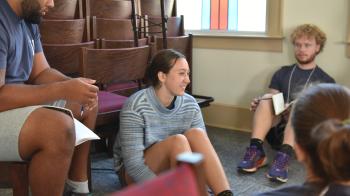
DECATUR, Georgia — "How many people look to the Bible and discover that God always shows up where everything is easy?" the Rev. Dr. Mark Douglas asked a roomful of college students. God, he reminded them, "shows up not only in Scripture but in history at the points when things are hard, and God says, 'I have heard the sufferings of my people, and I am sending you, and you're not going alone.'"
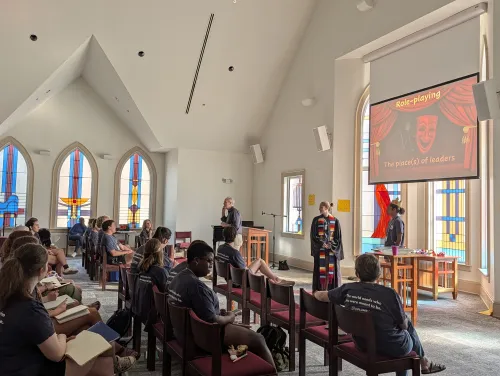
At last week’s UKirk Collegiate Ministries retreat on servant leadership at Columbia Theological Seminary, Douglas urged students to see leadership less as holding a title and more as standing in relationship, speaking a word from God to the people, carrying the people's cries to God and remaining with them in the messy middle. In a workshop titled "Being a Servant Leader Is Living in Community (Even When It's Hard)," he framed those three roles as ancient callings that are increasingly complex in a time of ecological crisis, demographic shifts and digital disruption.
Douglas began by asking participants to choose which role most closely described their ministry: speaking something of God to the people, representing the people and their needs before God, or standing among the people for shared discernment. Students moved into three corners of the room and were given what Douglas called "four really heady, big questions" about each role's rewards, frustrations, threats and possibilities.
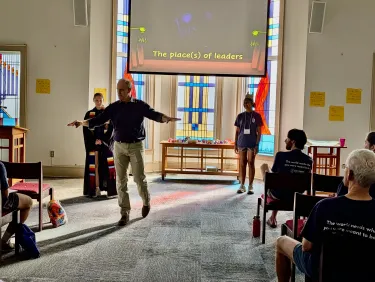
During the report-back, students named both the gifts and costs of leadership. One participant in the "God-to-the-people" group described the rare privilege of integrating study and experience in a single moment. "It's about bringing all of your knowledge and experiences to fruition at one place or time, then inviting the people who are listening to think deeply," the student said.
From the group focused on speaking the people's needs to God, another student named the intimacy of intercessory leadership. The participant appreciated "being trusted with the mournings and the sorrows, but also the joys."
Douglas called that kind of trust "remarkable" in a culture where "everybody spends a lot of time pushing people away." A third group, reflecting on what it means "to stand among the people," spoke about building connections, witnessing others' growth and sharing the emotional strain and occasional imposter syndrome that can come with serving in visible leadership roles.
Having grounded the conversation in students' experiences, Douglas turned to the world in which they will be leading, arguing that servant leadership is being tested in a time of overlapping crises.
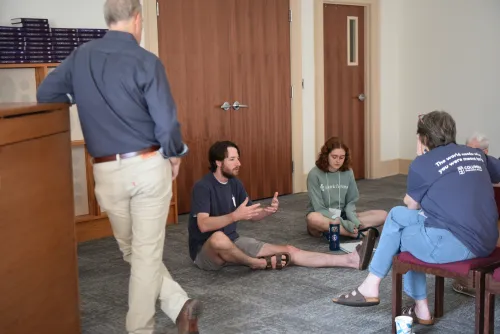
He noted that atmospheric carbon dioxide has reached levels "higher than at any point in the last 800,000 years" and that even the most optimistic projections point to at least 1.5 degrees Celsius of global warming. Citing journalist Elizabeth Kolbert's work on mass extinctions, he said humanity is living through a "sixth great extinction," a human-driven collapse of biodiversity that threatens the "breadth of life on Earth" that makes human flourishing possible.
In the United States, Douglas said, those ecological pressures intersect with rapid demographic change. "We are simultaneously undergoing two great changes," he said. "We're becoming dramatically more colorful ... and we're also becoming more gray." By "more colorful," he pointed to increasing racial, ethnic and cultural diversity, driven in part by migration and immigration trends reshaping societies around the world. By "more gray," he meant longer life expectancies and an aging population. Together, he said, those trends create new points of tension in congregations and communities, intensifying conflict and making the work of servant leadership both more difficult and more necessary.
Drawing on the work of Catholic peace scholar John Paul Lederach, Douglas later commended six practices for transforming conflict rather than merely managing it. He urged students to treat any presenting issue as a window into deeper histories, systems and identities; to "make complexity a friend" by listening for why an issue matters so deeply to people; and to look for even small areas of shared concern that can become building blocks for new relationships.
Over time, he said, that kind of patient, relational work can redirect the energy of conflict toward growth, reconciliation and more faithful community life. As he closed, Douglas returned to the theme with which he began: God's presence in hard places and complex communities. "Don't despair of the hard," he told the students. "Don't quit on the complex. That's the most interesting space to be. Because that's always the space in which divinity is packed."
Watch video reels of students' take-aways on what it means to be a servant leader on YouTube.
(Reels produced by Beth Waltemath and Victoria Shircliffe).
You may freely reuse and distribute this article in its entirety for non-commercial purposes in any medium. Please include author attribution, photography credits, and a link to the original article. This work is licensed under a Creative Commons Attribution-NonCommercial-NoDeratives 4.0 International License.