Which comes first, wisdom or desire?
Dr. Christine Roy Yoder compares moral skill and moral will for student leaders

DECATUR, Georgia — “What do you really want?” Dr. Christine Roy Yoder asked college students before talking about how Scripture understands a moral and wise leader. “A lot of wisdom is concerned with what it is we desire and want,” Yoder told participants in a workshop called “Being a Servant Leader is Being Grounded in Scripture” at the inaugural UKirk Collegiate Ministries Leadership Retreat. “What are our hungers, and how do we shape our hungers in ways that are life-giving?" Yoder clarified that while some hungers and desires are damaging, but desire is not inherently bad. "What determines the life-giving nature of the desire is to what it is directed,” she said.
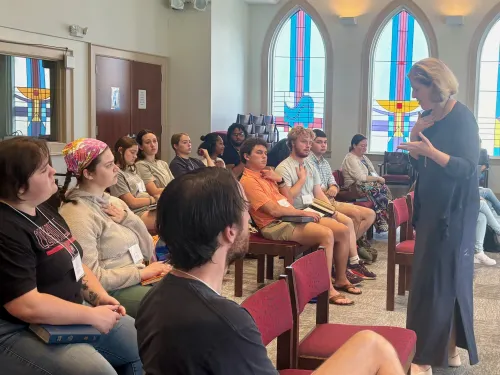
For Yoder, the J. McDowell Richards Professor of Biblical Interpretation at Columbia Theological Seminary, servant leadership grounded in Scripture begins not with strategy but with transformed desire. Transforming desire changes who you are “from the inside out” and shapes what your life is aimed toward. The Aug. 13-15 retreat brought together students in Presbyterian campus ministries from across the country under an overarching theme of servant leadership.
Drawing on Hebrew ideas of the self, Yoder told students that wisdom in Scripture begins in the heart, not in the brain. “In North American culture, we’re very influenced by Greek dualism,” she said.
“We think about the self as being most identified with your head, your mind, your brain and your heart,” said Yoder. “The brain is where it’s all happening cognitively," she explained before asking, "What’s happening in the heart? Feeling, emotion, right?”
“Ancient Israel doesn’t have the same anthropology,” she continued. “Ancient Israel talks a lot about the heart. The word in Hebrew is 'lev' or 'levav,' which names the place from which cognition, speech, interpretation, awareness is located."
Yoder explained that in ancient Hebrew, there is no word for brain: "Everything that really identifies [the self] in terms of emotion and cognition comes out of the lev." Yoder described how the Wisdom literature of the Bible "speaks fiercely for you to protect the lev, for it is the source of all living.”

If the lev is the center of thought and emotion, according to Yoder, the Bible also names another center of the self: the "nephesh": “The other center of self, which most English translations render as ‘self’ or ‘soul,’ is right at the base of your neck," she said while inviting students to touch the hollow at their collarbones. “In Hebrew, nephesh at the base of the neck is where our breath, hunger and longing live.” When God forms the human from the earth and breathes into it," she added, "it becomes a 'nephesh chaya' — “a living, craving, breathing being.”
For students discerning their callings in college campus life and beyond, that anthropology matters. In Yoder’s reading, wisdom is God’s way of reshaping our thinking, feeling, breathing and longing toward what is life-giving for neighbors and communities.
From there, she turned to what this means for servant leadership, describing wisdom as a combination of moral skill and moral will. Speaking on wisdom and leadership for young adults, Yoder told UKirk leaders that wise leadership “must have as one of its components moral skill,” which she defined as “the capacity to discern accurately what is happening in the moment and to respond intelligently and appropriately." Moral skill is the practiced ability to “read the room” and respond wisely.
But skill alone is not enough, Yoder explained. Servant leaders also need moral will, a disposition “that loves what God loves." The moral will "loves justice, loves beauty and hates wickedness, hates wrongdoing, hates injustice.” Moral will, she said, is about “seeking to do as best we can understand the right thing, driven by these passions, these loves of justice and rightness and truth.”

Both are necessary in a servant leader. “If you have moral skill, but you do not wed it to moral will, what can you do?” Yoder asked. “I can read a room. I can respond in ways that seem intelligent, but I’m not driven by the disposition of love, justice and wisdom. Conversely, if you have moral will as a servant leader, but you have no moral skill, you’re deeply committed to do the right thing, but you don’t know how to move it. You don’t know how to bring people along in it with you.”
That tension brought Yoder back to the humility at the heart of the Wisdom tradition and the kind of servant leadership that Presbyterian campus ministries hope to form. “The pursuit of wisdom is a lifelong pursuit that requires constant leaning in and paying attention,” she said. “As soon as someone claims ownership of wisdom, they are an idiot.”
For college students in campus ministries, the pursuit of wisdom means seeing servant leadership not as a credential or destination, but as an ongoing formation of their thinking, feeling, breathing, longing selves which can be shaped by Scripture toward God’s wisdom in their ordinary lives on campus and beyond.
You may freely reuse and distribute this article in its entirety for non-commercial purposes in any medium. Please include author attribution, photography credits, and a link to the original article. This work is licensed under a Creative Commons Attribution-NonCommercial-NoDeratives 4.0 International License.