‘I think of your dad as a church musician’s church musician’
The daughters and wife of famed Presbyterian composer Hal Hopson appear on Sounding Board
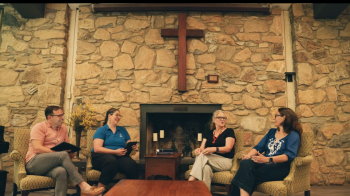
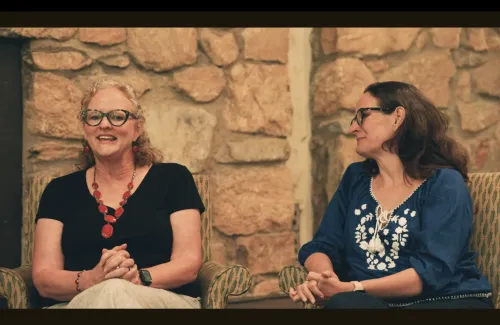
LOUISVILLE — First two children of Hal and Martha Hopson, Maria Aggen and Carol Herriage, appeared on Sounding Board, recorded during this summer’s Presbyterian Association of Musicians’ Worship & Music Conference at Montreat Conference Center. Then it was their mother’s turn to speak with Sounding Board hosts Sarah Abushakra and Jeremy Roberts. The 71-minute conversations can be seen here or heard here or here.
Aggen recalled that as a girl, people would ask their father for his autograph during the Worship & Music Conference. “I thought that was the funniest thing. To us, he was just dad,” she said. She and her siblings would go to sleep listening to their father composing and their mother playing piano or organ. “He had in his mind a certain way he wanted [the music] to sound,” she said. “He would play it over and over again.”
Harriage began coming to the Worship & Music Conference as a baby. These days she brings her own children. “If feels like home to me,” she said while seated with the hosts and her sister in Convocation Hall. “It was a huge part of our lives, and I know for mom and dad it was a special place.”
“I call Montreat my happy place. The rest of the year can be so much noise and work,” Aggen said. “It’s so peaceful and beautiful, and I enjoy being around like-minded people.”
Hal Hopson once ordered a harpsichord kit and assembled the instrument himself at home, which took several weeks. “He had to cure the strings in the oven,” Herriage said. “Maybe there were some dinners that were delayed or didn’t happen.”
“I was thinking about all the ways your dad made my life simpler,” said Abushakra, herself a church musician. “He had a whole book of descants and reharmonizations and interludes,” which meant “I didn’t have to improvise because he’d been generous enough to write it down. I think of your dad as a church musician’s church musician,” she told the sisters. “He added to the church canon in an incredible way to support people in large churches and small churches and everything in between.”
At home, “he’d talk about enjoying the whole congregation being part of the service,” Aggen said. Worship “wasn’t something that was performed, but something the whole congregation takes part in. Congregational singing was his passion, bringing everyone together.”
“He wanted to [produce resources] accessible to everybody,” Herriage said. “He had roots in the small church and he was in larger churches too. All those were important to him. He wanted to reach people where they were.”
“There’s such a practicality to a lot of his music,” Roberts said, mentioning specifically Hopson’s abridged version of Widor’s “Toccata” that Roberts plays when the occasion warrants an edited version of Widor’s beloved piece. “Hal has already done that for me,” Roberts said.
Abushakra said every church choir she’s ever directed has sung Hopson’s signature “The Gift of Love” “really beautifully, and they know it well. It’s become a heart song. It almost doesn’t matter what the sermon’s about; we can always sing about love. It’s been a real go-to for me.”
Among those who eulogized Hopson during his service last summer was Dr. Charlotte Kroeker, executive director of Church Music Institute, and Roberts read part of her tribute: “Hal was a musician who thought theologically. He understood the importance of good texts and developed the ability to edit and write theologically, liturgically and biblically faithful words to accompany his music.”
“He wanted sound theology to be available to everyone,” Herriage said. That was often the conversation over late lunch on Sunday afternoon, she said — the sermon and worship, “and we were encouraged to talk about it. It was an ongoing conversation in our house.”
The family has established the Hal and Martha Hopson Service Musician Fund to support the service musician position at PAM’s Worship & Music Conference, which Aggen said “has been integral in our faith and our upbringing. We’re very happy to be part of it.”
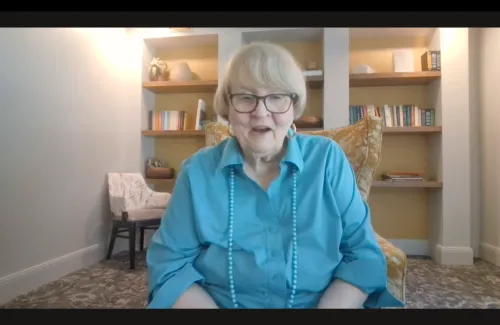
The hosts then turned to Martha Hopson, who spoke to them from her home in Austin, Texas.
Her husband, who died July 20, 2025 at age 95, got drafted after completing graduate school and served two years in the Army. “When he came back, he was looking for a job. Fortunately for me, he got a job in the church I had grown up in,” she said.
When she was in college, he came to visit her over the Christmas holidays. He helped her get her coat on, and then told her, “I came to ask you how you would feel about changing the nature of our relationship,” Martha told the hosts.
“So polite,” Abushakra said. “What a gentleman.”
The two were married and Martha Hopson completed her education, in part at Westminster Choir College, where her husband had become chair of the Church Music Department. Over the years, “there were times we worked in the same church and other times where we each had separate positions,” she said.
From time to time, she couldn’t find a musical selection to fit that week’s lectionary passages. “I would mention that to Hal, and he’d say, ‘I’ll write you something,’ and he would,” she said. “Many of the things he had published were mixtures of things that were for the church he was serving or the church I was serving. They came out of the crucible of the real life of the church.”
Her husband often wrote pieces “that could be done by an average church choir,” she said. “That was one of his important guiding principles.”
In their lives together, “things were changing a lot in the church. We had become more aware of language for women and for all people, and for God,” she said. “The reason for that language movement was to make [lyrics] theologically better about what we really believe about God.”
“The sturdiness of our faith,” she said, “was part of his choice of texts.”
As children and grandchildren gathered to say goodbye to their beloved father and grandfather last year, the Rev. Dr. Laura Mendenhall, the former president of Columbia Theological Seminary, dropped off enough hymnals so that Hal’s family could honor him the best way they could — by singing him into the heavenly realm.
These days, Martha Hopson is restarting a handbell choir at the senior living complex where she lives. “I got the bells out on the floor of my apartment, polished them up, and I’m ready to start again,” she told the hosts. One handbell player has an unfortunate timing habit. “She would turn the bell upside down and look at it like it was the bell’s fault,” Martha said with a grin.
“There are so many ways to enrich our lives and our belief in God and our acceptance [of others],” she said. “I think so many of those ways come through music, whether it’s bells or singing or organ or [other instruments]. All of them can be used for praise”
“That was certainly Hal’s thought and his drive with music,” she said. “He started playing for his little church at age 13. It was definitely life-long.”
Previous editions of Sounding Board can be seen here.
You may freely reuse and distribute this article in its entirety for non-commercial purposes in any medium. Please include author attribution, photography credits, and a link to the original article. This work is licensed under a Creative Commons Attribution-NonCommercial-NoDeratives 4.0 International License.