Really?
The Rev. Dr. William Yoo cites some unexpected sources during a Synod School talk on faithfully reforming the economic system
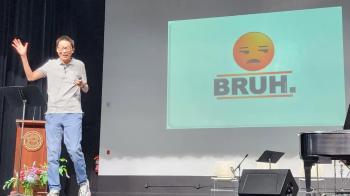
STORM LAKE, Iowa — Among the many sources he leaned on for Thursday’s presentation at Synod School, the Rev. Dr. William Yoo cited two observers not often identified in Christian circles: former Saturday Night Live comedians Seth Meyers and Amy Poehler.
Instead of the “woe” used by the prophet in Amos 5:18-24, Yoo, Associate Professor of American Religious and Cultural History at Columbia Theological Seminary, sought more contemporary translations, including the classic “Really?” segments the comedians presented on SNL.
Yoo’s teenage son had his own phrase, which he used frequently during the months following the pandemic: “Bruh,” which Yoo translated as “I’m a little exasperated” because you are, for example, serving dinner while I’m busy playing a video game.
Yoo then circled back to Amos 5:11-17, where the prophet talks about exploiting small farmers and taking away their opportunity “to lead lives of dignity and flourishing,” as Yoo put it.
“God hates it,” Yoo said. “God says ‘Bruh’ or ‘Really?’ to you who are trampling on the poor.”
The Rev. Dr. Martin Luther King Jr.’s “I Have a Dream Speech” occurred during the 1963 March on Washington for Jobs and Freedom, but King was no socialist, argues Jonathan Eng in “King: A Life.”
“Though he called for a fairer distribution of wealth, he didn’t criticize private ownership of productive assets and natural resources as inherently unjust,” scholar Tommie Shelby wrote, as quoted by Eng. Yoo said that King “condemned capitalism for generating massive economic inequality while arguing that the system could be reformed. He called for higher worker wages and strong unions, but he did not insist on equal pay for all workers regardless of skill or for nonprofit worker cooperatives.”
Yoo touched on the work of two economists, John Maynard Keynes and Joan Robinson. Keynes argued that capitalism is “better than any other economic system and can be managed to harness its productive powers while containing its darker aspects,” according to Yoo. Robinson called capitalism “dazzlingly efficient at producing and selling goods but not at delivering needs such as housing, healthcare and a good education.”
The economist Adam Smith wrote about The Invisible Hand, but a second hand is needed, Yoo said, “to help prevent too much inequality, and it can really only be government.”
“That’s the Keynesian idea. The government’s hand can be too heavy,” Yoo noted. “It needs to be more adept.”
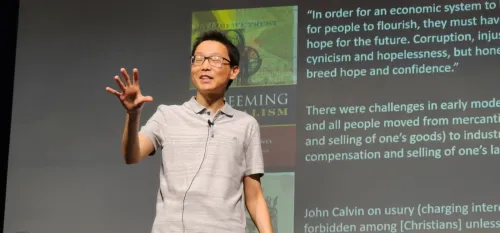
In “Redeeming Capitalism,” Kenneth J. Barnes says that in order for an economic system to be heathy and for people to flourish, they must have faith in the system and hope for the future. “Corruption, injustice and fraud all breed cynicism and hopelessness, but honesty, justice and integrity breed hope and confidence,” Barnes wrote.
On the practice of charging interest to borrowers, John Calvin wrote it’s “not wholly forbidden among [Christians], unless it be repugnant both to Justice and to Charity.”
Calvin and others seemed to agree that 5% was an agreeable interest rate for lenders to charge people and businesses, Yoo said, adding, “it’s hard to assume risk if you don’t charge interest.”
“Money is a thing that God has created,” Yoo said. “It is a means for people to have access to dignity and flourishing.”
In Leviticus 19:33-37, God calls us to love the foreigner because we were once foreigners ourselves. “Then it talks about basic economic fairness,” Yoo noted. “These are the principles that should shape how we live and how we think about immigration and economics.”
As followers of Christ, we’re called to love God and love neighbor “within the polis and its economic systems,” Yoo said. “But Christians are not simply to accept the inequities and inefficiencies of the day.”
“Christian ministry must encourage people to interpret how they may promote a moral economy with equality of opportunity so that as many as possible have access to sufficient employment/industry at just wages/incomes,” he said. “Markets alone are insufficient, so we support government programs to supplement low wages and participate in charity to provide help for the needy among us.”
“We also seek to minimize the risk of dependency and fraud as well as exploitation and unrestrained greed because these components undermine … the good and flourishing of all God’s Creation.”
In “Old Testament Ethics for the People of God,” Christopher J.H. Wright said that “What God has done, what God has said, what God plans, what God is like — all of these, we have seen, undergird the Old Testament’s ethical worldview … Personal experience of God’s goodness is turned into motivation for ethical behavior that responds out of gratitude and love.”
“That’s the work I want to encourage us to be involved in,” Yoo said.
Synod School, which concludes Friday, is a ministry of the Synod of Lakes and Prairies.
You may freely reuse and distribute this article in its entirety for non-commercial purposes in any medium. Please include author attribution, photography credits, and a link to the original article. This work is licensed under a Creative Commons Attribution-NonCommercial-NoDeratives 4.0 International License.