Educating voters and ensuring their right to cast a ballot this fall
The PC(USA)’s Advocacy & Witness ministry hosts three ecumenical advocates of free, fair and safe elections
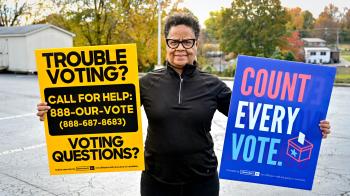
LOUISVILLE — On Wednesday, three ecumenical faith leaders joined with the PC(USA)’s Advocacy & Witness ministry for an informative webinar on voter rights and voter education.
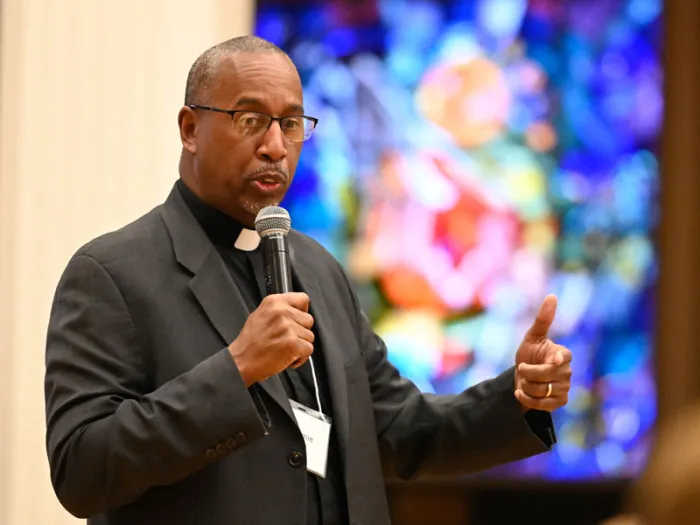
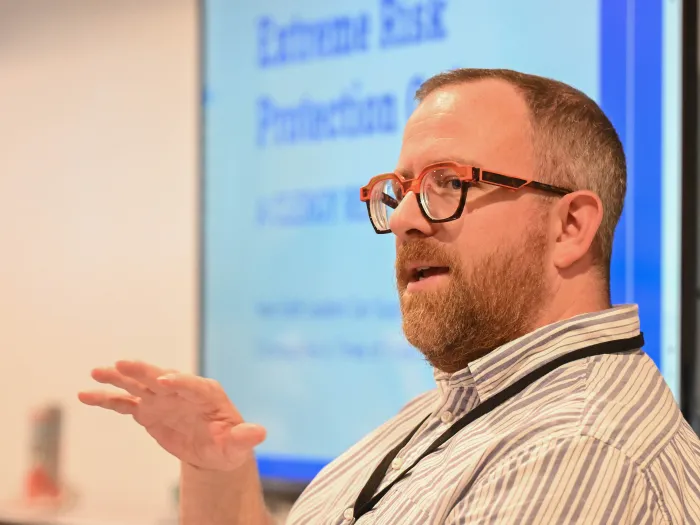
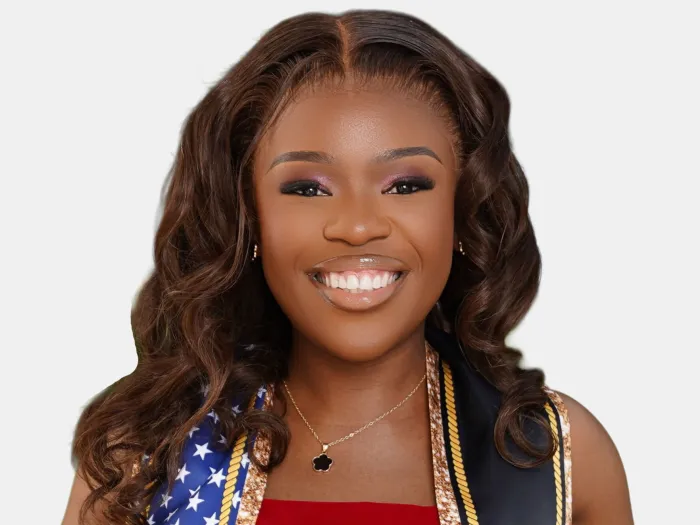
More than 160 people attended to hear ideas and strategies for protecting voting rights from:
- The Rev. Adam Russell Taylor, president of Sojourners
- The Rev. Dr. Alvin O’Neal Jackson, a leader in the Poor People’s Campaign who co-founded the Disciples Center for Public Witness
- The Rev. Dr. Hanna R. Broome of Repairers of the Breach and president of the North Carolina Council of Churches
Taylor said his parents — his mother is Black and his father is white — instilled in him the belief that his generation has unfinished civil rights work to engage in.
“Voting rights have to be fought for. Democracy is not a given,” he said. We’re currently seeing “the greatest assault on voting rights and on our election system in our generation, and maybe in history.”
In 2013, the U.S. Supreme Court weakened the Voting Rights Act by removing the pre-clearance provision in its Shelby County v. Holder decision, then “finished the job” in Louisiana v. Callais by removing a provision that enabled states to strengthen Black representation among elected officials. The Court “opened the floodgates for racialized gerrymandering across the South,” he said. “We are facing a landscape where the right to vote is being challenged.”
Sojourners and its partners have launched Faiths United to Save Democracy to train poll chaplains and peacekeepers for this fall’s midterm elections. “It is fundamentally a theological and moral issue,” Taylor said. “We have framed it in a theological way because it’s an assault on Imago Dei itself — that we are made in the image of God.” The aim, he said, is to “train and equip faith leaders to provide a moral presence at voting sites. We think that work is critical.”
It’s also important to deal with the threat posed by an administration “that has taken over every aspect of the machinery at the federal level designed to protect elections,” potentially “subverting the midterm elections,” Taylor said. Potential scenarios include the presence of Immigration and Customs Enforcement officers at or near polling places on Election Day and a refusal to seat the 120th Congress in January 2027.
“It could be used as a pretense to deny the election results. That’s what authoritarian leaders have done across the world,” Taylor said. “If we show up with our faith, we can turn back those efforts.”
Jackson grew up in the 1950s and 1960s in the Mississippi Delta. A retired Christian Church (Disciples of Christ) pastor, Jackson said that “We don’t need another March on Washington. We need a march to the polls. We have the power to reclaim our tools of government, and it’s time we used it.”
Bishop William Barber II, the president and senior lecturer at Repairers of the Breach and co-chair of the Poor People’s Campaign, is extending a call to “vision voting,” Jackson said — “not party, not partisan, but what is your vision for the country?” The call is for 100 days of mobilization, “calling the nation to the table of democracy and vision voting,” Jackson said.
“We’ve got to remain diligent and organize around a vision,” he said. “That’s how we bring all kinds of folks together.”
Broome called voting “our right and our faithful obligation.”
“What does faith require of us? That we protect our neighbor,” she said. “Our vote is a tool we have been given to love the widow, the orphan, the stranger and the least of these. Walking away from the ballot has never protected anybody who was already unprotected.”
Five generations of her family has been invested in ensuring the right to vote, she said, and so “I am fighting so my grandchildren will inherit a world that’s more just.”
“We can’t stay silent,” Broome said. “Too many people have fought for too long for too little for us to sit down now.”
When the prophet Amos made his celebrated cry, “he wasn’t running for office,” Broome noted. “He was refusing to let God’s people look away from injustice. That isn’t partisanship; it’s the oldest act of faith there is.”
To people who tell her, “I’ve voted my whole life and nothing’s changed,” Broome tells them, “You’re wrong.”
“We stand in the tradition of Fannie Lou Hamer and Ella Baker,” she said. “We should be stubborn enough to keep showing up.”
During a question-and-answer session that followed their presentations, panelists looked to the work ahead. Taylor said that while the threat to democracy remains a focus of that work, “we have to connect that better to how that affects people’s lives,” including people’s economic plights. “We’re trying to do more about that and do it better.”
Broome suggested that friends at church can produce short videos of themselves walking the short distance to drop their ballot in the mailbox. “Do a montage of your people walking to the mailbox,” she said. “That can be your march to the polls.”
“To me, what lends our democratic system legitimacy is we have a government of, by and for the people,” Taylor said. “Voting is the most critical expression of that, electing and replacing officials on a regular basis.”
“Our democracy is stronger when more people can exercise that fundamental freedom,” he said. “We are all made in the image of God, and our vote is our voice and agency to do what our faith requires of us.”
You may freely reuse and distribute this article in its entirety for non-commercial purposes in any medium. Please include author attribution, photography credits, and a link to the original article. This work is licensed under a Creative Commons Attribution-NonCommercial-NoDeratives 4.0 International License.