
A fresh take on the first 30 Psalms
Dr. Marty Folsom, author of ‘The Psalms: A Sanctuary for the Soul,’ discusses ancient wisdom with the hosts of ‘A Matter of Faith: A Presby Podcast’
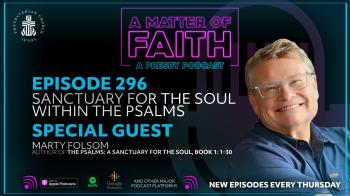
LOUISVILLE — The Psalms are the place we meet with God and they hold “the depth of the wisdom of the God who created the universe and engaged David and others who were wrestling with the issues of their time,” which aren’t so different from the issues we modern-day folks wrestle with.
That’s what author, theologian and marriage and family therapist Dr. Marty Folsom had to say during the most recent edition of “A Matter of Faith: A Presby Podcast,” hosted each week by Simon Doong and the Rev. Lee Catoe. Listen to their 58-minute conversation here. Folsom’s new book is “The Psalms: A Sanctuary for the Soul, Book 1:1-30.”
Part of what Folsom seeks to do in his book is to help readers wrestle with their emotions as they study the ancient texts. “If we begin to engage the Psalms as the emotive place where David and the other authors wrestle with the nature of depression and guilt and all these things,” we enter into “the living presence of the God who meets us there,” he told the hosts.
To Folsom, the setting for the Psalms is what he calls the Garden of God — not the Garden of Eden, but the place where God is present. “What does it mean to be humans created by God to live in the dynamic wrestling with life,” he said, including “our value, who God is, what we are doing in this world? Those are all issues the Psalms want to take us into.”
We can say the Book of Psalms was written “far away and long ago, and we dismiss it because of that,” Folsom said. “Or we can say, ‘Let’s get to the center of the meaning of it all,’ and that is to begin with the act of the One who brought it into being and ask, ‘What is the meaning that is being brought in?’ which Psalm 8 and Psalm 19 are going to pick up on. They’re Creation hymns.”
If we say that it’s our perspective that matters the most, “the Psalms don’t want you to go there,” Folsom said. “They want you to get a bigger picture that brings a download of meaning to your life, because you’ve recentered out of your self-focused self-interest and you’re now living within the currents of a love that cannot be stopped: a concern for neighbor, a concern for the nature of the very fearful threat that’s right outside my door.”
Among others, the Psalms help us answer these age-old questions, Folsom said: “How do I go on another day and who’s going to go with me to help me feel I’m not alone?”
“Doing life means doing relationships,” he said. “The Psalms reorient us back into a personal, foundational way of being. The way we invite people into that accentuates the dynamic of the dialogue. … The ancient suddenly becomes present. It becomes wisdom that is not to be abandoned. That’s often something we’ve forgotten.”
Jesus was “fully aware of the Psalms,” studying them and quoting them from the Cross, Folsom noted. “If it was his breath then, it’s his breath today,” he said.
The Psalms are much more than how we traditionally think of them — as poetry and part of the ancient songbook.
“The Psalms are a reality-aligning experience,” Folsom said. “It is the science of the personal that allows us to understand who we are because we understand who God is.” We are “impoverished in the language of emotion. The Psalms have this dimension of embodied-ness that gets us out of our heads.”
Returning to his garden metaphor, Folsom noted gardens are present throughout the Bible, from Genesis to Revelation. Then he asked: would you rather invite someone to come share your garden for an hour, or attend church with you for an hour?
“I think most people would rather invite people into their garden,” Folsom said. “It has the implicit sense of a life-giving experience that I think is amazing.”
Folsom then spent some time with the hosts tracing how he explores each of the first 30 Psalms in his book. Subsequent volumes are coming, he said.
He calls Psalm 2 “Embraced by the Storm.” For each psalm, Folsom offers a modern-day poetic rereading, which he places alongside the biblical psalm. “They’re saying the same thing,” he said, “to give you depth into what’s going on and to draw you into the experience.”
Folsom has a dentist friend who earned a doctorate after receiving his DDS degree. “Why would you do that?” Folsom asked his friend. “A Ph.D. puts me in a place where I can move the field of dentistry forward,” his friend told him.
“I thought, that’s what we’re missing. We need people who are asking, how do we move the field forward so it becomes more true to what it is: ministry that gets people to brush their teeth twice a day,” Folsom said. “What if we had people with practices that built relationships as a hygiene for their life with God and one another? Dentistry would have taught us something,” his friend told him, “and I’m really trying to live into that kind of space.”
“How do we give people the tools so the hygiene of their spiritual and relational life is fed and nourished” and they say, “wow! This feels renewing and refreshing,” Folsom said. “I’m clean and connected in a way that I wasn’t before.”
“Let’s let the creativity flow,” Folsom suggested to the hosts and listeners. “It’ll take us to places we’ve never gone to.”
New editions of “A Matter of Faith: A Presby Podcast” drop here every Thursday.
You may freely reuse and distribute this article in its entirety for non-commercial purposes in any medium. Please include author attribution, photography credits, and a link to the original article. This work is licensed under a Creative Commons Attribution-NonCommercial-NoDeratives 4.0 International License.


