Housing as a ‘fundamental right’
Damon E. Thompson of Local Initiatives Support Corporation addresses the Faith-Based Development Summit
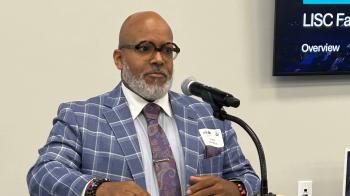
LOUISVILLE — During last week’s Faith-Based Development Summit, Detroit-based Damon E. Thompson, the senior director of national housing strategic initiatives for the Local Initiatives Support Corporation (LISC), talked about housing being “a fundamental right.”
“No one wakes up and says, ‘I want to be homeless,’” Thompson said during a plenary session of the day-long conference. “I am passionate about preserving housing.”
He described a “crisis of affordability” in housing in cities across the nation, where the median price for a single-family home last year was $422,000. There’s also the economic plight of cost-burdened renters, who numbered more than 22 million in 2023.
There’s currently a deficit of more than 7 million affordable and available rental homes, Thompson said, but “out of crisis comes opportunity.”
“It’s not just about finance. It’s about right-sizing policy,” including proposed legislation such as S.2720, the Yes in God’s Backyard Act. According to Thompson, among a number of helpful tools, the legislation would provide technical assistance to faith-based organizations, technical assistance to local governments on best practices to streamline the permitting process, and $50 million per year in grants to cities and counties that “adopt practices removing barriers to affordable housing on properties owned by faith-based organizations,” he said.
LISC works with many faith-based organizations on developing their property into affordable housing. “It’s high touch, high investment, and high impact” work, he said. “It’s not just providing a check to a church,” he said. Important considerations include “do you have site control? Do you have the capacity? We provide coaching, education and resources.”
Thompson said he sees housing projects fall apart “simply because of lack of information. I’ve seen churches enter deals with bad developers because no one at the church was able to vet [the proposal] and say, ‘is this a sound developer?’ That technical assistance is paramount. The lack of knowledge kills deals.”
Utilizing a self-paced curriculum, LISC organizes faith communities into cohorts of up to a dozen churches and assigns a consultant to each cohort. For every 10 churches that complete the training, maybe half will elect to go forward with their project. “The rest will say, ‘now I see how daunting this is. Maybe we’ll build a community center instead,’” he said.
Churches that do move forward are provided “a team of consultants,” Thompson said. “They are helping you to build a team when you’re ready for a fundable project.”
The average development time is three to five years, he said.
In three areas where LISC has concentrated in recent years — New York, the Bay Area and the Seattle area — 92% of the housing units developed have been affordable homes, he said. Ninety-one mission-driven and faith-based organizations have been served, and 2,488 units have been proposed or developed.
“We need policies that support developers to build smaller and that support density,” Thompson said. “There needs to be some right-sizing to meet people of all income levels.”
Read previous Presbyterian News Service articles on last week’s Faith-Based Development Summit here and here.
You may freely reuse and distribute this article in its entirety for non-commercial purposes in any medium. Please include author attribution, photography credits, and a link to the original article. This work is licensed under a Creative Commons Attribution-NonCommercial-NoDeratives 4.0 International License.